
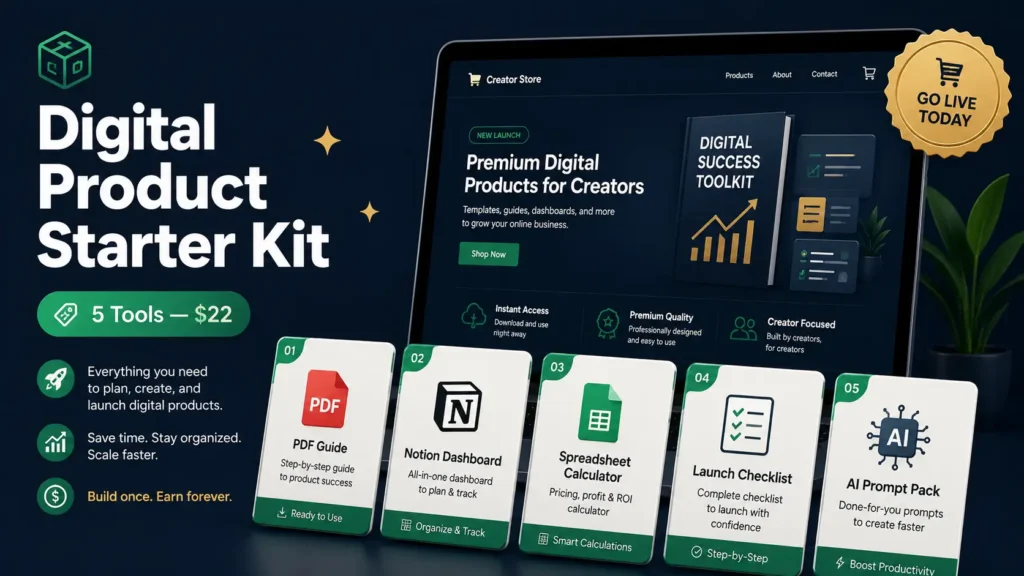
Most people never launch their first digital product not because they lack ideas, but because they lack a system. The Money AI Pro Digital Product Starter Kit gives beginners five ready-to-use tools: a launch guide, business planner, profit calculator, 48-hour checklist, and 85+ AI prompts, all in one bundle for $22. This post covers why most beginners stall, what the kit includes, and how to launch your first product this week.
The opportunity has never been bigger. The digital goods market is valued at $157 billion in 2026 and is projected to hit $511 billion by 2031. People are buying digital products every single day. 68% of internet users paid for digital content every month in 2025. The market is ready.
And yet most beginners never launch their first Digital Product Starter Kit or first product at all. They research for months. They watch tutorials. They fill notebooks. Then they close the laptop and tell themselves “soon.”
Here’s the uncomfortable truth: the problem isn’t motivation. It isn’t skill. It isn’t time. It’s the absence of a system. Without a clear path, your brain hits decision fatigue before you write a single word of your product. What should I sell? How do I price it? Where do I list it? Who is going to buy it?
Those questions loop on repeat, and you go nowhere.
The Digital Product Starter Kit from Money AI Pro removes every one of those questions. Five tools. One bundle. One clear path from idea to first sale, this week.
Table of Contents
What Is a Digital Product Starter Kit?
A digital product starter kit is a bundled set of tools, templates, and guides designed to help complete beginners launch their first digital product as fast as possible. It typically includes a step-by-step launch guide, a product planner, a profit validation tool, a launch checklist, and AI prompt resources that together remove the guesswork from the entire process.
The key word is “bundled.” A single guide tells you what to do. A kit gives you everything you need to actually do it. The launch guide tells you the steps. The checklist breaks those steps into hours. The AI prompts remove the blank page. The calculator tells you if your idea is even worth building. The planner tells you what to do next week.
Each tool solves a different point of friction. Together, they remove nearly every reason to keep waiting.
This is not a course. There’s no video library to binge, no homework to submit, and no 8-week program to complete before you launch. You open the tools, follow the steps, and publish. As Forbes notes in its breakdown of starting a digital products business, your first product should be simple to create and solve a real problem. A starter kit is exactly the system that makes that possible for a beginner.
Struggling to launch?
Here’s the exact toolkit that helps beginners launch in under 48 hours.
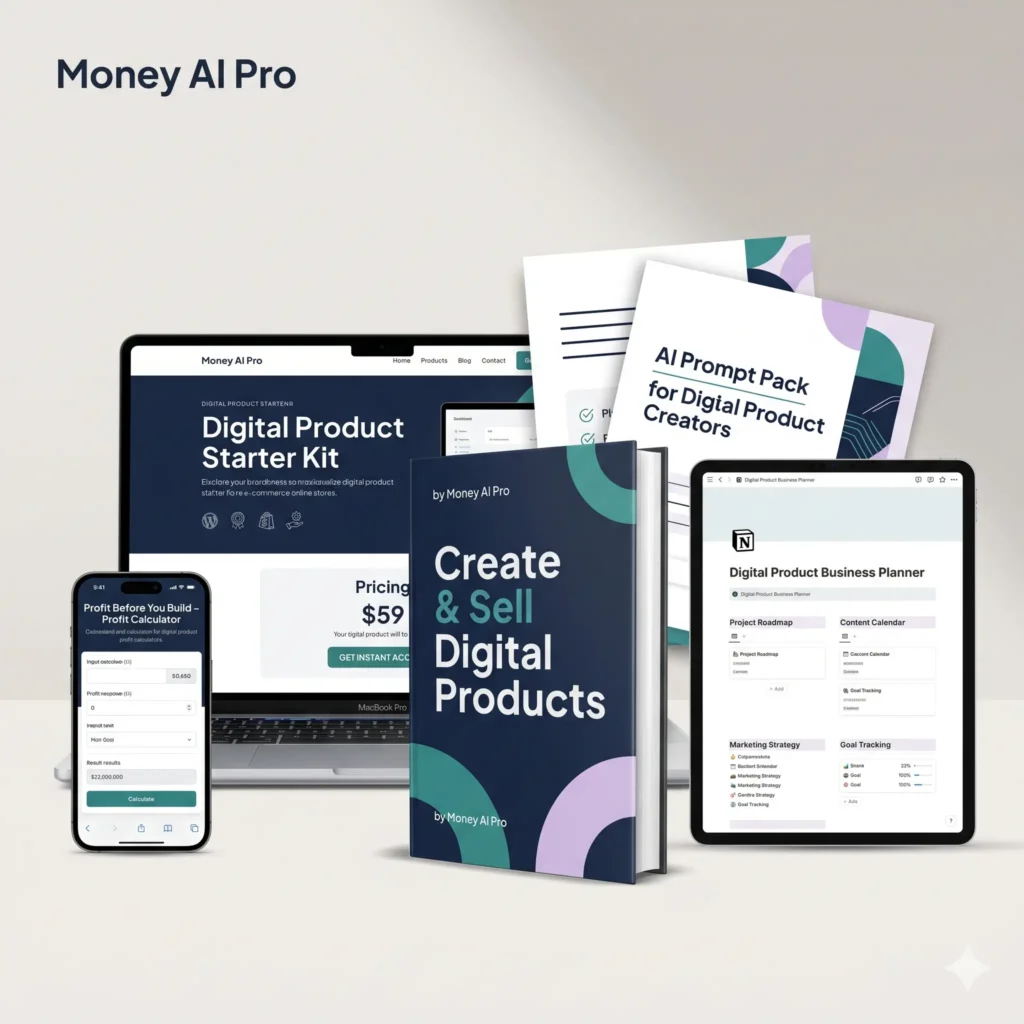
Digital Product Starter Kit: Launch Your First Digital Product This Week
You’ve been thinking about launching a digital product for months. Maybe years.
You’ve watched the tutorials. Downloaded the free guides. Filled notebooks and Notion pages.
But you still haven’t launched.
This kit fixes that. 5 tools. One bundle. 22 dollars.
Instant download. No experience needed. No fluff. Just the exact system a beginner needs to choose an idea, build a simple product, price it, and sell it — fast.
Why Do Most Beginners Never Launch Their First Digital Product?
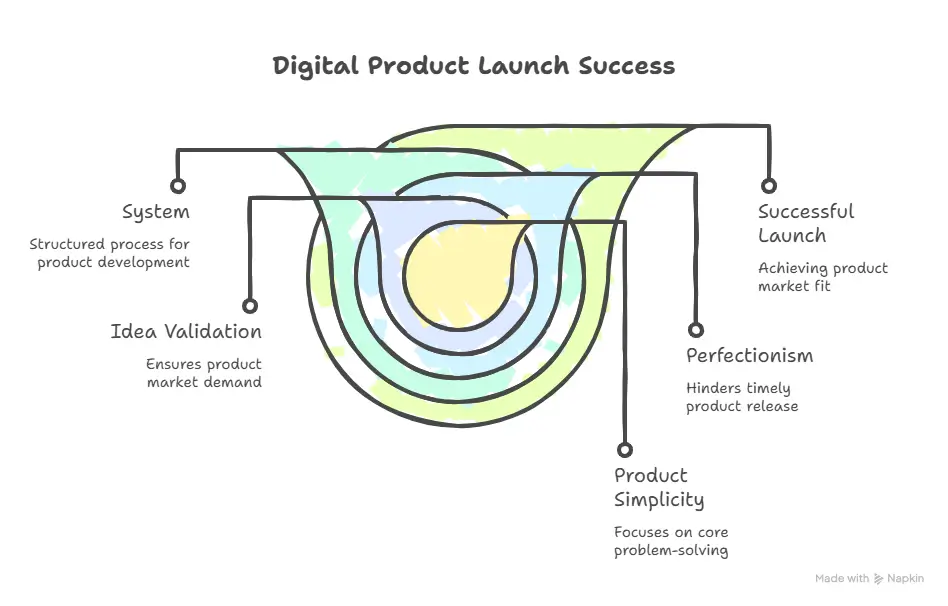
Most beginners never launch because they have no system to follow. Without a clear sequence of steps from idea to published product, they fall into research mode indefinitely. They keep consuming information instead of creating something, and the longer they wait, the harder starting feels.
It’s not a willpower problem. It’s a systems problem.
A breakdown of the most common digital product mistakes reveals three patterns that kill most first launches before they happen. First, beginners overcomplicate their first product. They try to build a massive 20-video course when a simple five-page checklist would sell better and take a fraction of the time. Second, they skip idea validation entirely and spend weeks building something nobody wants. Third, they hide behind perfectionism, endlessly tweaking instead of publishing.
According to Dennis Leoca’s analysis of why digital products fail, overbuilding the first version is one of the top mistakes. Your first product doesn’t need 100 features. It needs to solve one real problem clearly.
The fix is simple. It’s not more research. It’s a system that tells you what to do first, what to do second, and when to stop tweaking and hit publish.
If you’re still figuring out what to sell, start with our guide to brainstorm your first product idea before coming back to build it.
The 5 Tools Inside the Digital Product Starter Kit
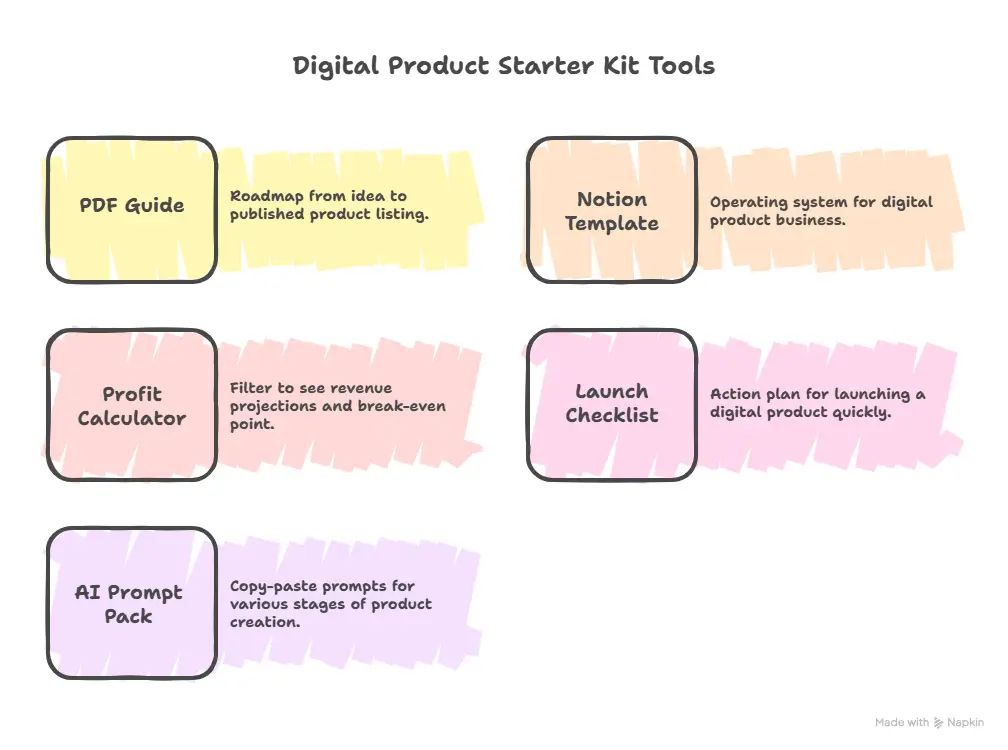
The Money AI Pro Digital Product Starter Kit is five tools built to solve five specific problems every beginner faces. Here’s exactly what you get.
Tool 1: Create and Sell Digital Products (PDF Guide)
This is the roadmap. It takes you step by step from a random idea to a published product listing. It covers which product types sell best for beginners, how to write a simple listing that converts, and where to sell even if you have zero audience or email list. It also covers the classic beginner mistakes that kill first sales so you can skip them entirely.
Tool 2: Digital Product Business Planner (Notion Template)
This is your operating system. The Digital Product Business Planner has 11 sections covering every stage of your digital product business: product idea tracker, launch planner, content calendar, and income tracker. It replaces the scattered notes, random spreadsheets, and half-finished Notion pages most beginners rely on. You plan your next 90 days in one place.
Tool 3: Profit Before You Build Calculator (Google Sheets and Excel)
This is your filter. Before you spend hours building a product, the Profit Before You Build calculator lets you enter your price and traffic estimates and instantly see your revenue projections, break-even point, and conversion targets. It tells you whether your idea is worth building before you invest a minute in creating it. AI-driven product development workflows now make it possible to ship digital products in under 60 minutes, but only if you’re building the right product. This calculator makes sure you are.
Tool 4: Your First Digital Product in 48 Hours (Launch Checklist)
This is your action plan. A six-page PDF with five clear steps from idea to live product, an hour-by-hour action plan for 48 hours, a simple pricing formula, and “good enough” rules that kill perfectionism and push you to publish. You always know what to do next. No more staring at a blank screen wondering where to start.
Tool 5: AI Prompt Pack (85+ ChatGPT and Claude Prompts)
This is your shortcut. Eighty-five copy-paste prompts for every stage: product ideas, product creation, sales pages, email sequences, social posts, and Pinterest and Instagram content. You don’t start from a blank page. You start from a prompt that does the heavy lifting while you make the decisions.
🚀 Launch My First Product
Get the Starter Kit Today
Why Should You Validate Your Idea Before You Build It?
You should validate your digital product idea before building it because most products fail not due to poor quality, but because nobody wanted them in the first place. Validating takes minutes using a profit calculator and a quick market check. It saves you weeks of building something with no buyers waiting on the other side.
Stan Store’s guide to idea validation puts it simply: validation means proving people will actually pay for what you’re creating before you build it. You turn your idea into a hypothesis. Then you test that hypothesis with real signals before you invest real time.
Research shows a 77% reduction in expected loss when founders validate before building. That number should stop every beginner in their tracks. Three out of four potential failures are avoidable with one simple step most people skip.
The Profit Before You Build calculator inside the kit makes this step take five minutes instead of five weeks. You enter your price point, your estimated traffic, and your expected conversion rate. The calculator outputs your projected revenue, your break-even point, and whether the numbers make the idea worth pursuing.
If the numbers work, you build. If they don’t, you adjust the price or the product before you waste time. That’s not overthinking. That’s smart.
How Fast Can You Actually Launch a Digital Product From Scratch?
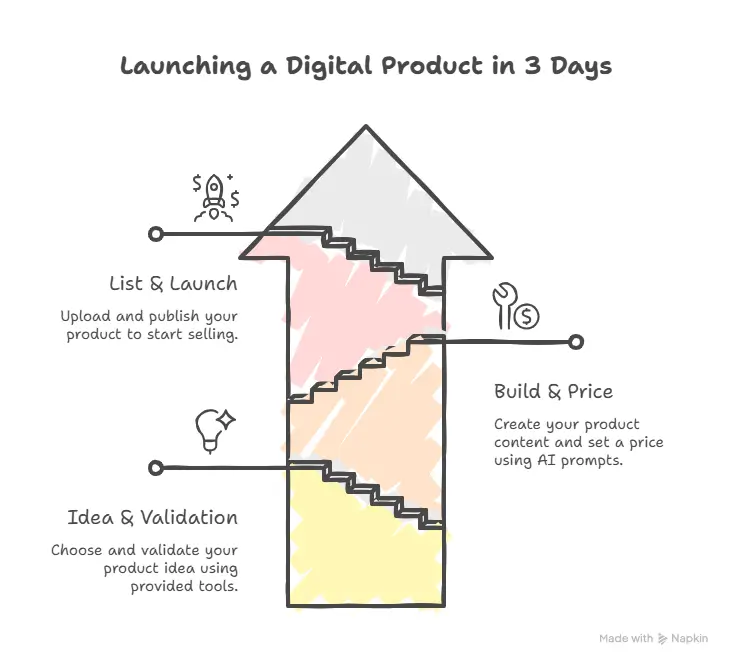
You can go from idea to live digital product in 48 to 72 hours when you follow a clear checklist and use AI to handle the writing tasks. The 48-Hour Launch Checklist and AI Prompt Pack inside the kit are specifically designed to compress that timeline without cutting corners on quality.
Here’s a realistic three-day breakdown.
Day 1: Idea and Validation
Choose your product idea using the guide’s product type breakdown. Run it through the Profit Before You Build calculator to confirm the numbers work. Pick your selling platform. For beginners with no audience, Payhip and Gumroad are the two most practical starting points, both free to start with no monthly fees required.
Day 2: Build and Price
Open the 48-Hour Checklist. Use the AI Prompt Pack to draft your product content, your sales copy, and your product description. The prompts do the heavy lifting. You make the decisions and apply your knowledge. Keep the product simple. A clean five-page PDF, a useful spreadsheet, or a focused template beats a bloated course that takes months to finish.
Day 3: List and Launch
Upload your product. Write your listing using the prompts. Set your price using the simple pricing formula in the checklist. Publish it. That’s it. You’re live. Selling your first digital product in three days is entirely achievable with the right plan, and the kit gives you exactly that plan.
For more detail on what comes after launch, our guide on how to sell digital products in 2026 walks you through getting your first sales.
Who Is the Digital Product Starter Kit Built For?
This kit is built for complete beginners who want to launch their first digital product but keep stalling. It works best for people with no audience, no email list, and no prior experience selling online, who want a simple, fast system instead of another course to binge and forget.
If you fit any of these, this kit is for you:
Complete beginners who have never sold anything online and don’t know where to start. The guide, checklist, and AI prompts remove every major obstacle a first-timer faces.
Side hustlers planning for too long who have been thinking about digital products for months without publishing anything. The 48-hour checklist gives you a deadline that’s actually achievable.
Freelancers adding passive income who want to package their knowledge into a product that earns while they sleep. The planner and calculator help you figure out which of your skills is worth productizing. Our guide to generate passive income online covers the bigger picture strategy once you’re ready to scale.
Content creators managing social media, ideas, and income all at once who need one system to connect it all.
Students and 9-to-5 workers who want to start building an income stream without quitting their job first.
If you haven’t decided what to sell yet, start with our guide to the best digital products to sell online and come back to the kit with a clear idea in hand.
This kit is NOT for people already selling consistently and looking for advanced ads or scaling tactics. It’s a beginner system. That’s the point.
Is the Digital Product Starter Kit Worth $22?
Yes. The five tools inside the kit sell separately for a combined value of $39. At $22, you get a 44% saving on a complete beginner launch system. And a single sale of even a $15 digital product recoups your entire investment before you’ve made your second sale.
Here’s the math from the product page itself. If you create a $17 PDF and sell just six copies a month, that’s $102 every month from one product, after it’s built. Sell 30 copies and that’s $510 a month. The kit costs $22 once. No subscription. No upsells. No hidden fees.
Compare that to the alternative: spending another three months in research mode, watching free tutorials, and still not publishing anything. Every week you wait is a week of sales you’ll never recover.
The Thrivecart guide on selling digital products puts it clearly: the digital product sales market is booming right now. The creators who capture that growth are the ones who actually launch.
A $22 system that gets you to launch this week is not an expense. It’s the cheapest shortcut in the room.
Stop Researching. Start Shipping.
Three things worth remembering before you close this tab.
First, the digital goods market is worth $157 billion and growing. The buyers are already out there. They’re already spending. The only question is whether your product will be there when they go looking.
Second, the reason most beginners never launch isn’t ability. It’s the absence of a system. The Digital Product Starter Kit is the system. Five tools, one bundle, one clear path.
Third, done beats perfect. A simple $15 PDF live today earns infinitely more than a perfect $97 course planned for next year.
You’ve already proven you want this. You’re still reading.
Now you have two options. Close the tab, wait for “the right time,” and stay stuck in research mode. Or spend $22 once, follow a proven system, and finally launch your first digital product this week.
The right time is now. Get the Digital Product Starter Kit and launch this week.
Frequently Asked Questions
What is included in a digital product starter kit?
The Money AI Pro Digital Product Starter Kit includes five tools designed for beginners: a step-by-step PDF guide on how to create and sell digital products, a Notion business planner with 11 sections, a profit calculator in Google Sheets and Excel format, a 48-hour launch checklist, and an AI prompt pack with 85+ copy-paste prompts for ChatGPT and Claude. Everything is instantly downloadable and works on any device.
Do I need an audience or email list to use this kit?
No. The kit is specifically designed for people starting from zero. The PDF guide covers where and how to sell your product even without an audience, an email list, or a website. Platforms like Payhip and Gumroad let you list and sell digital products for free with no monthly cost, making them ideal starting points for complete beginners. The AI Prompt Pack also includes social media prompts to help you start building an audience while you sell.
How is this kit different from a course on selling digital products?
This is not a course. There are no videos to watch, no modules to complete, and no program to work through over weeks or months. It’s a set of five practical tools you open and use immediately: a guide, a planner, a calculator, a checklist, and an AI prompt pack. The goal is to get you from idea to live product as fast as possible, not to teach you theory you’ll never apply. As research consistently shows, most beginners fail from overbuilding and over-planning, not from lack of knowledge. This kit fixes that by giving you action steps, not more information.
What type of digital product should I create first?
Your first

Très bon article ! J’utilise Claude Fable 5 sur pour ce type de besoin. Claude Fable 5
merci, oui Claude Fable 5 est trés fort
Discover high-quality resources for your next project at ai data, offering curated, ready-to-use collections for research and development.
Researchers and engineers must document provenance, collection methodology, and potential biases.
Different tasks require tailored dataset structures and labeling schemes. Natural language processing datasets often depend on tokenization choices and contextual annotations.
Ethical and legal considerations shape dataset creation and sharing policies. Publicly available datasets spur research but should include protections for individuals.
Evaluation datasets and benchmarks enable objective comparison of models. Continuous dataset maintenance addresses concept drift and evolving real-world distributions.
Creating robust datasets involves deliberate choices to guarantee coverage, balance, and correct annotations.
Great breakdown! Solid datasets really are the backbone of any AI project — curation, ethics, and maintenance make all the difference. 🙌
Discover high-quality resources for your next project at biometric data, offering curated, ready-to-use collections for research and development.
Maintaining records of data sources, collection procedures, and inherent biases is an essential practice.
Different tasks require tailored dataset structures and labeling schemes. Text datasets for NLP require careful handling of tokenization, context markers, and annotation standards.
Ethical and legal considerations shape dataset creation and sharing policies. Privacy preservation techniques such as anonymization and differential privacy can mitigate risks.
Evaluation datasets and benchmarks enable objective comparison of models. Reliable reproduction depends on versioned datasets and explicit partitioning rules.
Consent, transparency, and governance frameworks are essential for responsible dataset use.
Discover high-quality resources for your next project at free datasets, offering curated, ready-to-use collections for research and development.
Curating high-quality datasets demands careful attention to diversity, representativeness, and annotation accuracy.
Different tasks require tailored dataset structures and labeling schemes. Text datasets for NLP require careful handling of tokenization, context markers, and annotation standards.
Ethical and legal considerations shape dataset creation and sharing policies. Publicly available datasets spur research but should include protections for individuals.
Evaluation datasets and benchmarks enable objective comparison of models. Reproducing results requires stable dataset versions and detailed split protocols.
Privacy preservation techniques such as anonymization and differential privacy can mitigate risks.
Discover high-quality resources for your next project at video datasets, offering curated, ready-to-use collections for research and development.
AI datasets provide the essential examples that enable algorithms to learn patterns and make predictions.
Different tasks require tailored dataset structures and labeling schemes. Sequence datasets require aligned timing information and comprehensive noise profiles.
Ethical and legal considerations shape dataset creation and sharing policies. Open datasets accelerate progress but must balance accessibility with participant protection.
Evaluation datasets and benchmarks enable objective comparison of models. Reproducing results requires stable dataset versions and detailed split protocols.
Carefully constructed benchmarks highlight strengths and expose weaknesses of models in specific scenarios.
Solid write-up — learned a lot. Worth trying Pixwit — for all-in-one AI video.. Pixwit
So relocating — total ordeal. Had my turn not so long ago, and I’ll be straight with you, it was brutal. Everyone says it’s simple, then you see how much you’ve accumulated. I heard mixed things from everyone, but I didn’t trust hearsay. So here’s the long and short: when you’re after reliable nevada moving services, do some legwork first. Simple reason: local expertise is half the battle — especially for cross-state trips. Me — asked pointed questions — and no exaggeration, I saved both cash and nerves. Now here’s the gem that made everything fall into place. moving companies nevada moving companies nevada That compilation saved me hours. No funny business with rates — transparent to the core. Picked a crew off that page and absolutely zero drama. Don’t skip the fine print. Double-check equipment. The right crew makes moving boring. Wishing you a stress-free transition!
Moving is always a challenge — just dealt with it a few months ago, and no joke, quite the ordeal. You grab some boxes, then reality hits hard. A buddy used one outfit, but I needed to be sure. Anyway: when you need movers in nevada, don’t rush into a decision. Here’s the deal: local nevada movers know the territory — especially with tight schedules. I personally — asked about insurance and all the fees — and trust me, it was completely worth the time. Check out this source that helped me find the right fit. nevada long distance movers https://movers-in-nevada-mtw.com Honestly that resource cut through the confusion. Everything is transparent — clear quotes. Went with their recommendation and absolutely no problems. Be thorough with this. Nail down the timeline. Good service is worth every cent. Hope this points you the right way!
The emphasis on having a system is more useful than simply collecting product ideas. A launch guide, planner, calculator, checklist, and prompt library can reduce the number of decisions a beginner has to make at once. The 48-hour checklist is especially practical because it turns a vague goal into a sequence of actions. Even a small launch benefits from a clear workflow that helps people move from planning to publishing without overcomplicating the first version.
You’ve captured the essence of why this bundle works—it reduces decisions so beginners can focus on action, not overthinking. That 48-hour checklist turns a vague goal into a clear, doable sequence, which is exactly what helps people move from planning to publishing without getting stuck.
Appreciate you breaking it down so practically—this is the kind of clarity that makes launching feel possible. 🙌
Small visual details often carry more weight than people expect in a bio, caption, or profile name. A well-organized collection of copy and paste symbols is most useful when it lets people browse by mood and intended use, rather than making them search through a long unlabelled character list. Clear categories also help users choose decoration that supports readability instead of overpowering the words around it.
For social profiles, the useful distinction is between a decorative look and text that remains easy to copy, search, and recognize across apps. A simple generator helps people test a few Unicode styles before committing to a bio, display name, or short message. Letra Cursiva is most useful when it keeps that process straightforward: clear previews, copy-ready output, and enough restraint that the styling supports the message instead of making it harder to read.
A first-sale guide is most useful when it turns a broad ambition into a sequence of small, testable decisions. The emphasis on a system addresses the common problem of delaying a launch while waiting for perfection. Alongside checklists and prompts, readers would benefit from a clear way to define one buyer, one problem, and one simple offer before adding more features.
Very thorough and well-researched. Impressive work. https://traderzo.com/best-ai-trading-tools-for-stock-forex-and-crypto-traders/
Thank you
Making a move — quite the journey. Had my turn not so long ago, and I’ll be upfront, pretty intense. Seems manageable at first, then you see the mountain of stuff. A buddy tried one service, but I did my own digging. Anyway: when you’re on the hunt for trustworthy local movers, make sure you compare. Think about this: professional teams know the logistics — especially for cross-town moves. In my case — requested breakdowns of costs — and no word of a lie, it was absolutely worth the effort. Take a look at this link that put everything in perspective. movers nevada movers nevada That compilation gave me a clear starting point. Rates are displayed plainly — nothing left to guess. Got my move scheduled there and it went off without a hitch. So be smart about it. Insist on a contract. The right crew makes everything easier. Wishing you a smooth relocation!
A writing aid is most useful when it helps authors notice patterns before those patterns become editing problems. Contador de Palabras combines basic counts with checks for sentence structure, readability, keyword repetition, and pace in Spanish text. This gives a draft more than one kind of feedback: a short text may still be hard to read, while a well-sized paragraph may rely too heavily on the same terms. Reviewing those signals together can make revision more deliberate. The goal is not to optimize every number, but to identify where wording can become clearer, more balanced, and easier for readers to follow.
Bermanfaat. Coba WanVideoGen: — image-to-video dan multimodal. WanVideoGen
This website lets you sms gratuit for quick online verification.
Once the need is gone, there is nothing else to manage or maintain.
This website lets you sms online for quick online verification.
For many people, a temp number is the easiest tool for secure short-term contact.
When a field appears empty, the important question is whether it truly contains nothing or contains a character that simply is not rendered. That distinction matters in forms, usernames, copy-and-paste workflows, and text validation. A utility such as Invisible Text can make the process more deliberate by letting people create a chosen amount of blank-looking content and test it before using it. Clear verification is especially useful because different platforms may treat whitespace differently.
A useful hiring resource should help a small team move from an open role to a repeatable process. That means defining the must-have outcomes for the role, using the same evaluation criteria for each candidate, and recording why a decision was made. Clear recruiting guidance can also explain where speed creates risk, such as inconsistent interview questions, vague compensation discussions, or missing communication with candidates after the process ends.
The emphasis on a system is important because a first product launch contains several small decisions that can otherwise become reasons to delay. A guide, planner, calculator, checklist, and prompt collection can be useful when they help someone move from choosing an offer to defining a simple launch sequence. The strongest next step is usually to set a narrow deadline and finish the minimum version. That keeps momentum tied to action rather than endless preparation.
A structured interview is easier to run when each question is tied to a specific claim in the resume and a requirement in the role. RoleProbe frames that preparation around follow-up prompts, observable answer signals, and requests for supporting evidence. That can help interviewers move beyond broad competency questions, compare answers more consistently, and document why a candidate’s examples do or do not match the position’s needs.
Large PDFs can create unnecessary friction when an attachment has to meet an upload limit or travel quickly by email. A browser-based tool such as ComprimirPDF is relevant because it keeps the task straightforward: reduce the file size locally, avoid registration, and keep the document under the user’s control. That combination is especially useful when the file contains material that should not be routinely uploaded to a third-party service.
A custom typeface benefits from a workflow that separates inspiration from production. Start with a clear visual direction or source material, review the letterforms in context, then export only after checking how the characters work across headings and body text. FontGenerator supports that progression with options to begin from a description, an image, or handwriting, followed by testing and editing before download. Offering TTF, OTF, WOFF, and WOFF2 also makes the final choice more intentional for print, apps, or the web.
Converting mathematical material into an editable format is most useful when the workflow preserves structure rather than merely producing plain text. A practical tool should handle photographed equations, screenshots, and handwritten notation while leaving room for careful correction. imagetolatex brings those needs together with equation editing and table-generation options, which can help students and writers move from a visual draft to reusable mathematical content.