
The digital economy has fundamentally transformed how entrepreneurs build wealth, and 2026 represents a pivotal moment for creators ready to capitalize on this revolution. Whether you’re a designer with untapped creative assets, a fitness coach with transformative knowledge, or a productivity expert sitting on valuable templates, the opportunity to generate substantial income from digital products has never been more accessible or lucrative.
Table of Contents
1. The 2026 Digital Commerce Landscape
Understanding Digital Products and Their Explosive Growth
Digital products are non-physical goods delivered instantly to customers via download links or private access portals. Unlike traditional merchandise that requires manufacturing, warehousing, and shipping logistics, digital products exist as files—PDFs, videos, spreadsheets, graphics, or software—that can be sold infinitely without depleting inventory.
The global digital products market is experiencing unprecedented expansion. According to recent industry analysis, the digital fitness and wellness sector alone is projected to reach $83 billion by 2027, reflecting a compound annual growth rate that outpaces most traditional retail categories. This explosion isn’t limited to fitness; educational content, creative assets, and productivity tools are all experiencing similar trajectories as consumers increasingly prefer instant, downloadable solutions over physical alternatives.
The “Digital Advantage”: Why 2026 Favors Digital Over Physical
The competitive advantages of digital products have become even more pronounced in 2026. First, there’s the infinite scalability factor—create once, sell forever. Whether you sell one copy or ten thousand copies of your e-book, your production costs remain static. There’s no need to reorder inventory, manage suppliers, or worry about storage fees eating into your margins.
Second, the economics are undeniably superior. With zero shipping costs, no material expenses, and minimal overhead, profit margins on digital products typically range from 85-95%. Compare this to physical products, where margins often hover around 30-50% after accounting for manufacturing, fulfillment, and returns.
Third, global reach happens automatically. A customer in Tokyo can purchase your Notion productivity template at 3 AM and receive instant access, with no international shipping delays or customs complications. This 24/7 automated sales potential means you’re genuinely earning while you sleep—not as a cliché, but as a operational reality.
Market Potential: Booming Sectors Worth Your Attention
Beyond the fitness and wellness explosion, several sectors are demonstrating remarkable growth trajectories. The online education market continues its meteoric rise, with professionals actively seeking specialized knowledge in micro-niches. Rather than pursuing expensive degree programs, modern learners prefer targeted courses teaching specific skills—whether that’s mastering Procreate illustration techniques, understanding cryptocurrency trading strategies, or implementing sustainable living practices.
The remote work revolution has permanently altered demand patterns. Productivity templates, project management frameworks, and digital organization systems are no longer nice-to-have luxuries but essential tools for distributed teams and solo entrepreneurs managing complex workflows. This shift has created sustainable demand for well-designed digital utilities that save time and reduce cognitive load.
Creative professionals are also driving significant market expansion. With social media marketing becoming increasingly visual and video-centric, demand for design assets—fonts, icons, graphics packages, and video templates—continues growing as small businesses seek professional-quality materials without hiring full-time designers.
Success Stories: Learning from Digital Product Pioneers
Ashley Renee built a six-figure business selling keto cookbooks and meal plans, transforming her personal health journey into a thriving digital enterprise. Her success wasn’t accidental—she identified an underserved niche within the broader keto community, created comprehensive recipe collections with shopping lists and macro breakdowns, and built trust through consistent value delivery on social platforms.
Zara Simon-Ogan took a similar approach in the haircare space, creating detailed e-books addressing specific challenges faced by people with textured hair. By combining personal experience with research-backed recommendations, she developed products that resonated deeply with her target audience, commanding premium prices because customers recognized the specialized expertise and time-saving value her guides provided.
These creators share common traits: they identified genuine pain points within communities they understood intimately, created solutions that delivered measurable value, and leveraged platforms that allowed them to maintain brand control while minimizing overhead costs.
2. Strategic Distribution: Platforms vs. Marketplaces
The Storefront Strategy: Building Your Digital Real Estate
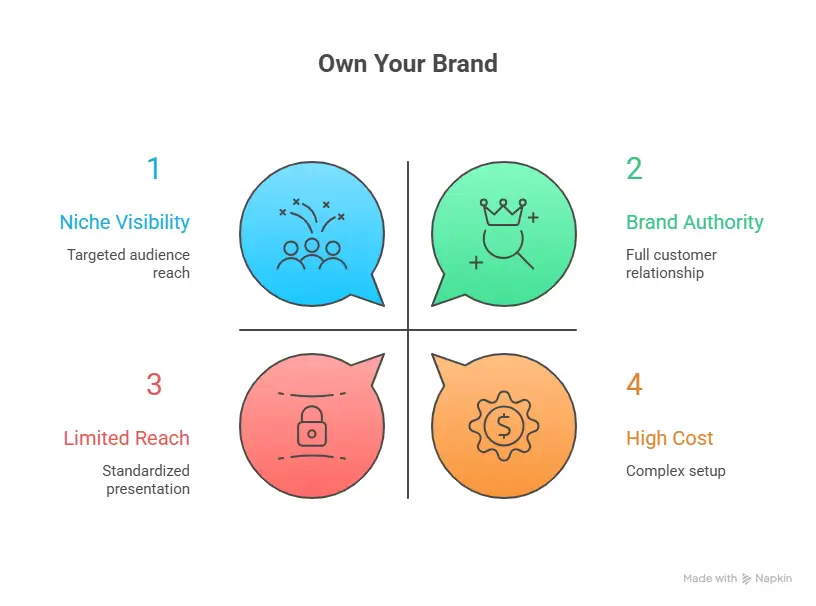
One of the most critical decisions you’ll make is choosing between building your own branded storefront versus listing products on third-party marketplaces. While marketplaces offer initial visibility, establishing your own storefront using platforms like Sellfy, Gumroad, or Shopify provides superior long-term advantages.
When you control your storefront, you own the customer relationship. This means building an email list of buyers you can market to repeatedly, creating upsell opportunities, and establishing brand recognition that transcends any single platform. Marketplace fees typically range from 10-30% per transaction, and these costs compound significantly as your business scales. A creator generating $10,000 monthly through marketplace sales might forfeit $2,000-$3,000 in fees—money that could fund advertising, product development, or simply remain as profit.
Brand control represents another crucial advantage. Your storefront becomes your digital headquarters, reflecting your aesthetic choices, messaging, and customer experience preferences. Marketplaces, by contrast, impose standardized layouts that make differentiation challenging and prevent you from controlling the narrative around your products.
Platform Deep Dive: Choosing Your Foundation
Sellfy has emerged as a favorite among digital creators seeking simplicity without sacrificing functionality. The platform allows you to launch a functional store within minutes, upload files up to 10GB, and integrate essential features like abandoned cart recovery, discount codes, and upselling tools. Transaction fees are competitive, and the platform handles VAT/sales tax calculations automatically—a significant administrative relief for international sellers. The email marketing integration means you can nurture customer relationships without juggling multiple tools.
Gumroad appeals to creators prioritizing minimalism and speed to market. The platform’s straightforward interface makes listing products nearly effortless, and the “pay what you want” pricing option enables interesting experiments with value-based selling. However, transaction fees can be higher than alternatives, especially on the free tier, and customization options remain limited compared to more robust platforms.
Shopify represents the enterprise-grade option, offering virtually unlimited customization through its app ecosystem and theme marketplace. For creators planning to build comprehensive brands with multiple product lines, complex automation, and advanced marketing funnels, Shopify’s capabilities justify the higher monthly costs. The learning curve is steeper, and you’ll need to invest time understanding the platform’s architecture, but the scalability potential is unmatched.
Payhip positions itself as a cost-effective middle ground, providing essential e-commerce features without overwhelming complexity. The platform’s affiliate program functionality allows you to recruit partners who promote your products for commission, effectively building a sales force without upfront costs. Email marketing and course hosting capabilities are built in, reducing your need for additional third-party services.
WooCommerce suits technically inclined creators comfortable with WordPress. This open-source solution offers maximum flexibility and no platform fees, though you’ll handle hosting, security, and technical maintenance yourself. For those with development skills or budget to hire technical support, WooCommerce can provide the most cost-effective long-term solution as you scale.
Leveraging Marketplaces: Strategic Visibility Without Dependence
While building your owned storefront should be the priority, marketplaces serve valuable strategic purposes, particularly when launching. Platforms like Etsy, Creative Market, and Amazon KDP provide immediate access to audiences actively searching for digital products, offering discovery opportunities that would take months to replicate through organic marketing on your own site.
Etsy works exceptionally well for visual products like printables, templates, and design assets. The platform’s built-in search traffic and consumer trust can generate initial sales that validate your product concept and provide social proof. Use Etsy to test products, gather reviews, and understand customer preferences, then migrate your most successful offerings to your owned platform where you retain larger profit margins.
Creative Market caters specifically to designers and creators selling fonts, graphics, templates, and creative tools. The curated marketplace attracts professional buyers willing to pay premium prices for quality assets, making it ideal for positioning higher-end design products. The platform’s commission structure rewards exclusive listings, so consider whether the visibility trade-off justifies limiting distribution.
Amazon KDP (Kindle Direct Publishing) remains the dominant force for e-book distribution, providing unparalleled reach to readers worldwide. While royalty rates typically range from 35-70% depending on pricing and exclusivity agreements, the platform’s recommendation algorithm and Prime reading integration can drive volume that compensates for lower per-unit margins. Many successful authors use KDP for broad distribution while selling premium bundles or supplementary materials directly through their own storefronts.
The optimal strategy involves using marketplaces as discovery engines and portfolio builders early in your journey, gradually transitioning successful products to your owned platform while using marketplace presence to drive awareness and capture buyers at different stages of purchase intent.
3. The Product Deep Dive: 6 High-Profit Categories
1. Educational & Informational Assets
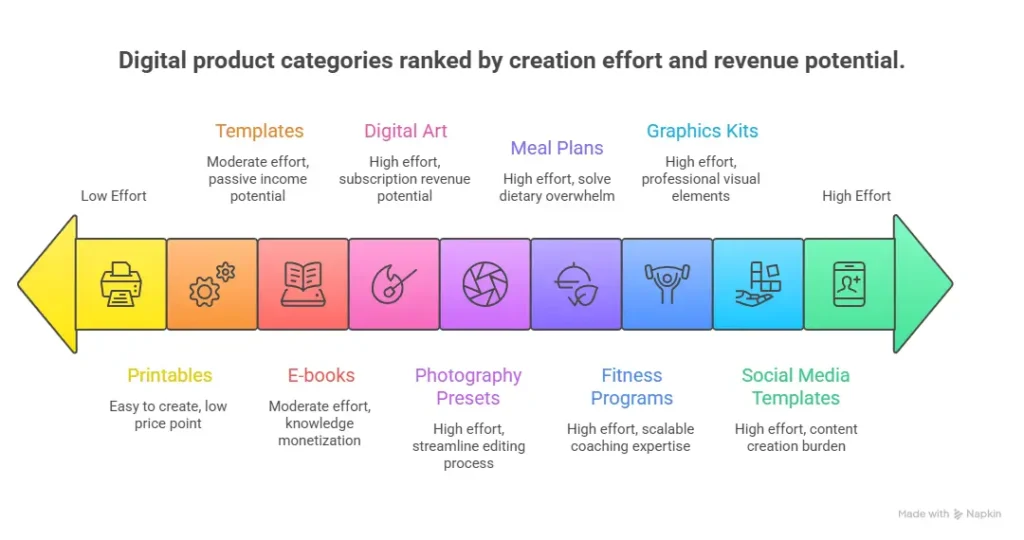
E-books represent the quintessential entry point for knowledge monetization. If you possess expertise in any specialized domain—whether that’s Instagram growth strategies, sustainable gardening, or productivity systems for ADHD professionals—an e-book allows you to package that knowledge into an accessible, affordable format. The barriers to entry are remarkably low: you need only your expertise and basic design tools like Canva or even Google Docs.
The key to successful e-books lies in specificity. Rather than writing “The Complete Guide to Fitness,” target “The Busy Executive’s 20-Minute Workout System” or “Strength Training for Women Over 50.” Narrow niches command attention and allow you to become the definitive authority rather than competing against hundreds of generic alternatives.
Online Courses & Tutorials scale your knowledge into premium-priced offerings by combining video instruction, downloadable resources, and structured learning paths. The perceived value of courses dramatically exceeds e-books, allowing you to charge $97-$497 or more for comprehensive multi-module programs. Platforms like Teachable, Thinkific, or even selling directly through your Sellfy store enable you to create professional learning experiences without technical complexity.
Successful courses solve specific, painful problems through step-by-step instruction. Emma Chieppor built a thriving business teaching Excel skills to non-technical professionals, transforming a seemingly dry topic into engaging video lessons that help people automate workflows and advance careers. The transformation she delivers—from manual data entry to automated reporting—justifies premium pricing because students recognize the ROI in time savings and career advancement.
If you’d rather not start from a blank page, the Digital Product Starter Kit packages the exact beginner formula described above into one $22 bundle — a PDF guide, a Notion planner, a profit calculator, a launch checklist, and an AI prompt pack. It’s built specifically so a first-time seller can go from idea to listed product in a weekend instead of a month.
2. Creative Design & Visual Tools
Digital Art has evolved from a hobbyist pursuit to a legitimate income stream for illustrators and designers. Whether you’re creating custom Procreate brushes that enable specific artistic effects, designing Twitch emotes for streamers, or illustrating inspirational quotes for social media, digital art products serve creators seeking to enhance their visual content without commissioning custom work.
The subscription economy has particularly benefited digital artists. Rather than selling individual illustrations, many creators now offer monthly memberships providing subscribers with fresh graphics, seasonal collections, or exclusive brushes. This model transforms sporadic purchasers into recurring revenue while building community around your creative style.
Photography Presets & Stock monetize your unique editing aesthetic and photographic eye. If you’ve developed signature color grading techniques or consistently achieve specific moods in your images, presets package those styles into one-click solutions for other photographers. Lightroom presets, Photoshop actions, and mobile editing presets all sell consistently to photographers seeking to streamline post-processing or emulate looks they admire.
Stock photography remains viable for photographers building extensive libraries of commercial imagery. Focus on underserved niches—authentic representations of diverse families, remote work scenarios, sustainable business practices—rather than competing in oversaturated categories like sunset beaches or generic office meetings.
3. Utility, Productivity & “Shortcut” Tools
Templates & Planners address the universal human need for organization and efficiency. Notion templates for project management, Excel budgeting spreadsheets, Canva social media layouts, and Google Sheets habit trackers all sell because they eliminate the blank page problem and encode best practices into ready-made frameworks.
The beauty of template creation lies in the leverage—hours invested in designing one exceptional template can generate years of passive income as customers discover ongoing value. Financial planning templates, content calendars for creators, and client management systems for freelancers address persistent needs that recur across customer cohorts.
Printables offer perhaps the lowest barrier to entry in digital products while providing genuine utility. Wall art with motivational quotes, meal planning sheets, children’s educational worksheets, and party decoration sets all qualify as printables—digital files customers download and print themselves. While individual printables typically sell for modest prices ($3-$15), creators often bundle related items into collections commanding $20-$40, improving perceived value while increasing transaction size.
The key to printable success involves understanding your customer’s aesthetic preferences and functional needs, then delivering designs that feel personalized to their lifestyle or values rather than generic mass-market alternatives.
Two tools make this stage easier. Before you sink hours into building a template, run it through Profit Before You Build — a 5-sheet Excel calculator with 121 formulas that tells you, in minutes, whether an idea can actually hit your income target. And if you want a ready-made planning system instead of designing one yourself, the Ultimate Life & Side Hustle Planner covers goal-setting, tracking, and daily planning across HTML, GoodNotes/PDF, and Notion formats — the exact category this section is describing.
4. Health, Wellness & Lifestyle Assets
Meal Plans & Cookbooks capitalize on the evergreen intersection of health goals and culinary overwhelm. Whether focused on specific dietary frameworks like keto, vegan, or Mediterranean diets, or addressing particular needs like batch cooking for families or anti-inflammatory eating, recipe collections solve the “what should I eat?” question that plagues millions daily.
Successful meal plan products go beyond simple recipe lists, providing comprehensive solutions including shopping lists organized by store section, macro breakdowns for tracking-conscious consumers, meal prep instructions, and substitution suggestions for accommodating preferences or allergies. This thoroughness justifies higher price points ($27-$67) compared to basic recipe PDFs.
Fitness & Training Programs package your coaching expertise into scalable digital formats. Rather than trading time for money through one-on-one training, programs allow you to serve hundreds of clients simultaneously with structured workout routines, form instruction videos, progression guidelines, and modification options. Programs targeting specific goals—postpartum recovery, marathon training, or calisthenics mastery—attract motivated buyers willing to invest $47-$197 for proven systems.
The digital format also enables you to update programs based on feedback and emerging research, improving your product over time while maintaining pricing integrity through versioning and bonus content for existing customers.
5. Modern Tech & Design Assets
Graphics & UI Kits serve designers, marketers, and entrepreneurs seeking professional visual elements without hiring full-time designers or purchasing expensive software. Font collections, icon sets, logo templates, and presentation deck designs all qualify as building blocks that customers combine into finished projects.
The key differentiator in this crowded category is cohesion and quality. Rather than selling random individual icons, create comprehensive kits with consistent styling across hundreds of elements, allowing customers to build entire brand identities or marketing campaigns with visual unity.
Social Media Templates address the content creation burden facing businesses and creators maintaining presence across multiple platforms. Instagram story templates, carousel post layouts, Pinterest pin designs, and YouTube thumbnail frameworks all reduce the friction between content ideas and published posts.
Focus on specific niches or industries—real estate agents, health coaches, e-commerce brands—rather than generic business templates. This specialization allows you to incorporate industry-specific terminology, appropriate imagery, and relevant color schemes that resonate more deeply with target buyers.
AI-Generated Tools represent an emerging category as artificial intelligence becomes embedded in creative and professional workflows. ChatGPT prompt packs teaching users how to generate specific outputs, AI art prompts for Midjourney or DALL-E, and workflow automation guides all monetize your expertise in leveraging these technologies effectively.
As AI tools proliferate, the value shifts from access to technology—which is often free or inexpensive—to knowing how to use these tools strategically. Your product packages that knowledge into shortcuts that save customers hours of experimentation.
Content templates only work if they’re backed by a plan, which is where the All-in-One Social Media Planner comes in — a 16-tab Google Sheets/Excel system for scheduling, tracking performance, and organizing content across platforms, built with the SEO and Pinterest strategy already worked into it.
6. Recurring Revenue & Scalable Services
Subscription Models transform one-time purchasers into ongoing supporters through exclusive memberships. Patreon, Substack, or self-hosted membership areas provide subscribers with regular content deliveries—weekly templates, monthly courses, or behind-the-scenes access—in exchange for recurring fees.
The subscription approach builds predictable revenue that compounds as you retain existing members while adding new subscribers. A creator with 200 subscribers paying $19 monthly generates $3,800 in predictable monthly revenue before accounting for any one-time product sales.
Digital Services & PLR (Private Label Rights) represent different approaches to scalability. Digital services package your expertise into deliverables like custom Notion setups, brand identity packages, or website templates customized during brief consultation calls. PLR products, by contrast, are pre-made digital goods you purchase wholesale and rebrand as your own, allowing rapid entry into new product categories without creation time.
While PLR offers speed, differentiation becomes crucial—simply reselling unchanged PLR products rarely succeeds. Successful PLR entrepreneurs significantly customize content, bundle multiple resources, and target specific niches where generic PLR hasn’t saturated the market.
Here are more Digital Products you can create and sell
4. The “Validation First” Framework
Market Research: Finding Profitable Opportunities
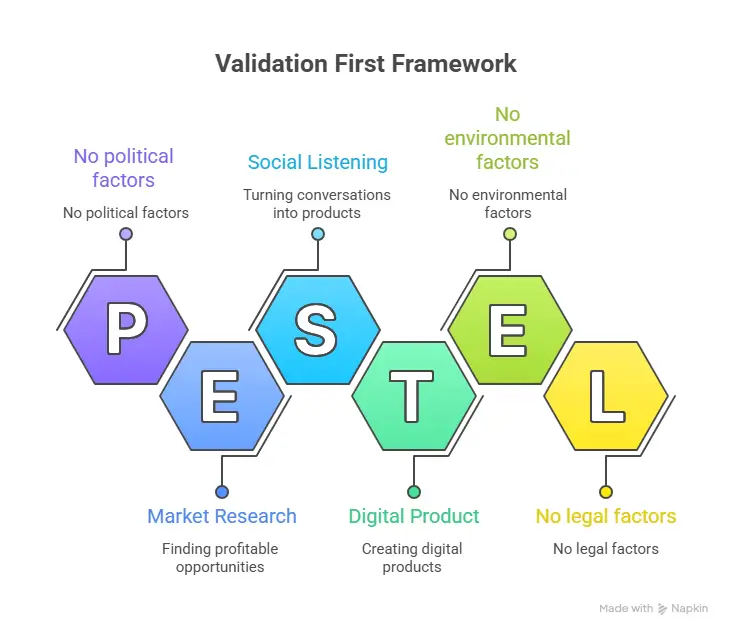
Before investing weeks creating your digital product, validate demand through systematic research. Tools like Semrush, Ahrefs, or even Google’s Keyword Planner reveal search volumes for terms related to your proposed product. If thousands of people monthly search for “meal prep template for families” but few quality paid products exist, you’ve identified an opportunity gap.
Study competitor offerings exhaustively. What features do existing products include? What do reviews praise or criticize? Where do Q&A sections reveal unmet needs? Your product should either serve an underserved niche, deliver superior quality to existing options, or bundle features that competitors sell separately.
Social Listening: Turning Conversations Into Products
Your target audience is already telling you what products they need—you simply need to listen systematically. Join Facebook groups, subreddits, and niche communities where your ideal customers congregate, paying attention to recurring questions, frustrations, and requests for recommendations.
Emma Chieppor discovered her Excel tutorial opportunity by noticing repeated requests in business forums from professionals struggling with specific spreadsheet functions their jobs required. Rather than creating generic Excel training, she built targeted guides addressing exactly those pain points, ensuring product-market fit before filming a single video.
Comment sections on YouTube videos, Instagram posts, and blog articles in your niche reveal specific language customers use when describing problems. Incorporate this exact phrasing into your product descriptions and marketing copy—when customers see their own words reflected back, perceived relevance increases dramatically.
Choosing Your Format: Matching Medium to Message
The complexity of your content should dictate format selection. Detailed processes requiring visual demonstration—makeup techniques, software tutorials, or exercise form—demand video instruction where learners can observe nuances that text descriptions would struggle to convey.
Simple reference materials like checklists, templates, or written frameworks work perfectly as PDFs, offering customers the ability to print, annotate, and reference without needing to watch lengthy videos. Many creators optimize for both preferences by creating video courses that include PDF workbooks and checklists as supplementary downloads.
Audio formats suit narrative or interview-based content, while interactive tools like spreadsheet calculators or Notion databases provide hands-on utility that static formats cannot replicate. Choose formats that serve your customer’s context—will they use your product at a desk with full computer access, or do they need mobile-friendly resources they can reference throughout their day?
5. Execution: Launching and Automating Your Store
Technical Setup: From Concept to Live Store
Modern platforms have eliminated technical barriers that once prevented creators from launching digital businesses. Using Sellfy as an example, you can establish a functional storefront in under an hour. The process involves selecting a store name and URL, uploading your product files (supporting sizes up to 10GB for video courses or high-resolution design assets), writing compelling product descriptions, and connecting payment processors like PayPal or Stripe.
Product descriptions should follow a proven formula: lead with the transformation or outcome your product delivers, detail what’s included, address common objections, and close with clear purchasing instructions. Rather than listing features, emphasize benefits in language that resonates with your target customer’s aspirations and pain points.
High-quality product mockups and preview images dramatically impact conversion rates. Show your e-book cover, preview pages from your template, or screenshot your course dashboard to help browsers visualize exactly what they’re purchasing. Transparency builds trust and reduces purchase hesitation.
Growth Hacking Tools: Maximizing Every Visitor
Once your store is live, built-in tools can significantly boost revenue without increasing traffic. Abandoned cart recovery emails automatically remind browsers who added products but didn’t complete checkout, recovering 15-30% of otherwise lost sales through gentle follow-up messages offering assistance or limited-time discounts.
Upselling and cross-selling features suggest complementary products during checkout. If someone purchases your social media template pack, immediately offer your companion content calendar template at a discount. This strategic bundling increases average transaction value while providing customers with complete solutions.
Discount codes serve multiple purposes beyond simple price reductions. Create unique codes for different marketing channels to track which platforms drive sales, offer first-purchase discounts to email subscribers incentivizing list growth, or provide seasonal promotions creating urgency around typically slow periods.
The “Bio Link” Strategy: Converting Social Following to Customers
Social media platforms increasingly restrict external links to protect user engagement, making your profile bio link exceptionally valuable real estate. Tools like Linktree, Beacons, or custom landing pages allow you to create a hub showcasing all your digital products, recent content, and special offers from a single clickable link.
Your bio link strategy should match your content strategy. If you’re posting Instagram reels demonstrating productivity tips, your bio link should prominently feature your productivity templates and planners. Direct correlation between content value and product offering increases conversion likelihood as followers already trust your expertise from free content consumption.
Regularly update your bio link to reflect new products, seasonal offerings, or time-sensitive promotions. Announce updates in your content—”New template collection in my bio!”—training your audience to check regularly rather than treating it as static information.
6. Expert Pricing & Final FAQ
Value-Based Pricing: Escaping the Race to the Bottom
New creators often underprice digital products, assuming lower prices guarantee more sales. This logic fails because it ignores perceived value psychology—prices communicate quality. A $7 e-book may actually sell worse than the same content priced at $27, as potential buyers question whether such cheap information can truly solve their problems.
Value-based pricing focuses on the outcome your product delivers rather than your costs or time invested. A template saving customers five hours weekly is worth significantly more than $10—that’s 20+ hours monthly, potentially worth hundreds or thousands in reclaimed productivity. Price based on transformation, not production cost.
Premium courses commanding $197-$497 sell successfully when they provide clear ROI through career advancement, income generation, or substantial time savings. Buyers don’t question high prices when they understand the return exceeds the investment. Your marketing must clearly articulate this value equation.
You can see this play out at the entry level too. Profit Before You Build sells in the $9–$17 range not because it’s cheap to make, but because it answers one specific question — “will this idea make money?” — better than a free spreadsheet template ever could. Narrow, outcome-focused products justify their price even at the low end of the market.
Addressing Common Challenges and Concerns
Competition in digital products is inevitable but often overestimated. Most niches can support multiple successful creators because customers value different teaching styles, perspectives, and personality fits. Your unique experiences, communication style, and specific angle differentiate you from competitors even when covering similar topics.
Trust establishment overcomes the primary barrier preventing strangers from purchasing your products. Build credibility through consistent free content demonstrating expertise, transparent product previews showing exactly what customers receive, detailed customer testimonials highlighting specific results, and money-back guarantees removing purchase risk.
Piracy concerns rarely materialize into significant problems for most digital creators. Yes, some people will share or pirate your products, but these individuals typically wouldn’t have purchased anyway. Focus energy on serving paying customers exceptionally rather than building elaborate protection schemes that often degrade legitimate user experience.
FAQ’s
What is a digital product?
A digital product is any item or asset that exists in digital format and can be sold and distributed electronically without physical inventory. Unlike physical goods, a digital product is delivered instantly via download, email, or access link. Common examples include e-books, online courses, software, templates, stock photos, music files, and printable planners. The key advantage of any digital product is that it can be sold unlimited times without restocking or manufacturing costs.
What are the best digital products to sell for beginners?
The best digital product for beginners is typically an e-book or PDF guide because they require minimal technical skills to create. Templates (Canva designs, Excel spreadsheets, Notion boards) are also excellent starter digital products since they solve specific problems and can be created using free or low-cost tools. Printables represent another beginner-friendly digital product category—wall art, planners, and checklists require only design skills and can be sold immediately. Start with one digital product that leverages your existing expertise rather than trying to master a completely new skill.
If you want to see this approach in action rather than build it from scratch, the Digital Product Starter Kit is a working example of a beginner-friendly bundle — guide, planner, calculator, checklist, and prompt pack — priced to be a low-risk first purchase or a template for your own first product.
How much money can you make selling digital products?
Income from selling digital products varies dramatically based on niche, pricing, and marketing effort. Beginners might earn $100-$500 monthly from their first digital product, while established creators routinely generate $5,000-$50,000+ monthly. The beauty of a digital product business is scalability—your income isn’t capped by hours worked since each digital product sells repeatedly without additional effort. Creators like Ashley Renee have built six-figure businesses selling digital products (keto cookbooks), while others earn modest side income. Success depends on choosing the right digital product for your audience and consistently marketing it.
What digital products are in high demand right now?
High-demand digital product in 2026 include productivity templates (Notion dashboards, project management spreadsheets), online courses teaching specific skills (AI tools mastery, social media growth, freelancing), meal plans and recipe collections for niche diets, social media content templates (Instagram carousels, Pinterest pins), and ChatGPT prompt packs. The fitness and wellness digital product market is particularly strong, projected to reach $83 billion. Any digital product that saves time, solves a specific problem, or helps people make money tends to perform well regardless of market conditions.
Do I need a website to sell digital products?
No, you don’t necessarily need a traditional website to sell digital products. Platforms like Sellfy, Gumroad, and Payhip allow you to create a digital storefront in minutes without coding or web design skills. However, having your own branded space to sell digital products provides long-term advantages including lower transaction fees, customer email ownership, and complete brand control. You can also sell digital products through marketplaces like Etsy or Creative Market initially, then transition to your own platform as you grow.
How do I price my digital product?
Price your digital product based on the value and transformation it provides, not the time you spent creating it. A digital product that saves customers 10 hours monthly is worth significantly more than one providing mild entertainment. Entry-level digital products like checklists or single templates typically sell for $7-$27, comprehensive e-books range from $27-$67, template bundles command $37-$97, and premium online courses (a high-value digital product) often sell for $97-$497+. Test different price points and remember that higher prices often increase perceived value—don’t automatically assume cheaper means more sales for your digital product.
Can I sell the same digital product on multiple platforms?
Yes, you can sell the same digital product on multiple platforms simultaneously, though some marketplaces offer higher commission rates for exclusive listings. Many successful creators use a multi-channel strategy: selling their digital product on their own Sellfy or Shopify store for maximum profit margins, listing on Etsy for discovery and search traffic, and potentially offering through platforms like Gumroad for their social media audience. Just ensure you can fulfill orders from all platforms and that marketplace terms don’t prohibit cross-posting your digital product.
How do I protect my digital product from piracy?
While no protection is foolproof, you can minimize piracy of your digital product through several strategies: watermark PDF pages with purchaser information, use platforms that generate unique download links expiring after use, limit download attempts per purchase, and add your branding throughout the digital product so shared copies still advertise your business. However, most successful creators don’t obsess over piracy—the vast majority of customers are honest, and people who pirate your digital product likely wouldn’t have purchased anyway. Focus energy on serving paying customers rather than building complex protection for your digital product.
The digital products business model in 2026 offers unprecedented opportunities for creators ready to package their knowledge, creativity, or productivity systems into scalable assets. By choosing the right distribution platforms, creating products that genuinely solve problems, validating demand before heavy production investment, and pricing based on transformation rather than time invested, you position yourself to build sustainable income streams that compound over time.
The creators succeeding in this space aren’t necessarily the most talented or knowledgeable—they’re the ones who consistently ship products, learn from customer feedback, and refine their offerings based on real market response. Your digital product business starts with a single product serving a specific audience, then scales through iteration, improvement, and expanding into complementary offerings as you deepen your understanding of customer needs.

This post has given me a lot to think about. https://traderzo.com/stock-market-ai-the-future-of-artificial-intelligence-in-investing/
The distinction between a downloadable product and a valuable product deserves more attention. Instant delivery can make digital commerce accessible, but buyers still need a clear outcome, usable guidance, and confidence that the material fits their situation. A blueprint is most helpful when it also addresses validation: who the offer is for, what problem it solves, and how feedback should shape the next version. For visual products especially, presentation matters as much as the file itself—examples, fonts, and thoughtful designs can make an abstract promise easier to evaluate before purchase.