
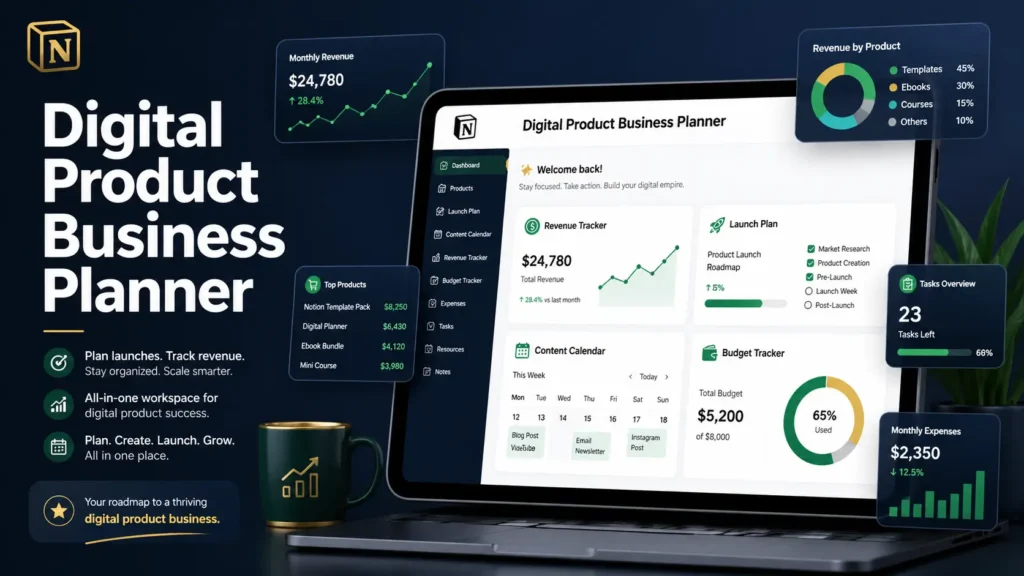
Most digital product businesses don’t fail because of a bad product. They fail because there’s no system behind the business. A Digital Product Business Planner gives you one place to track revenue, plan launches, manage content, and control your budget. This post breaks down what a good planner should include, why it matters, and how the Money AI Pro Digital Product Business Planner helps you stop guessing and start running a real business for just $12.
If you’re selling digital products, you already know the feeling. You’re busy every single day. You’re posting, creating, tweaking, and promoting. But at the end of the month, you’re not sure what’s actually working. You don’t know your real profit. You don’t have a clear launch plan. You’re running on energy and hope, not data.
Here’s the uncomfortable truth about the digital product business world: a staggering 95% of digital products don’t succeed. And most of the time, the product itself isn’t the problem. The problem is the lack of a system behind it.
The global digital goods market is valued at $124.32 billion in 2025 and is projected to reach $511 billion by 2031. The opportunity is real. But the sellers who actually capture it are the ones with a plan, not just passion.
That’s exactly what a Digital Product Business Planner gives you. Not more motivation. Not another checklist. A real operating system for your business.
Table of Contents
What Is a Digital Product Business Planner?
A digital product business planner is a structured system, template, or workspace that helps digital product sellers organize every part of their business in one place. It typically covers revenue tracking, product launch planning, content scheduling, budget management, and goal setting, giving you a clear view of where your business stands and where it’s going.
This is not the same as a generic daily planner or a simple to-do list. A generic planner helps you manage your time. A digital product business planner helps you manage your business. The difference matters.
If you’re selling on platforms like Etsy, Gumroad, or Payhip, or if you’re building your own store, you need something built for the specific challenges of selling digital products. Revenue can fluctuate week to week. Launches require coordination across content, email, and social media. Products need to be tracked from idea stage all the way to live sale.
A good planner brings all of that together. It helps you move from reactive (responding to what’s happening) to proactive (directing what happens next). If you’re still figuring out what to sell, it’s also worth spending time to brainstorm your digital product ideas before building your plan.
Why Do So Many Digital Product Businesses Fail Without a Plan?
Most digital product businesses fail not because the product is bad, but because the seller has no system to track what’s earning, what’s flopping, or what to do next. Without a plan, you post randomly, spend without tracking, and set goals with nothing to measure them against. You feel productive but go nowhere.
According to research on why digital products fail, the single biggest mistake sellers make is building before validating and then continuing to run their business without a real structure in place. The excitement of creating something new replaces the discipline of running it like a business.
Here’s what that looks like in practice:
- You create content but have no calendar, so posting becomes inconsistent.
- You make sales but don’t track them, so you don’t know your profit margin.
- You set goals at the start of the month but have no system to review progress.
- You spend on tools and ads but have no budget tracker, so money leaks out quietly.
The result is burnout. You put in real effort but can’t point to real results. That’s not a motivation problem. It’s a systems problem.
According to Stripe’s breakdown of digital product businesses, the businesses that grow consistently are the ones that treat their digital products as a real business from day one, including how they plan, track, and measure.
What a Strong Digital Product Business Planner Should Include
Not all planners are equal. A basic PDF template you fill in once and forget is not the same as a dynamic system you use every week. Here are the core sections that separate a useful planner from a decorative one.
1. Revenue Tracker
You should be able to log every sale and see your total income at a glance. Knowing where your money comes from helps you double down on what’s working. According to Forbes’ guide to starting a digital products business, tracking revenue from the start is one of the most important habits for long-term growth.
2. Launch Plan
Every product launch has moving parts: building the product, writing the sales page, scheduling content, sending emails, and promoting across platforms. A launch plan section keeps all of that organized with clear steps and deadlines. Without it, launches feel chaotic and underperform.
3. Content Calendar
Consistent content drives consistent sales. Digital planners and templates are consistently ranked among the most profitable digital products precisely because they solve the consistency problem. A good content calendar inside your planner should cover Instagram, TikTok, and email at minimum.
4. Budget Tracker
You need to know your expenses, not just your income. A budget tracker with category breakdowns and alerts for overspending keeps your profit margin healthy.
5. Goals and Vision System
Monthly and quarterly goals give direction. Without them, effort gets scattered. A goals section lets you set targets and review them regularly, which is what turns ambition into actual progress.
6. Product Vault
If you have more than one product (or plan to), you need a way to manage them all. A product vault tracks the status of each product: idea, in progress, or live.
You can learn more about how to create and sell planner templates as a digital product category in its own right, but for running your overall business, you need a planner that covers all six areas above.
How Does the Money AI Pro Digital Product Business Planner Work?
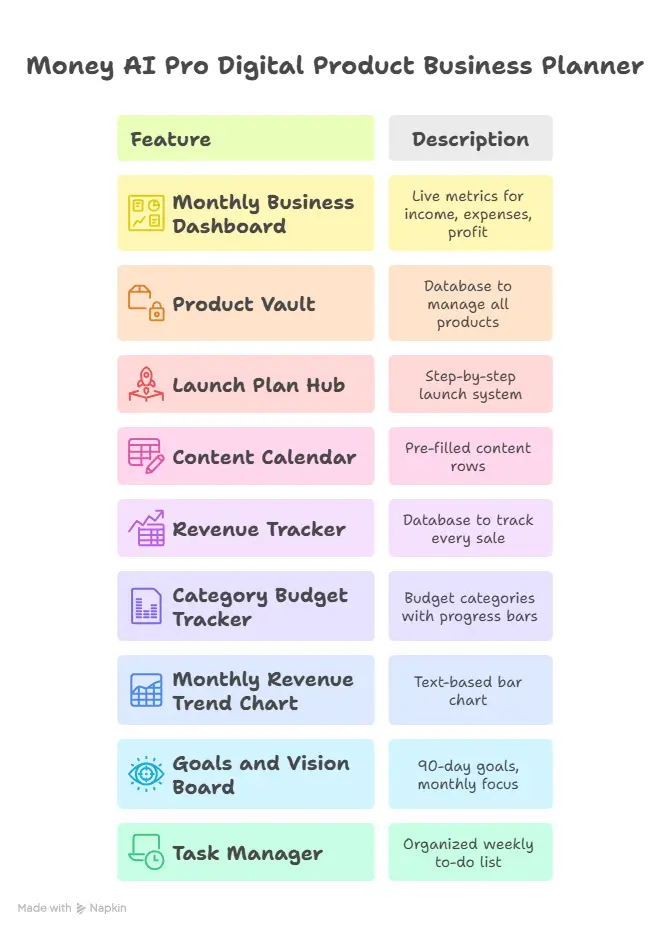
The Money AI Pro Digital Product Business Planner is an all-in-one Notion workspace with 11 built-in sections designed specifically for digital product sellers. You get instant access after purchase, duplicate it into your free Notion account in one click, and you’re set up in under 10 minutes.
Here’s what’s inside:
Monthly Business Dashboard
Six live metric callouts show your income, expenses, net profit, profit margin percentage, monthly goal, and remaining budget. You see your real numbers at a glance, without any spreadsheet headaches.
Product Vault
A database to manage all your products in one place. Track each one by status: live, in progress, or idea stage. It comes pre-loaded with five sample products so you can see exactly how it works before you touch a thing.
Launch Plan Hub
A step-by-step launch system with five phases and 25+ checkbox tasks. This is the section that prevents you from winging your next launch. Every step is already mapped out.
Content Calendar
Pre-filled with eight content rows across Instagram, TikTok, and email. Plan your content weeks ahead and stay consistent without having to rebuild the system from scratch.
Revenue Tracker
A database with 10 sample transactions already entered. You just replace them with your own. Track every sale so you always know where your money comes from.
Category Budget Tracker
Six budget categories with visual progress bars and built-in over-budget alerts. No more accidental overspending.
Monthly Revenue Trend Chart
A text-based bar chart showing month-over-month performance. Spot your growth patterns and peak sales months without needing a separate analytics tool.
Goals and Vision Board
90-day goal toggles, monthly focus, a word of the month, and reflection prompts. Aligned action beats random hustle every time.
Task Manager
Five category toggles with four tasks each. Your weekly to-do list, already organized by business area.
As Thrivecart’s guide to selling digital products notes, Notion-powered digital planners are one of the most flexible and accessible formats for running a digital product business. This planner takes full advantage of that flexibility with a setup designed for sellers, not just project managers.
Who Is This Planner Built For?
The Money AI Pro Digital Product Business Planner is for anyone who sells, or plans to sell, digital products and wants one organized system instead of scattered notes, random spreadsheets, and forgotten goals.
It works well if you are:
- A digital product creator who wants to track revenue and plan launches properly
- An Etsy, Gumroad, or Payhip seller who feels disorganized and overwhelmed
- A content creator launching your first or fifth digital product
- A coach, designer, or freelancer adding digital products to your income stream
- A beginner who wants structure from day one, not after six months of chaos
If you’re still exploring what to sell, check out our guide to the best digital products to sell online. Once you know your product, this planner gives you the system to build a business around it.
This planner is NOT for people looking for a magic button or those who won’t commit to reviewing their numbers at least once a month. It’s a tool, and tools only work when you use them.
How to Use a Digital Product Business Planner to Grow Faster
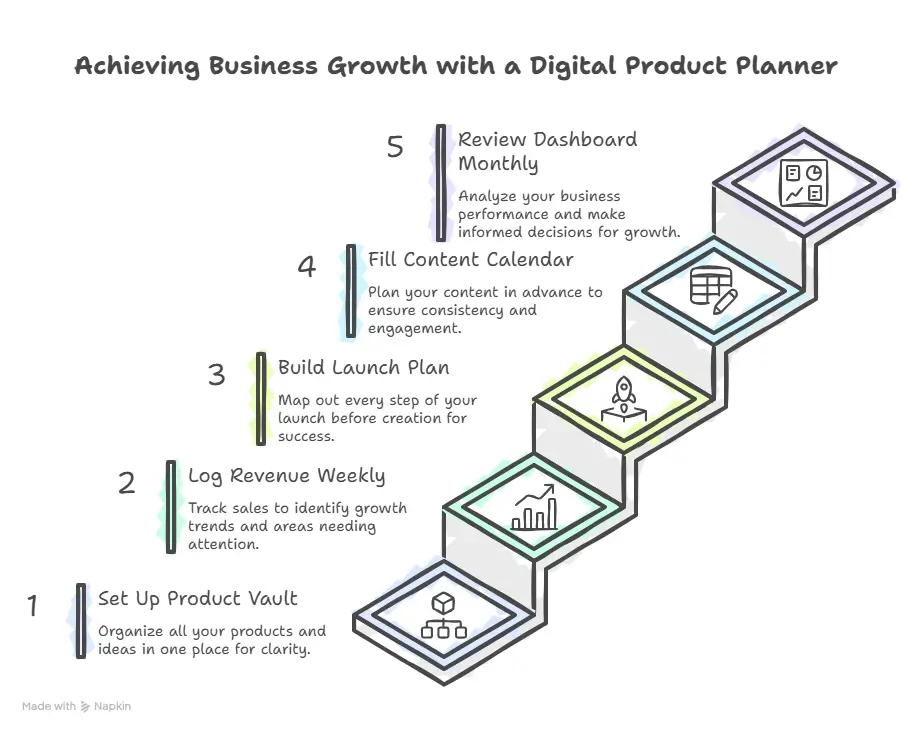
Having a planner is one thing. Using it consistently is what actually moves the needle. Here’s a simple weekly and monthly routine that works.
Step 1: Set up your Product Vault first.
Add every product you have, including ideas still in your head. Seeing everything in one place immediately gives you clarity on what to prioritize.
Step 2: Log your revenue every week.
It takes five minutes. Open the Revenue Tracker and add every sale from the past seven days. Over time, this data tells you which products are growing and which need attention. This habit alone is worth the price of any planner.
Step 3: Build your next launch plan before you start creating.
Use the Launch Plan Hub to map out every step before you open Canva or write a single word. A planned launch outperforms a rushed one every time. For more on this, see our full guide on how to sell digital products in 2026.
Step 4: Fill your Content Calendar two weeks ahead.
Batch your content planning into one session per week. Decide what you’ll post on Instagram, TikTok, and email, and enter it into the calendar. Consistency compounds.
Step 5: Review your Dashboard on the first of every month.
Look at your income, expenses, profit margin, and goal progress. Make one decision based on what you see. That one decision, made consistently, is what grows a business.
You can also use the planner to identify products that could be bundled together for higher sales or packaged in ways that increase your average order value.
According to Whop’s guide on creating and selling digital planners, the creators who grow the fastest are the ones who treat their business like a business from the start, not after they hit a wall. This planner gives you the structure to do that.
Is a $12 Digital Product Business Planner Worth It?
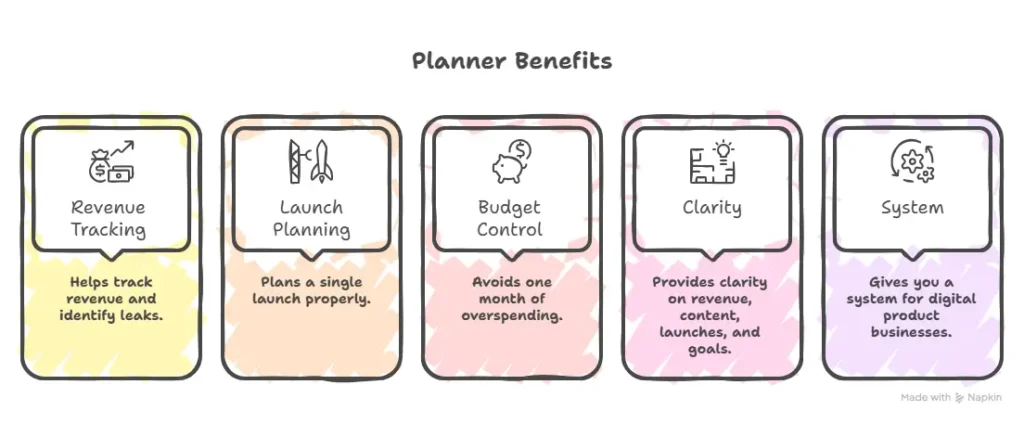
Yes. A $12 planner that helps you track your revenue, plan a single launch properly, and avoid one month of overspending will pay for itself many times over. The real question isn’t whether $12 is worth it. It’s what one missed launch, one untracked revenue leak, or one more month of operating without clarity is costing you.
Think about it this way. If you have a $27 product and you sell just one extra copy because your launch was planned properly, you’ve already made more than double your investment. If your budget tracker catches one overspend, it’s paid for itself again.
The Money AI Pro Digital Product Business Planner is on sale right now for $12 (originally $27). That’s lifetime access to an 11-section Notion workspace with no subscriptions, no recurring fees, and no complicated setup.
Most planners are either too basic (a pretty PDF you fill in once) or too complicated (a 47-tab spreadsheet that nobody actually uses). This one is different. It’s built specifically for digital sellers, pre-filled with realistic sample data, and covers the full business cycle from idea to launch to profit analysis.
If you want to take your digital product income seriously and generate real passive income with digital products, having a proper business system is not optional. It’s the starting point.
The Bottom Line
Here are three things worth remembering.
First, most digital product businesses fail from lack of system, not lack of effort. You can work hard and still go nowhere without the right structure.
Second, a dedicated digital product business planner gives you clarity on revenue, content, launches, and goals. That clarity is what turns scattered activity into real business growth.
Third, you don’t need more hustle. You need a better system.
The Money AI Pro Digital Product Business Planner gives you that system for $12. Instant download, lifetime access, and a free Notion account is all you need to get started.
Stop running your business on vibes. Get the Digital Product Business Planner today and start running it like a CEO.
Frequently Asked Questions
What is a digital product business planner?
A digital product business planner is a structured template or workspace designed to help digital product sellers manage their entire business in one place. It typically includes sections for revenue tracking, launch planning, content scheduling, budget management, and goal setting. It’s different from a generic planner because it’s built around the specific workflow of creating and selling digital products.
How is the Money AI Pro planner different from a regular planner?
Most planners are either too simple (a static PDF) or too complex (a spreadsheet that requires setup expertise). The Money AI Pro Digital Product Business Planner is a Notion workspace with 11 purpose-built sections for digital sellers. It comes pre-filled with sample data so you can see exactly how it works before entering your own numbers. It covers the full business cycle from product idea to launch to monthly profit analysis, all in one place.
Do I need to know Notion to use this planner?
No. The planner includes a built-in 5-step beginner guide that walks you through setup in under 10 minutes. A free Notion account is all you need. You duplicate the template into your own workspace with one click and start adding your data right away. No technical knowledge is required.
What types of digital products is this planner best for?
This planner works for any type of digital product business, including ebooks, templates, printables, courses, Canva designs, digital planners, coaching programs, and membership content. Whether you sell on Etsy, Gumroad, Payhip, or your own website, the planner’s revenue tracker, launch hub, and content calendar adapt to your setup. According to Printful’s research, digital planners and templates are among the most profitable digital product categories, making a dedicated planning system especially valuable in this space.
Can I use the Digital Product Business Planner even if I haven’t launched a product yet?
Yes,

Fantastic read! Nano Banana at https://nanobanana2.love/ is one of my go-to resources for AI tools and creativity.
Very informative! Pixwit AI is amazing for AI image generation, and Free Video Generator offers great free video capabilities.
This is so true! I’ve been feeling exactly that way – busy all the time but unsure if I’m actually making progress. The 95% failure rate is scary, but it makes sense that a solid system is key. A planner that helps track revenue, plan launches, and manage content sounds like exactly what’s needed to turn passion into a sustainable business. Might have to check out the Money AI Pro Digital Product Business Planner! Thanks for sharing this insightful post.
Appreciate that—and you nailed it: being busy isn’t the same as making progress. The planner you mentioned sounds like a great fit if it helps you track what actually drives revenue, not just activity. The real shift happens when you stop treating planning as “one more task” and start using it as your filter for what to say no to. Hope it gives you that clarity—come back and let us know how it goes!
Thank you—and I really appreciate you saying that! 🙏
That “busy all the time but unsure if I’m actually making progress” feeling is *so* common among digital creators, and honestly, it’s one of the biggest reasons good products go unnoticed. You’re putting in the work, but without a clear way to measure it, progress stays invisible.
What you said about turning passion into a sustainable business is exactly the heart of it. Passion gets you started—but systems keep you going. And when you’ve got revenue tracking, launch planning, and content management all in one place, it stops being a guessing game and starts being a real strategy.
Hope the planner brings you that clarity—and if you grab it and have any questions, I’m always here to help. Would love to hear how it works for you!
Appreciate you stopping by and sharing your thoughts! 🙌
This is so true! I’ve been selling digital products for a while now and feel the struggle of being constantly busy but not really knowing what’s working. The point about 95% of digital products failing due to lack of system really hit home. It’s easy to get caught up in the creative side but neglecting the business aspect. A planner to track everything sounds like exactly what I need to stop running on hope and start using data. Great breakdown of why a good planner matters!
That’s exactly it—creativity without tracking is just guessing. You don’t need more ideas; you need a simple way to see what actually moves the needle. Even a basic spreadsheet tracking inputs (what you posted, where, when) and outputs (sales, clicks, replies) will turn hope into a repeatable process. A planner works, but the real win is committing to a weekly 10-minute review.
Thank you—and honestly, that means even more coming from someone who’s already in the trenches selling digital products. 🙌
You nailed it: being *busy* and being *effective* are two very different things—and it’s so easy to confuse the two when you’re deep in the creative side. But without a system to pull back the curtain and show you what’s actually driving results, you’re left running on hope.
The planner is really just a tool to help you ask the right questions:
– What actually sold?
– What did I promote?
– What did it cost me?
– What should I do differently next time?
Once you start tracking, the guesswork fades and clarity takes over.
Really appreciate you sharing your experience—and if you do grab the planner, I’d genuinely love to hear how it lands for you. You’re already ahead of the game by recognizing what’s missing. 🚀
This is exactly what I needed to hear! I’ve been feeling overwhelmed trying to juggle creating, marketing, and tracking everything. The idea of a planner that helps manage revenue, launches, content, and budget in one place is really appealing. Knowing that 95% of digital products fail due to lack of system is a wake-up call. For $12, the Money AI Pro Digital Product Business Planner sounds like a worthwhile investment to bring some order to the chaos and actually track what’s working. Thanks for the insightful post!
Love that you caught the real takeaway—it’s not about working harder, but replacing chaos with a simple system. At $12, if it helps you stop guessing and spot even one underperforming area to fix, it pays for itself instantly. Hope it brings you clarity, not just organization. Let us know which page you reach for first!
This is so true! I’ve been feeling exactly this way. So much time spent “doing,” but at the end of the month, I’m left wondering where all the effort went. The 95% failure rate is scary, but it makes sense. I definitely need a system to track everything. Just knowing what a good planner *should* include is helpful. I’m going to check out the Money AI Pro Digital Product Business Planner. Thanks for sharing!
Thank you—this means a lot! You just described exactly why I created the planner. That feeling of being busy but not knowing where your effort went is miserable. The 95% stat is scary, but the good news is you don’t need more talent or more hours—just a simple system to track what actually works. So glad the post helped, and yes, the Money AI Pro planner is designed to do exactly that. Let me know if you have any questions once you check it out! 🙌
Thank you—that means so much! 🙏
That “so much time spent doing, but where did it all go?” feeling is exactly why I created this planner. You’re not alone in that, and the fact that you’re recognizing it is already the first step toward changing it.
The 95% stat *is* scary, but here’s the flip side: it means the fix is totally within your control. It’s not about having a better product or more talent—it’s about having a simple system to track what’s working so you can stop guessing and start growing.
I’d love to hear how the planner works for you once you dive in. And if you ever have questions or want to tweak it to fit your workflow, just reach out—I’m always happy to help.
You’ve got this! 🚀
This really hit home! The statistic about 95% of digital products failing because of a lack of system, not product, is a stark reminder. It’s so easy to get caught up in the creative side of things and forget the business engine powering it, right? I’ve definitely felt that end-of-month confusion, wondering where the profit actually went despite all the daily hustle.
It sounds like this planner is exactly what’s needed to move from just “playing the game” to actually building a strategic business. Speaking of games and strategy, I’ve found that even in something as seemingly simple as online games, having a good way to track progress and understand what’s working (like different strategies in a game) can make a huge difference. You can check out some fun ones at Crossy Road Online; it’s a great place to just dive in and play without any fuss. It’s a different kind of system, but the principle of understanding your actions and outcomes is similar!
This really hits home about the “running on energy and hope, not data” part. I totally get that feeling of putting in tons of work creating and promoting, only to feel like I’m just guessing what’s effective for my coloring page business. It’s so easy to get caught up in the creative flow without a solid business structure.
The article’s point about systems being the missing link for most digital product ventures makes a lot of sense, especially when you look at the huge market growth projected. It’s not just about having a great product, but about having the engine to drive it. This planner sounds like it could really help bring clarity to that. It’s making me think about how I could apply a similar structured approach to planning out new coloring page themes and promotions, rather than just reacting.
Speaking of creative tools, I’ve found that having a dedicated resource for different creative projects can make a big difference. For my coloring pages, I’ve been exploring different ways to generate and organize them, and I came across [ai colorpage](https://inkpages.pro/) which has been surprisingly helpful for turning ideas into printable sheets quickly.
Do you find that having a dedicated system for planning launches and tracking performance is what separates the truly successful digital product creators?
Absolutely—and you just hit on the exact shift that separates creators who grow from those who stall. It’s not about working harder or having better ideas; it’s about having a system that tells you what to *keep doing* and what to *stop doing*.
For your coloring page business, that structure could be as simple as:
– Tracking which themes sell best
– Noting when promotions convert
– Planning launch cycles around buying patterns
That way, you’re not reacting to every whim—you’re strategically testing, learning, and repeating what works.
To answer your question: yes, 100%. The successful ones don’t just create—they *review*. They look at the numbers, adjust, and treat their business like a science experiment, not a hobby. A launch without tracking is just a gamble. A launch with tracking is data you can use next time.
And thanks for mentioning Inkpages—those kinds of tools are exactly what I mean by “having an engine.” Speed from idea to execution, without losing quality, is a superpower.
Curious—what’s one metric you’d start tracking this month to get more clarity in your coloring page business?
The statistic about 95% of digital products failing due to a lack of system really hit home. It’s so easy to get caught up in the creation and promotion, especially when you’re passionate about what you’re building, but then realize you don’t actually know if it’s profitable or sustainable. That feeling of “running on energy and hope” is all too familiar. I found a similar perspective on Cursor Camp Guide that complements this well, emphasizing the need for structured processes. It’s a good reminder that even the most brilliant product needs a solid business foundation to thrive, especially with the market growing so rapidly.
The statistic about 95% of digital products failing due to a lack of system, not product quality, really hit home. It perfectly articulates that feeling of being busy but not necessarily effective. I’ve been there, pouring energy into content and promotion without a clear understanding of what’s actually driving revenue. It’s easy to get caught up in the day-to-day and forget the bigger picture strategy. Having a structured planner seems crucial for turning that passion into a sustainable business. I found a similar perspective on Plants vs Brainrots Hub that complements this well, emphasizing the need for organized resources and data tracking in any creative venture. For anyone struggling with that “running on vibes” feeling, a tool like this could be a game-changer.
Thank you—you completely captured the heart of it. That “running on vibes” feeling is exactly what I wanted to call out, because so many talented creators burn out not from lack of effort, but from lack of visibility into what’s actually working.
You’re so right that it’s not about the product quality—most people create great stuff. It’s the missing feedback loop between effort and revenue that sinks them. A planner won’t magically fix everything, but it forces you to pause, review, and decide what to keep, kill, or tweak. That alone changes the game.
Really appreciate you sharing the Plants vs Brainrots Hub perspective too—always love when different corners of the creator space land on the same truth: track it or guess it. Thanks for adding to the conversation. 🙌
The statistic about 95% of digital products failing is a stark reminder that passion alone doesn’t translate to sustainable business. I’ve definitely felt that end-of-month confusion about what’s actually moving the needle, especially when I’m juggling content creation and promotion. It’s easy to get caught up in the daily grind, much like how sometimes I get lost in playing a few rounds of Crossy Road Online and forget about time. The idea of a structured planner, an actual “operating system” as you put it, makes so much sense for bringing order to that chaos, especially when the market opportunity is clearly so massive. I’m curious to see how the Money AI Pro planner specifically addresses tracking revenue and planning those crucial launches.
This really hits home. I’m always struck by that statistic about 95% of digital products failing – it makes so much sense when you think about how many people are just “winging it” with their online businesses. My own experience with AI Image Extender taught me the same lesson: you can have a cool tool, but without a clear system for how it fits into a larger business strategy, it’s just not going to gain traction. The idea of a planner acting as an “operating system” for a digital product business is spot on. It’s like needing a good workflow for image editing; you can’t just randomly adjust pixels and expect a professional result. You need a process. It makes me wonder how many digital product creators are missing out on growth simply because they haven’t mapped out their operations.
That AI Image Extender example is such a great parallel—because you’re right, you can have the most powerful tool in the world, but without a clear workflow and strategy for how it fits into the bigger picture, it’s just a cool feature without traction. Editing images without a process is like randomly adjusting pixels and hoping for a professional result. It might work once in a while, but it’s not repeatable or scalable.
And that’s exactly it—so many creators miss out on growth not because their product isn’t good, but because they’ve never mapped out their operations. They’re building without a blueprint, creating without a system, and promoting without tracking.
The planner really is that operating system—it helps you see the full picture so you can make intentional decisions instead of reactive ones.
Appreciate you sharing that insight—and love the work you’re doing with AI Image Extender! 🙌
The statistic about 95% of digital products not succeeding really hits home. It perfectly encapsulates that feeling of being busy constantly, but without a clear understanding of what’s actually driving revenue or growth. I’ve definitely been there, relying more on “vibes” and hope than concrete data. It makes sense that a lack of a systematic approach is the culprit, rather than the product itself. It’s like trying to explore a vast, unknown world without a map – you might stumble upon something amazing, but it’s far more efficient to have a guide. I wrote about a similar approach to systematic planning in game development on Subnautica 2 Map and found that having clear objectives and tracking progress was crucial. This planner sounds like it provides that essential framework for digital product creators.
It’s so true that most digital product businesses fail due to a lack of systems, not a lack of product quality. I’ve seen this play out countless times in creative fields. It’s easy to get caught up in the creation and promotion, but without a clear way to track what’s actually generating revenue and what’s just a time sink, you’re essentially flying blind. I wrote about a similar approach to systematic planning in creative ventures on AI Interior Lab and found that even simple tracking mechanisms made a huge difference in understanding where to focus efforts. The statistic about 95% of products not succeeding is stark, but it really highlights the importance of that operational backbone you’re describing.
You nailed it—flying blind is exactly the right phrase. So many talented creators pour their hearts into their work, only to burn out because they never had a clear view of what was actually moving the needle. That operational backbone isn’t the “boring” part—it’s the *sustainable* part.
I love that you’ve seen this play out across creative fields and even applied it in your own work at AI Interior Lab. That kind of cross-industry recognition is powerful—it proves that whether you’re designing interiors, creating digital art, or selling planners, the principles remain the same: *track, review, adjust, repeat.*
And yes—that 95% stat is jarring. But honestly, I see it as good news. It means the gap between struggling and succeeding isn’t talent or product quality—it’s simply a matter of putting a simple system in place. And that’s something anyone can do.
Thanks for bringing your perspective and for sharing that even simple tracking has made a huge difference for you. It’s a reminder that done beats perfect, and consistency beats intensity. 🙌
Love that you brought in your experience from AI Interior Lab—because it’s such a great example of how tracking and structure apply across creative fields. Whether you’re designing interiors or launching digital products, the principle is the same: without visibility into what’s actually driving results, you’re just throwing effort into the wind and hoping some of it lands.
You’re absolutely right that even simple tracking mechanisms can make a huge difference. It doesn’t have to be complex—it just has to exist. A few key metrics tracked consistently will show you where to focus and where to pull back.
The 95% stat is stark, but like you said, it really highlights the importance of that operational backbone. Systems aren’t the ‘boring’ part of business—they’re the foundation that makes everything else possible.
Appreciate you sharing your perspective! 🙌
This really hits home about the “running on energy and hope, not data” part. It’s so easy to get caught up in the daily grind of creating and posting, only to realize you have no real idea if any of it is moving the needle. The 95% failure rate statistic is brutal but probably accurate for many solopreneurs.
It’s funny, in the gaming world, specifically with something like Blox Fruits, there’s a similar need for solid data. Trying to figure out trades or the value of in-game items without a reliable calculator or system is just a recipe for losing out. I’ve found that having a tool like the Blox Fruits Calculator (https://bloxfruitstrades.com/) really helps cut through the noise and make informed decisions, which feels like the same principle this planner offers for digital products.
Do you think the biggest hurdle for creators is admitting they *need* a system, or actually implementing one?
That statistic about 95% of digital products failing due to a lack of system, rather than product quality, really hit home. It’s so easy to get caught up in the daily grind of content creation and promotion, and then at the end of the month, you’re left wondering where the revenue actually went. I’ve experienced that feeling of just operating on hope and energy more times than I care to admit. It sounds like this planner provides that much-needed operational framework. I wrote about a similar approach to systemizing service-based businesses on mobile detailing near me and found that having clear metrics and planning tools was crucial for growth, not just staying afloat. It’s great to see tools like this specifically for digital products.
The statistic that 95% of digital products don’t succeed due to a lack of system, rather than a bad product, really resonates. It’s so easy to get caught up in the creation and promotion hustle, thinking that’s enough. I’ve definitely experienced that end-of-month confusion about what’s actually profitable! It’s like running a physical service business, where tracking your time and expenses is crucial. I wrote about a similar approach on mobile detailing near me and found that even a simple system for tracking was a game-changer for understanding profitability and planning future growth. This planner sounds like it bridges that exact gap for digital product creators.
That’s such a powerful parallel—because you’re absolutely right, whether you’re running a mobile detailing business or selling digital products, the fundamentals are the same: *if you don’t track it, you can’t improve it.*
In both cases, it’s tempting to focus all your energy on the “doing”—creating the product, polishing the service, posting the content—while the backend (tracking, analyzing, adjusting) gets pushed aside. But that backend is what separates sustainable growth from spinning your wheels.
The fact that you saw that shift in your own service business and recognized the same pattern here tells me you already have the mindset. You just need the right system applied to the digital space.
And you’re spot on—this planner is designed to bridge exactly that gap. Not to add more busywork, but to give digital creators the same clarity that a time-tracking or expense-logging system gives a service pro. Same principle, different toolbox.
Thanks for bringing that real-world comparison—it’s a great reminder that good business hygiene applies everywhere. 🙌
This really hit home about the “running on energy and hope, not data” feeling. I’ve definitely been there, staring at my spreadsheets trying to figure out what actually moved the needle. It’s so easy to get caught up in the daily grind of creating and promoting, only to realize you’re just treading water.
The point about 95% of digital products failing due to a lack of system, not product, is a powerful reminder. It sounds like this planner is a solid way to build that much-needed infrastructure. It reminds me a bit of how even in something as simple as a game, having clear rules and a way to track progress makes all the difference. Speaking of tracking progress and daily challenges, I’ve been diving into Wordleos lately – it’s a fun way to keep the brain sharp with daily puzzles and see how you stack up on the leaderboard. It’s a small thing, but that consistent engagement and tracking feels surprisingly powerful.
That’s such a great connection—tracking progress in a daily puzzle game and tracking progress in business really do share the same core principle: *consistent small actions, measured over time, reveal what works.*
You’re absolutely right that without clear rules and a way to measure, you’re just guessing. Whether it’s Wordleos or a business planner, the magic isn’t in the tool itself—it’s in the *habit* of showing up, logging the data, and letting it guide your next move.
That staring-at-spreadsheets feeling you mentioned? That’s exactly what a good system prevents—because instead of trying to decode chaos after the fact, you’re building clarity *as you go*. One metric tracked daily beats a dozen metrics guessed monthly.
Thanks for sharing that perspective—and honestly, comparing business structure to game mechanics is a brilliant way to think about it. Keep sharpening that brain with puzzles, and let the same tracking mindset guide your business wins too. 🙌
This really hits home about the “running on energy and hope, not data” part. I’ve definitely felt that pull, especially when I’m deep in the creative process for something like designing a new room on roomflip.pro. You can get so focused on the visual outcome that it’s easy to forget the underlying business strategy – tracking what’s actually bringing in clients or what marketing efforts are paying off. It’s like knowing how to design a stunning space but not knowing if that design actually leads to a booking! The idea of a planner providing that operating system for a digital product business makes so much sense. It’s about building that sustainable structure, just like a solid business plan is crucial for any creative venture.
That’s such a perfect analogy—designing a stunning room without knowing if it leads to a booking is *exactly* the same as creating a beautiful digital product without knowing if it sells. The visual is just the starting point; the real magic is in the data behind it.
You’re spot on that structure isn’t the enemy of creativity—it’s what *protects* it. When you have a system tracking what works, you free up mental energy to focus on what you actually enjoy: the creative work itself.
For your room design business, that might look like:
– Tracking which room styles get the most inquiries
– Noting which marketing channels bring in your ideal clients
– Measuring how long it takes from first contact to booking
That way, you’re not just designing beautiful spaces—you’re designing a business that consistently fills them.
Thanks for bringing that real-world perspective. It’s a great reminder that the same principles apply whether you’re selling planners, printable art, or room design services: track it, learn from it, and let the data guide your next creative move. 🙌
That roomflip.pro comparison is so good—because you’re absolutely right. You can design a stunning, magazine-worthy space, but if it doesn’t lead to bookings or client inquiries, it’s just a beautiful image with no business impact. The creative work is essential, but without the strategy to back it up, it’s hard to build something sustainable.
That’s exactly what a planner does—it helps you connect the dots between your creative efforts and the business outcomes they’re supposed to drive. It’s not about stifling creativity; it’s about giving it a structure that ensures it actually pays off.
Appreciate you sharing that perspective—and love the work you’re doing at roomflip.pro! 🙌
This is such a crucial read for any digital product creator! It perfectly articulates why so many of us feel stuck, even with great products. The idea that 95% fail due to lack of system, not product quality, is a wake-up call. I especially appreciate the focus on turning “energy and hope” into data-driven decisions. Understanding your real profit and having a clear launch plan, perhaps aided by tools like a square feet calculator for specific financial analyses, truly transforms a hobby into a business. Thanks for highlighting the importance of a true operating system!
Really glad this resonated with you—and you nailed the core takeaway: it’s not about the product, it’s about the engine behind it.
That shift from “energy and hope” to “data and decisions” is exactly what turns a side project into a real business. You’re absolutely right that knowing your numbers—profit, costs, breakeven points—is non-negotiable. Even a simple habit of tracking revenue per launch or cost per lead can completely change how you plan.
And I love that you brought in the idea of using specific tools for financial clarity. Whether it’s a square feet calculator for cost analysis or a simple spreadsheet for margins, the tool doesn’t matter as much as the *habit* of checking the numbers before making decisions.
Thanks for adding that layer to the conversation—it’s a reminder that a “business operating system” isn’t just about content and launches. It’s about money in, money out, and making informed choices every step of the way. 🙌
Thank you—that means a lot! You’re absolutely right that understanding your real profit is the foundation of everything. Without that clarity, it’s easy to mistake activity for progress. And I love the square feet calculator comparison—because just like you need precise measurements to plan a space, you need precise numbers to plan a sustainable business.
That shift from ‘energy and hope’ to data-driven decisions isn’t just helpful—it’s what turns a passion project into a real, thriving business. And a solid operating system is what makes that shift possible.
Really appreciate you sharing your perspective. Glad the post resonated! 🙌
The statistic that 95% of digital products fail, not because of the product itself but due to a lack of system, really hit home. It makes so much sense when you think about it; passion and a great idea are essential, but without structure, those efforts can easily get lost in the day-to-day hustle. I’ve been trying to organize my own digital product efforts, and finding a centralized way to track revenue and plan launches has been a game-changer. I wrote about a similar approach to business planning on MW4 Hub and found that having clear metrics makes all the difference in knowing what’s actually working versus what’s just busywork. It’s encouraging to see tools specifically designed to tackle this common pitfall in the digital product space.
That statistic about 95% of digital products failing is quite sobering, but it makes perfect sense when you consider how many people jump into selling online without a solid business framework. It’s easy to get caught up in the creation and promotion, thinking that’s enough. The article’s point about a lack of systems being the real culprit resonates with me. I’ve seen it in other areas too; for instance, in the energy sector, success hinges on robust operational systems, not just having good technology. Having a dedicated planner to track revenue, plan launches, and manage content seems crucial for avoiding that “running on energy and hope” trap. I wrote about a similar approach to operational efficiency on Spire ESS and found that having clear, trackable metrics makes all the difference. It’s about moving from guesswork to informed decisions.
The statistic about 95% of digital products failing due to a lack of system, not a bad product, really hit home. It’s so easy to get caught up in the daily grind of content creation and promotion and forget to step back and look at the bigger picture. I’ve definitely been there, pouring energy into things without a clear way to measure their impact. Having a centralized planner to track revenue and plan launches, as you described, would be a game-changer for avoiding that “running on vibes” feeling. I wrote about a similar approach to structured planning in creative fields on Maze Craze Online and found that consistent, organized tracking is crucial for identifying what truly works. It sounds like this planner offers a much-needed operating system for digital product businesses.
The statistic that 95% of digital products don’t succeed due to a lack of system, rather than product quality, really struck a chord. It makes so much sense – passion and a great idea are crucial, but without a structured way to track, plan, and budget, it’s easy to get lost in the day-to-day chaos. I remember when I was first setting up my own little project, essentially translating ideas into a functional format, and I found myself just winging it for months. I wrote about a similar approach to breaking down complex processes on MorseTranslator and found that having a clear framework, even for small tasks, made a huge difference. It’s easy to get overwhelmed by the sheer volume of work, so having a dedicated planner to consolidate everything seems like a game-changer for anyone serious about making their digital product venture sustainable.
Love that you brought in the MorseTranslator example—because it’s such a great reminder that even something as technical and precise as translation benefits from a clear framework. You wouldn’t just guess at Morse code patterns and hope they come out right; you’d follow a structured system to ensure accuracy and consistency. Same goes for digital products: without a clear system to track, plan, and budget, you’re essentially guessing your way through the chaos.
And you’re so right—that overwhelmed feeling comes from having too many moving parts and no single place to manage them. A planner consolidates everything so you can see the full picture and make decisions with confidence, not just hope.
Sounds like you already understand the power of structure with your approach to MorseTranslator. Hope this planner brings that same clarity to your digital product journey! 🙌
This article perfectly nails why so many digital products struggle – it’s not the product, but the lack of a solid system. The idea of a Digital Product Business Planner as an “operating system” for your business is brilliant. It makes total sense that tracking revenue, planning launches, and managing content effectively can be the game-changer, especially for just $12. It’s a great reminder that data and a plan beat pure energy and hope every time. Knowing your metrics, much like understanding a space with a square feet calculator, is crucial for growth!
Love that you brought in the square feet calculator comparison—because it’s so true! You wouldn’t try to design a room or estimate materials without knowing the exact dimensions. That precision is what turns a rough idea into a workable plan. Same with digital products: knowing your numbers—revenue per launch, cost per lead, profit margins—gives you the exact measurements you need to scale confidently.
And you’re absolutely right—data and a plan beat energy and hope every time. Energy fades. Hope is fleeting. But a solid system? That keeps you grounded and moving forward, even when things get busy.
Appreciate the kind words—and yes, at $12, it’s a small investment for the kind of clarity that can completely shift how you run your business. 🙌
It’s so true that many digital product businesses falter due to a lack of system, not a lack of product quality. I’ve seen it myself – people pour so much energy into creating something great, but without a clear way to track progress, plan launches, or manage finances, it’s easy to get lost in the day-to-day. The statistic about 95% of products not succeeding really hits home. It sounds like this Money AI Pro Digital Product Business Planner aims to provide that crucial operational framework. I wrote about a similar approach to business planning for service-based businesses on mobile detailing near me and found that even a simple, consistent system makes a massive difference in staying on track and actually seeing growth. It’s about moving from “hope and vibes” to actionable strategy.
I’ve been thinking a lot about this “system behind the business” idea. It resonates so much because, in my own work tracking down every hidden item and quest for KCD2Quest, having a clear system is absolutely crucial. Without it, I’d just be wandering around aimlessly. It sounds like the digital product world is much the same, and that 95% failure rate really highlights the need for more than just a great idea. It’s easy to get caught up in the creative side, but without a structured way to manage finances and launches, it’s like trying to forge a legendary sword without a proper forge and tools. This planner seems like it could be that essential framework.
The statistic that 95% of digital products don’t succeed because of a lack of system, rather than a bad product, really hit home. It’s so easy to get caught up in the creative side – designing, refining, and then wishing for sales – without building that crucial operational framework. I’ve definitely felt that “running on energy and hope” feeling myself when launching new creative ventures. It makes me think about how even for something as niche as AI tattoo design, having a clear plan for marketing, pricing, and tracking customer feedback is essential for growth, not just a nice-to-have. It’s about turning inspiration into a sustainable business. I wrote about a similar approach to systematizing creative businesses on InkBolt and found that even small steps in planning can make a huge difference in clarity and results.
The point about 95% of digital products failing not due to the product itself, but a lack of system, really resonates. I’ve seen so many creators pour their hearts into amazing offerings, only to see them fizzle out because they’re essentially flying blind. It’s easy to get caught up in the creation and promotion hamster wheel, and then wonder where the actual revenue is going. Having a centralized place to track everything, as this planner seems to offer, feels like the missing piece for so many. I actually wrote about a similar approach to systematic tracking on lily lovebraids and found that even simple spreadsheet tracking made a huge difference in understanding what was truly working. It’s definitely more about the business infrastructure than just the product’s inherent quality.
The statistic that 95% of digital products fail due to a lack of system, rather than product quality, really hit home. It makes sense when you think about how many people jump into selling without a clear strategy for tracking revenue or planning future launches. I’ve seen so many creative individuals get bogged down in the day-to-day execution, losing sight of the bigger business picture. It’s like building a beautiful house without blueprints. Having a centralized planner, as you describe, would be invaluable for staying organized and making data-driven decisions. I wrote about a similar approach to streamlining workflows on VirtualStagingAI and found that having a structured system, even for something as visual as real estate staging, makes a huge difference in efficiency and success.
It’s so true that passion alone doesn’t cut it in the digital product space. I’ve seen so many creators with amazing ideas get bogged down because they’re just winging it day-to-day. The statistic about 95% of products not succeeding really hits home, and the article’s point about a lack of system being the culprit makes perfect sense. It’s like trying to build a complex structure without a blueprint! I’ve been working on organizing my own digital product tracking, and having a centralized place for revenue, content planning, and budget management feels crucial. I wrote about a similar approach for tracking rare in-game items on Pokopia Crystals and found that consistent data collection makes a massive difference in identifying what’s actually performing well. This planner sounds like it could be a game-changer for moving beyond just “vibes” and into a data-driven business.
Love that you brought in the Pokopia Crystals example—because it’s such a perfect parallel! Tracking rare in-game items, monitoring their value, and identifying which ones are actually worth farming or trading requires consistent data collection and a clear system. Without that, you’re just guessing what’s valuable and hoping it pays off. Same goes for digital products: you can have a great idea, but without a system to track revenue, content performance, and budget, you’re essentially playing a guessing game with your business.
That shift from ‘vibes’ to data-driven decisions is exactly what separates sustainable growth from burnout. And it sounds like you already understand that with your approach to Pokopia Crystals.
Hope this planner brings that same clarity to your digital product work! 🙌
The point about 95% of digital products failing due to a lack of systems, rather than product quality, really resonates. It’s easy to get caught up in the creation and promotion, thinking that’s the whole game. I’ve definitely felt that “running on energy and hope” feeling more times than I’d like to admit when managing my Pokopia Crystals tracker. It’s so easy to lose track of what’s actually profitable or what marketing efforts are yielding results without a structured way to see it all. I wrote about a similar approach to tracking resources for events like Sableye’s Gem Hunt on Pokopia Crystals and found that having a dedicated system, even for something seemingly simple, makes a huge difference in efficiency and understanding progress. This planner sounds like it brings that level of clarity to the entire digital product business.
Love that you brought in the Pokopia Crystals tracker—because it’s such a great example of how even a focused, niche system can transform your understanding of progress. When you’re tracking something as specific as event resources or gem hunt progress, you start seeing patterns: what’s working, what’s falling short, and where to focus next. That same clarity is exactly what a business planner brings to the bigger picture.
And you’re so right—it’s easy to get caught up in the creation and promotion whirlwind and confuse activity with progress. But without a structured way to see what’s actually profitable, you’re left guessing. A system takes the guesswork out and gives you a clear view of what’s moving the needle.
Sounds like you’re already applying that structured mindset with Pokopia Crystals. Hope this planner helps bring that same level of clarity to your digital product business! 🙌
The statistic that 95% of digital products don’t succeed because of a lack of system, not product quality, really resonates. It’s so easy to get caught up in the creation and promotion, thinking that’s where the effort lies. But you’re right, without a clear way to track revenue, plan launches, and manage content, it’s just spinning wheels. I’ve seen this with my own side projects; without a structured approach, it’s hard to see what’s truly moving the needle. It makes me think about how even for something as seemingly simple as a passport photo, having a clear process and specifications is crucial for success. I wrote about a similar approach on AnyPassportPhoto and found that defining the “system” upfront saves so much time and reduces errors later. This planner sounds like it provides that much-needed operating system for digital product sellers.
It’s really striking how many digital product businesses fail not because of a lack of good ideas or products, but due to a missing operational system. Your point about running on “energy and hope, not data” is spot on. I’ve seen so many creators get caught in that trap, constantly creating but never really understanding their profitability or having a clear roadmap for growth. It makes me think about how crucial it is to have a structured approach, even for something as seemingly straightforward as selling digital goods. For my own work, ensuring that every photo meets precise specifications is paramount, and I wrote about a similar approach to systemizing requirements on AnyPassportPhoto and found that consistent adherence to a defined process is key to success. Having a dedicated planner, like the Money AI Pro one you described, seems like the perfect tool to move from reactive chaos to proactive business building.
That point about 95% of digital products failing not due to the product itself, but the lack of a system, really resonates. It’s so easy to get caught up in the daily grind of creating and promoting, and then at the end of the month, you’re left wondering where the actual profit went. I’ve been there, feeling like I’m just winging it. Having a dedicated planner, like the one you’ve described, seems crucial for moving beyond just passion and into a sustainable business model. It’s like having a reliable tuning setup for your car; without it, you’re just driving blind. I wrote about a similar approach to structured planning on Horizon 6 Guide and found that consistent tracking really helps identify what’s actually driving success.
That tuning setup analogy is spot on—you can have a powerful car, but without a reliable tune, you’re just guessing at performance, fuel efficiency, and handling. You might get lucky, but you’re far more likely to end up with uneven wear or a breakdown. Same with digital products: you can pour effort into creation and promotion, but without a system to track what’s actually driving profit, you’re essentially driving blind.
I love that you’re already experiencing the impact of consistent tracking with Horizon 6 Guide—because that’s exactly the shift: moving from feeling like you’re winging it to actually knowing what’s working and why. And once you have that clarity, you stop guessing and start making intentional moves.
Hope this planner brings even more of that structured clarity to your digital product journey! 🙌
The point about 95% of digital products failing not due to the product itself but a lack of system really hit home. It’s so easy to get caught up in the creative flow and marketing buzz, only to realize later that you’ve been operating on “energy and hope” rather than solid data. I’ve definitely been there. Having a central place to track revenue, plan launches, and manage content sounds like the exact antidote to that chaos. It’s fascinating how the global digital goods market is exploding, yet so many creators are missing out because they lack that foundational operating system. I wrote about a similar approach to systematizing creative output on AI Rap Creator and found that structure is key to turning passion into profit. This planner seems like it could be a game-changer for anyone serious about scaling their digital product business.
“Love that—’energy and hope’ is a dangerous fuel, because it feels great right up until you realize you’re running on empty with nothing to show for it. And you’re absolutely right: the market is exploding, but without the infrastructure to catch that momentum, most creators just get swept up in the noise.
That shift from creative flow to solid data is exactly what turns a passion project into a real business. And it sounds like you’ve already seen that with your work at AI Rap Creator—applying structure to something creative and turning it into something repeatable and profitable.
Appreciate you sharing that—and yes, a planner is that game-changer because it gives you the visibility to actually know what’s working so you can keep doing more of it. 🙌”
It’s so true that many digital product creators get caught up in the daily grind of content creation and promotion without a clear system for tracking what’s actually effective. I’ve definitely been there, feeling busy but uncertain about profitability. The statistic about 95% of digital products not succeeding really highlights the need for something more structured than just “vibes.”
I’ve found that having a dedicated space to log sales, expenses, and plan future releases makes a huge difference in gaining clarity. It’s less about reinventing the wheel and more about building a sustainable engine. I wrote about a similar approach on ai colorpage and found that simply visualizing the data helped immensely. It’s encouraging to see tools like the Money AI Pro Digital Product Business Planner emerge to address this gap.
This really hits home – that feeling of being swamped with daily tasks but not having a clear picture of what’s actually moving the needle. It’s so easy to get caught up in the “doing” and forget the “planning.” You’re right, the 95% failure rate isn’t about the product itself, but the lack of a solid system. Seeing those market projections is wild, though; it makes the need for a good planner even more crucial. It’s like trying to build a complex structure without a blueprint.
It also got me thinking about how many different aspects of a business can benefit from a structured approach, even something as seemingly straightforward as quick bursts of entertainment. I’ve been exploring a bunch of free online games lately – no downloads, just instant fun – and it’s surprising how much strategy goes into keeping players engaged, a bit like keeping customers engaged with digital products. Anyway, great post on bringing order to the digital product chaos!
“Love that—’caught up in the doing and forgetting the planning’ is such a perfect way to put it. So many creators are grinding nonstop, but without that blueprint, they’re just building without a plan. And eventually, that catches up with you.
The market projections really do make the case for a system even stronger—more competition means more noise, and without clarity, you’re just adding to it. A planner is that blueprint that turns effort into something intentional and sustainable.
And you’re right—engagement is engagement, whether it’s keeping players hooked in a game or keeping customers coming back to your products. The same principles apply: know what works, track it, and double down.
Appreciate you sharing that perspective—and thanks for stopping by! 🙌”
The statistic that 95% of digital products don’t succeed due to a lack of system, rather than a bad product, really hit home. It’s so easy to get caught up in the daily grind of creation and promotion, as you mentioned, and lose sight of the bigger picture – tracking what’s actually generating revenue and planning for future growth. I’ve definitely experienced that “running on energy and hope” feeling myself. It’s why I’ve been trying to formalize my own planning, and I even wrote about a similar approach on Wizard Alchemy Hub and found that having a dedicated space for revenue tracking and launch planning makes a massive difference. It’s not just about having a good idea; it’s about building a sustainable business around it.
“Couldn’t agree more—’running on energy and hope’ is such a common and costly way to operate. You can have all the passion in the world, but without a system to track and measure, you’re essentially flying blind. And flying blind might work for a while, but it’s not sustainable.
Love that you’re already formalizing your planning with Wizard Alchemy Hub—because whether you’re brewing potions or building digital products, the principle is the same: a dedicated space to track revenue and plan launches turns guesswork into a repeatable process. That’s the shift from ‘having a good idea’ to ‘building a real business.’
Appreciate you sharing that perspective—sounds like you’re already on the right track! 🙌”
This really hits home. I’m constantly juggling content creation, promotion, and trying to figure out if any of it is actually moving the needle. It’s so easy to get caught up in the daily grind and lose sight of the bigger picture, especially when you’re running on passion alone. The statistic about 95% of digital products failing because of a lack of system rather than product quality is a stark reminder.
It makes me think about how crucial a structured approach is, even in seemingly creative or fluid fields. For example, in Wizard Alchemy Hub, we’ve found that having clear planning tools for material farming routes and potion recipes makes a huge difference in efficiency – it’s like a business planner for your in-game progress. It’s all about having that underlying system to guide your actions and measure your success.
“That Wizard Alchemy Hub comparison is brilliant—because even in a magical world, you wouldn’t just wander around hoping to stumble upon the right ingredients. You’d map out farming routes, track which recipes yield the best results, and optimize your process. That’s exactly what a business planner does: it turns chaos into a clear, repeatable system so you’re not just wandering and hoping.
And you’re spot on about the daily grind—when you’re in it, it’s easy to mistake activity for progress. But having that structured approach, whether it’s for potions or products, gives you a way to measure what’s actually working so you can double down and adjust.
Love that perspective—thanks for sharing! 🙌”
This really hit home! The point about 95% of digital products failing not because of the product itself, but the lack of a system, is spot on. It’s so easy to get caught up in the *creation* and *promotion* of digital products, and then at the end of the month, you’re just staring at numbers and feeling completely lost. That “running on energy and hope, not data” feeling is all too familiar.
It’s like trying to build a fancy website without a solid backend – it might look good on the surface, but it’s not going to function long-term. Having a clear planner to track those core metrics seems essential. Speaking of making things look good on the surface, I’ve found that small details can make a big difference in how professional a digital offering feels. If anyone else is looking to add a bit of visual flair to their own online presence, I came across this cool tool called Bold Text Generator that lets you create all sorts of fancy text for bios and posts – it’s surprisingly effective for grabbing attention!
“Love that website analogy—you can have the most beautiful front-end in the world, but if the backend is a mess, it’s only a matter of time before everything crashes. Same with digital products: the creative side might shine, but without a system tracking what’s actually working, you’re building on a shaky foundation.
And you’re so right about small details adding that extra layer of professionalism. A little visual flair—whether it’s bold text in a bio or a polished email signature—signals that you care about the details, which builds trust before you even say a word. It’s all part of the bigger picture: systems and details working together to create something sustainable.
Appreciate you sharing that tip—and for bringing that great analogy to the conversation! 🙌”
This really hit home for me. The statistic about 95% of digital products failing because of a lack of system, not a bad product, is pretty stark, but totally makes sense. It’s like building a beautiful house but forgetting to map out the plumbing and electrical – it looks good from afar, but it’s not functional in the long run. I’ve seen so many people pour their heart into creating something amazing only to get bogged down in the day-to-day without a real overview. It reminds me a bit of estimating materials for a construction project; you can have the best tools and materials, but if you don’t have a solid plan for *how much* you need and *where* it’s all going, you’re bound to run into problems and waste. Thinking about that, it’s amazing how even seemingly different fields benefit so much from precise planning and calculation.
That building analogy is perfect—because you’re right, you could build something that looks beautiful from the outside, but without the plumbing and electrical mapped out, it’s not going to be a functional home. Same with digital products: the creative side might shine, but if the operational systems aren’t in place, it won’t hold up over time.
And I love that you extended the analogy to material estimation—because it’s so true. You wouldn’t just guess how much concrete or wiring you need and hope it works out. You’d measure, plan, and calculate before you start. That same precision applies to digital products: tracking revenue, mapping out launches, and understanding your numbers isn’t just helpful—it’s essential.
It’s a great reminder that planning isn’t just for ‘technical’ fields. Whether you’re building a house, launching a product, or running a creative business, a solid plan is what turns potential into longevity.
Appreciate you sharing that perspective! 🙌
This really hit home. I’m so used to just tweaking my digital products and hoping for the best, but the article’s point about 95% failing due to a lack of system, not a bad product, is spot on. It’s like trying to edit a photo without a clear plan for what you want to achieve, just randomly adjusting sliders. I actually find myself doing that with my own editing work sometimes – just jumping in and making changes without a defined goal.
It makes me think about how crucial a structured approach is, even in creative fields. For me, when I’m working on refining images with ImageRework, I always start by marking specific areas I want to improve. It’s that deliberate planning that makes all the difference in the final output. It’s not about having the most advanced tools, but how you use them systematically. Wonder if that planning mindset applies to *all* digital business ventures, not just product creation?
That photo editing analogy is so relatable—because you’re right, you could just start tweaking sliders and hope for a great result. But more often than not, you end up with something over-processed or disjointed. The magic happens when you go in with a clear goal: this area needs sharpening, this one needs color correction, this part needs to pop. That deliberate, step-by-step approach turns a random edit into a polished final image.
And to answer your question—yes, that planning mindset applies to every part of a digital business, not just product creation. Marketing, launches, customer follow-up, content planning, even email sequences all benefit from a structured approach. Without it, you’re just reacting, hoping things work out. With it, you’re making intentional decisions that stack up over time.
Love that you’re already applying this with ImageRework. That same deliberate planning is exactly what a business planner brings to the bigger picture. Appreciate you sharing that! 🙌
It’s so true that passion isn’t enough in the digital product space! I’ve seen so many creators with amazing ideas and products struggle because they’re essentially flying blind. That statistic about 95% of products failing really hit home – it’s not about a lack of talent, but a lack of system. The idea of a planner acting as an “operating system” for your business is spot on. It clicks with how I approach organizing game builds and resources on NTE Codes Hub; you need a solid framework before you can optimize anything. Trying to run a business on “vibes” is like trying to win a raid without knowing your character’s stats or team synergy. You need the data and the plan!
Do you think the biggest hurdle for creators is admitting they need a system, or is it finding the right one?
That raid analogy is perfect—you wouldn’t walk into a high-level raid without knowing your stats, your gear, or your team’s synergy. You’d plan, coordinate, and track your performance. Running a business on ‘vibes’ is the same as hoping for a boss drop without doing the mechanics—it might work once, but it’s not sustainable.
To answer your question—I think the biggest hurdle is admitting they need a system. So many creators equate structure with rigidity or think tracking will kill their creative flow. But in reality, the opposite is true: a good system protects your creativity by removing the mental clutter of ‘am I doing this right?’ and replacing it with clarity and confidence. Once you cross that mental barrier, finding the right system becomes much easier—because you’re actually looking for one that fits your workflow, not avoiding it altogether.
Love that you’re already thinking this way with NTE Codes Hub. Hope this planner helps bring that same level of strategy to your digital product work! 🙌
This really hit home! I’ve definitely felt that “running on energy and hope” feeling with my own digital ventures. It’s so easy to get caught up in the daily grind of creating and promoting, only to look up at the end of the month and realize I have no clue what’s *actually* moving the needle. The statistic about 95% of products failing due to a lack of system, not product, is a tough pill to swallow but rings so true. It’s like trying to navigate a maze without a map – you might wander around and find some cool stuff, but it’s not a sustainable path to the exit. Speaking of mazes and strategic thinking, I often find that focusing on the clear-cut logic of puzzles helps me approach business challenges with a fresh perspective. If you’re ever looking for a mental break that sharpens problem-solving skills, check out [Maze Craze Online](https://mazecraze.online/) – it’s a great way to reset and come back to planning with a clearer head. What’s one small step you’ve found helpful in building more structure into your digital product efforts?
The statistic that 95% of digital products don’t succeed, primarily due to a lack of systems rather than product quality, really hit home. It’s so easy to get caught up in the creation and promotion loop, especially when you’re passionate about what you’re making, but then realizing you have no clear picture of profitability or what’s *actually* working is disheartening. I’ve definitely been there, relying more on “vibes” than data. Thinking about this, it’s similar to how people approach permanent body art; there’s a huge creative impulse, but overlooking the practicalities like aging, placement, and the artist’s style can lead to regret. That’s why resources like Before You Ink are so crucial for making informed decisions. A structured planner, like the one described, seems like the perfect antidote to that “running on hope” feeling.
The statistic that 95% of digital products don’t succeed, not due to the product itself but a lack of a system, really resonates. It’s so easy to get caught up in the creation and promotion hamster wheel, feeling busy but not necessarily productive. I’ve definitely been there, relying on “vibes” rather than hard data for my own ventures. It’s precisely this kind of structured approach that can make all the difference. For those of us in the content creation space, having a clear plan for managing revenue, content, and launches is crucial. I wrote about a similar approach on AI Jingle Maker and found that even for something as specific as generating jingles, having a system for tracking client projects and performance metrics is key to growth. This planner sounds like a fantastic tool for anyone serious about turning their digital product passion into a sustainable business.
That ‘creation and promotion hamster wheel’ is such a vivid image—and it’s exactly where so many creators get stuck. You’re running, but you’re not really getting anywhere. And relying on ‘vibes’ might work for a while, but it’s not a sustainable way to build a business.
I love that you brought up AI Jingle Maker—because even something as niche and creative as jingle generation benefits from a clear system. Tracking client projects, performance metrics, and revenue streams turns a creative service into a scalable operation. Same principles apply to digital products: structure transforms passion into profit.
Sounds like you’re already on the right track. Hope this planner helps bring even more clarity to your creative business! 🎵🙌
The statistic that 95% of digital products don’t succeed is pretty sobering, but it makes total sense when you frame it as a lack of system. I’ve seen so many creators pour their heart into a product only to see it fizzle because they weren’t tracking metrics or had a vague launch strategy. It’s like building a beautiful house without a blueprint. The idea of a centralized planner to track revenue, manage content, and control budget is a solid solution to that chaos. I’ve been experimenting with integrating AI for market analysis and forecasting in my own ventures, and found that having a structured way to input and interpret that data is crucial. You can find some interesting AI-driven insights on BestCryptoByAI that highlight this need for organized data. This planner seems to offer that foundational structure for digital product businesses.
The statistic about 95% of digital products not succeeding really hits home. It makes perfect sense that the lack of a system, rather than a flawed product, is often the culprit. I’ve seen so many people pour their hearts into creating something amazing, only to struggle with the business side of things. It’s like having a super-fast race car but no track or pit crew to guide you. Having a centralized planner that covers revenue, launches, and budget sounds like the missing piece for many. I wrote about a similar approach to systematizing creative workflows on OrbitDash and found that having clear metrics, even for something as fluid as game development, makes a huge difference in knowing what’s actually working. This planner seems to bridge that gap for digital product creators.
That race car analogy is perfect—you can have the fastest vehicle on the planet, but without a track to run on and a pit crew to keep you on course, you’re not going to win any races. Same with digital products: you can create something brilliant, but without the operational framework to support it, you’re just spinning your wheels.
I love that you’re already applying that structured mindset with OrbitDash—bringing clear metrics to something as fluid as game development is proof that systems work across any creative field. Once you start tracking what’s actually working, you stop guessing and start steering.
Sounds like you already understand the power of that clarity. Hope this planner helps bring even more of it to your digital product work! 🙌
The statistic about 95% of digital products failing due to a lack of system really hit home. It’s so easy to get caught up in the creative side and the day-to-day hustle of posting and promoting, only to realize you have no real grasp on profitability or future strategy. I’ve definitely been there, feeling like I’m just throwing things at the wall and hoping they stick. It makes sense that a structured planner would be the key to differentiating between just playing business and actually running one, especially with the market growth you highlighted. Thinking about how to best track all these moving parts reminds me of estimating material needs for construction projects; you can’t just guess how much concrete you’ll need for a slab, you need a calculator to get it right. In a similar vein, a dedicated digital product planner seems essential for any serious business owner. I’m curious to see how the Money AI Pro planner specifically addresses budget control and launch planning.
That construction analogy is spot on—you wouldn’t show up to pour a slab without calculating exactly how much concrete you need. Guessing leads to waste, delays, or a foundation that cracks under pressure. Same with digital products: without a clear system for budget and launches, you’re just hoping things hold together.
To answer your question—the Money AI Pro planner tackles budget control by giving you a dedicated space to track expenses, projected revenue, and actual profit per launch. It helps you see where your money is going, what’s actually generating returns, and where you might be overspending. For launch planning, it includes a structured timeline to map out pre-launch tasks, promotion windows, and post-launch reviews—so you’re not scrambling last minute or forgetting key steps.
It really is about shifting from ‘playing business’ to running one. And with the market growing as fast as it is, that clarity isn’t just helpful—it’s becoming essential.
Appreciate the thoughtful question! 🙌
It’s so true that many digital product creators are running on fumes and hope rather than a solid strategy. I can definitely relate to that feeling of being busy with creation and promotion, but then having no clear picture of what’s actually generating revenue or what the true profit margin is. The statistic about 95% of digital products not succeeding really highlights the need for structure. I find that having a dedicated system, like the planner you described, helps maintain focus. It’s similar to how I approach organizing my Mahjong Solitaire game strategies; clarity and a systematic approach lead to better results, whether it’s solving a puzzle or running a business. I wrote about a similar approach to planning and organization on Mahjong Solitaire Online and found that even small steps towards a defined process make a huge difference.
That ‘running on fumes and hope’ line is painfully accurate—and honestly, it’s the #1 sign that a system is missing. You can be working nonstop, but without clarity on what’s actually generating revenue or profit, you’re essentially flying blind. And that’s exhausting.
I love the Mahjong Solitaire connection—because you’re so right: in that game, you can’t just randomly tap tiles and hope for the best. You need to see the board clearly, plan your moves, and reveal the right tiles in the right order. That’s exactly what a business system does: it gives you visibility and strategy so you’re not just guessing your way through.
Sounds like you’re already applying that mindset with your work on Mahjong Solitaire Online. Hope this planner brings the same clarity to your digital product journey! 🀄🙌
The statistic about 95% of digital products not succeeding really hit home. It’s so true that passion and a good product aren’t enough; you need a solid system. I often find myself in that “running on energy and hope” phase, especially when I’m deep into creating new content. It makes me wonder how many of those failures could have been avoided with better planning. I’ve been thinking about implementing a more structured approach myself, perhaps something that helps track metrics more effectively. It’s similar to how I approach my Mahjong Solitaire Online games; you need a strategy to win consistently, not just hope for good tile draws. This planner sounds like it could be that strategic backend for digital product creators.
Love that Mahjong Solitaire comparison—because you’re absolutely right. In that game, you can’t just hope for good tile draws and expect to win consistently. You need a strategy: clear patterns, intentional moves, and a system for revealing the tiles that matter most. Same goes for digital products: hope might get you started, but strategy is what keeps you winning.
That ‘running on energy and hope’ phase is so common, and it’s exactly where a structured approach makes the biggest difference. Not by sucking the fun out of creation, but by giving you a clear view of what’s working so you can double down on what matters.
Sounds like you already have that strategic mindset with your Mahjong Solitaire Online games—hope this planner brings that same clarity to your digital product work! 🀄🙌
The statistic that 95% of digital products don’t succeed due to a lack of system, rather than a bad product, really hit home. It’s so easy to get caught up in the daily grind of content creation and promotion, and then feel completely lost when it comes to understanding actual profitability or planning future launches. I’ve definitely been there, running on hope! Having a dedicated planner, like the Money AI Pro one you described, seems like the antidote to that “busy but not productive” feeling. I wrote about a similar approach to tracking progress and setting goals on my Abyss Roblox Codes hub and found that having a centralized system drastically improved my focus. It’s a great reminder that passion needs a solid operational framework to truly thrive.
That ‘busy but not productive’ feeling is so real—and it’s one of the most draining places to be. You’re putting in the hours, but without a system, it’s hard to tell if you’re actually moving forward or just spinning in place.
I love that you’re already applying this mindset with your Abyss Roblox Codes hub—bringing structure to something as dynamic as code tracking and goal setting is exactly the kind of framework that turns chaos into clarity. And you’re right: passion fuels the fire, but structure keeps it burning.
Hope this planner brings even more of that clarity to your digital product work. Thanks for sharing your perspective—and keep building! 🙌
The statistic that 95% of digital products fail not due to the product itself, but a lack of a system, really hit home. It’s so easy to get caught up in the creation and promotion, especially when you’re passionate about what you’re building, and lose sight of the underlying business structure. I’ve definitely experienced that feeling of “busy-ness” without clear progress. Having a centralized planner, like the one you described, seems crucial for moving beyond just “vibes” and into actionable data. It makes me think about how even in niche areas, like managing game codes, a structured approach is vital. I wrote about a similar approach to organizing information for Abyss Roblox Codes and found that a clear system, even for something seemingly simple, makes a massive difference in efficiency and user experience. This planner sounds like it could be a game-changer for so many digital product creators.
Love that you brought in the Abyss Roblox Codes perspective—because it’s such a great example of how even a niche, seemingly simple offering benefits from structure. You can have all the codes in the world, but without a system to organize, update, and track what’s actually being used, it becomes chaos fast. Same goes for digital products: great ideas get lost without the infrastructure to support them.
And you’re absolutely right—’busy-ness’ without progress is exhausting and demoralizing. A planner helps cut through that noise by giving you one place to track, review, and decide what’s next. It’s not about adding more work; it’s about making the work you’re already doing actually count.
Sounds like you already understand that with your work on Abyss Roblox Codes. Hope this planner brings that same clarity and efficiency to your digital product journey! 🙌
The point about 95% of digital products failing not due to the product itself, but a lack of system, really hit home. I’ve seen so many creators get lost in the daily grind of content creation without a clear picture of what’s actually driving revenue. It’s easy to fall into that trap, especially when you’re passionate about what you’re making. I’ve been experimenting with different ways to track my own digital product sales and planning future releases, and it’s a challenge to find something that consolidates everything effectively. While my focus is on creating free printable coloring pages, understanding the business side is crucial for sustainability. Something like this planner sounds like a great way to move beyond just “vibes” and build a real, measurable business. I’ve written about a similar approach to organizing creative workflows on ai colorpage and found that having that structured overview makes a huge difference.
Love that you’re bringing the coloring page perspective into this—because it’s a perfect example of how even something seemingly simple and creative benefits from a solid business structure. You can create beautiful free printables all day long, but without tracking what’s actually driving engagement or potential revenue, it’s hard to know what to keep creating or how to grow sustainably.
That challenge of finding something that consolidates everything effectively is exactly why I created this planner. It’s not about adding more work—it’s about bringing all the pieces into one place so you can actually see the full picture.
Sounds like you’re already applying that structured mindset with your work at ai colorpage. Hope this planner helps bring even more clarity to your creative business! 🎨🙌
The statistic about 95% of digital products not succeeding really hit home. It’s so easy to get caught up in the creation and promotion, thinking that’s the bulk of the work. But you’re right, without a system to track what’s actually *working* and what the real profit margins are, it’s just spinning wheels. I’ve been trying to formalize my own tracking lately, and I can see how a dedicated planner would streamline things immensely. It’s not just about having a good product; it’s about building a sustainable business around it. I’ve been thinking about how to best present my own business information, and even something as simple as a consistent Email Signature Generator can help maintain a polished and professional image across all communications. This planner sounds like it tackles the bigger picture, though, which is crucial.
Exactly—’spinning wheels’ is the perfect way to put it. You’re putting in the effort, but without a system to track and measure, you’re not really moving forward. And that’s exhausting.
You’re so right about the small details, too—a polished, consistent email signature might seem minor, but it signals professionalism and builds trust before you’ve even said a word. It’s all part of that bigger picture: every detail, from your signature to your revenue tracking, contributes to a sustainable business.
It sounds like you’re already thinking about the right things—formalizing your tracking, paying attention to presentation, and looking at the bigger picture. A planner really does tie it all together by giving you one place to see what’s working, what isn’t, and what to do next.
Appreciate you sharing your perspective—and yes, tackling the bigger picture is exactly the point! 🙌
The point about 95% of digital products failing not due to the product itself, but a lack of system, really resonates. I’ve seen so many creators pour their hearts into fantastic offerings, only to see them fizzle out because they couldn’t track what was working or plan future growth. It’s like building a beautiful house with no blueprints. That’s why having a dedicated planner, especially one that integrates tracking and budgeting, is crucial. It shifts the focus from just “creating” to “business building.” I’ve been exploring how AI can streamline creative processes, and I wrote about a similar approach on AI Jingle Maker and found that having a clear framework, even for something as creative as jingle generation, makes all the difference in efficiency and effectiveness. This planner sounds like it provides that vital structure for digital product entrepreneurs.
Love that ‘beautiful house with no blueprints’ line—because it captures exactly what happens when passion outruns structure. You can pour your heart into something amazing, but without a plan to support it, it’s only a matter of time before things start to crack.
And you’re so right about AI streamlining creative work—whether it’s generating jingles or building digital products, having a clear framework makes all the difference between chaos and consistency. It’s not about stifling creativity; it’s about giving it a foundation strong enough to support real growth.
Sounds like you’re already applying that mindset with AI Jingle Maker. Hope this planner brings that same clarity and structure to your digital product business! 🙌
The point about 95% of digital products failing due to a lack of system, rather than product quality, really resonated with me. It’s so easy to get caught up in the creative aspect and overlook the business operations. I’ve seen this happen in other fields, even something as seemingly unrelated as choosing a hairstyle. People might love the *idea* of a certain look, but without understanding how it fits their face shape or how to communicate that to a stylist, it often doesn’t translate well. A structured planner, like the one described, seems crucial for turning creative ideas into sustainable businesses. I wrote about a similar approach to structured planning for visual analysis on HairFit and found that having a clear framework makes all the difference. It’s about moving from “hope” to “strategy.”
That hairstyle analogy is brilliant—because you’re absolutely right. You can love the idea of a certain look, but if it doesn’t fit your face shape or you can’t communicate it clearly to your stylist, the result is often disappointing. Same with digital products: the idea might be great, but without understanding how it fits into a sustainable business model or how to execute it effectively, it rarely translates into success.
That shift from ‘hope’ to ‘strategy’ is exactly what a structured framework provides—whether it’s for choosing a hairstyle or building a business. And it sounds like you’ve already seen that impact with your work on HairFit.
Hope this planner brings that same clarity to your digital product journey! 🙌
The statistic that 95% of digital products don’t succeed because of a lack of system, rather than a bad product, really resonated with me. It’s so easy to get caught up in the creation and promotion, especially when you’re passionate about what you’re selling. I’ve found that having a dedicated system for tracking things like revenue and planning future content is crucial. I wrote about a similar approach to systematic planning for creative projects on HairFit and found it made a huge difference in understanding what was actually moving the needle. It sounds like this Money AI Pro planner offers that much-needed structure.
Love that—passion fuels the work, but structure makes it sustainable. So many creators burn out not because they lack talent or ideas, but because they’re running without a map. Having a system to track revenue, plan launches, and review what’s actually working turns that constant hustle into intentional growth.
Sounds like you’ve already seen the difference that structured planning can make with your work on HairFit—applying that same thinking to creative projects is exactly the right mindset. Hope this planner brings even more clarity to your digital product journey! 🙌
The statistic about 95% of digital products failing due to a lack of system, rather than a bad product, really resonates. It reminds me of how many people dive into creating something amazing but then get lost in the weeds of marketing and finance. It’s so easy to get caught up in the creative side and forget the business operations. I’ve often thought about how understanding your own operational style is crucial, almost like taking a sbti personality test to see where your natural strengths and weaknesses lie in business. This planner sounds like it could be the framework many creators desperately need to turn passion into profit.
That’s such a great angle—understanding your own operational style really is half the battle. Because if you don’t know your strengths and blind spots, you’re either burning out trying to do everything or overlooking the parts of the business that actually need your attention.
The sbti personality test comparison is spot on. Just like knowing your personality type helps you work with yourself instead of against yourself, having a clear system helps you build a business that plays to your strengths—not one that drains you.
You’re exactly right: passion gets you started, but it’s the structure that keeps you going. And a planner provides that framework without forcing you into a rigid mold. Appreciate you sharing that perspective! 🙌
The point about 95% of digital products failing not due to the product itself but a lack of system really resonates. It’s so easy to get caught up in the creation and marketing hustle, thinking that’s enough. I’ve definitely experienced that feeling of being busy but not knowing if it’s actually moving the needle on profitability. Having a centralized planner, as you describe, seems like the missing piece for so many of us. It’s like trying to build a house without blueprints – you might get some walls up, but it’s unlikely to be stable or efficient. It makes me think about how even something as seemingly simple as professional headshots can benefit from a streamlined process. I wrote about a similar approach to efficiency for creating consistent brand visuals on HeadshotAI and found that having a clear system, even for creative assets, unlocks so much potential. This planner sounds like it could do that for the entire business!
Love that house without blueprints analogy—because it’s so true. You might get something standing, but it’s not going to be stable, efficient, or built to last. Same with digital products: the hustle feels productive, but without a system, you’re just building walls in the dark.
And you’re absolutely right that even creative assets like professional headshots benefit from a streamlined process. Consistency and clarity in visuals build trust and professionalism—just like a planner builds clarity and structure across your entire business. It’s all connected.
Sounds like you’re already applying that mindset with HeadshotAI—bringing system thinking to creative work. Hope this planner helps bring that same level of clarity to the bigger picture! 🙌
This really hits home about the “running on energy and hope, not data” part of selling digital products. I’ve definitely been there, pouring hours into content and then just *hoping* it would translate into sales without a real system to track what was actually moving the needle. It’s wild how many digital products fail not because the idea is bad, but because the business structure is shaky.
That statistic about 95% of products not succeeding is pretty sobering, especially with how massive the digital goods market is projected to become. It makes total sense that the ones who capture that growth are the ones with a solid plan. It’s like trying to build a house without blueprints – you might get some walls up, but it’s not going to be a functional home.
It reminds me of how important it is to have clear, easily accessible tools, even for the small things. When I’m trying to express a feeling or add a bit of personality to my own content, I’ve found a tool like ShrugMoji (https://shrugmoji.com) super helpful for quickly grabbing all sorts of text emoticons without breaking my flow. It’s a small thing, but having those little details easily at hand makes a difference. How do you keep track of all the little pieces that make up your digital business?
Love that house without blueprints analogy—because you might get something standing, but it’s not going to be a home you’d want to live in. Same with digital products: you can build something, but without a plan, it’s not going to be sustainable or functional.
And you’re so right about the little pieces! Those small details—like a quick way to grab a text emoticon or a polished email signature—might seem minor, but they add up to a smoother workflow and a more professional presence. It’s all part of the system, even if it’s not the flashy part.
To answer your question: I keep track of all those little pieces by having a central hub—a single place where I store templates, checklists, and workflows. That way, I’m not hunting for things or breaking my flow. It’s the same principle as your ShrugMoji tip: make the small stuff easy so you can focus on the big stuff.
Appreciate you sharing that—and thanks for the ShrugMoji tip! 🙌
This really hit home about the “running on energy and hope, not data” feeling. It’s so easy to get caught up in the daily grind of creating and promoting digital products, only to stare at the end-of-month numbers and feel like you’re just treading water. The statistic about 95% of products not succeeding is pretty stark, but it makes sense when you think about how many people start businesses without a solid system.
It reminds me a bit of how crucial having a good map and clear objectives are when exploring a new, vast area. You can have all the best gear and enthusiasm, but without knowing where you’re going or tracking your progress, you’re likely to get lost. Speaking of needing clear systems and tracking, I’ve been working on something similar for exploring and managing complex environments. If anyone’s into deep dives and detailed data, I’ve put together a resource for tracking points of interest and progress in Subnautica 2 at subnautica2map.com. It’s all about having that structured overview!
The point about 95% of digital products failing due to a lack of systems, rather than product quality, really hit home. I’ve seen so many creators get stuck in the “busywork” cycle, constantly creating and promoting but never truly understanding their ROI. It’s easy to get lost in the daily grind without a clear roadmap. I’ve found that having a centralized place to track everything, from revenue to content planning, makes a huge difference. It’s like moving from just “playing the game” to actually “managing your inventory and strategy.” For example, when I’m evaluating potential trades in games like Blox Fruits, I’m always looking for a system to determine value accurately, which is why something like a Blox Fruits Trading guide is so helpful for consistent decision-making. Having a similar structured approach for any digital product business seems essential for long-term success.
The statistic that 95% of digital products fail is pretty eye-opening. It really drives home the point that passion and a good idea aren’t enough; a solid system is crucial. I’ve been building up my own digital product offerings, and I often find myself bogged down in the day-to-day without a clear overview of what’s actually performing. It’s easy to get lost in the creation and promotion cycle and lose sight of the business metrics. I wrote about a similar approach to tracking business health on MW4 Hub and found that having dedicated tools to monitor revenue and budget made a huge difference. It sounds like this planner offers that kind of structured clarity, which is exactly what many digital product creators need to move beyond just “vibes” and build something sustainable.
It’s so true about the systems! I’ve seen so many creative people get bogged down because they’re brilliant at the *product* but the business side feels like a tangled mess. The statistic about 95% failing really hits home, and it makes sense that it’s often the lack of a structured approach, not the idea itself.
I’ve been thinking a lot about how even fun, engaging tasks can become overwhelming without a system. It reminds me a bit of organizing themed activities – like finding the *right* kind of Halloween puzzle. You can have a ton of great games, but if you don’t know how to categorize them or plan when to play them, it’s just a big pile. Having a planner to break down launches and track data sounds like the adult version of that organizational clarity! It’s like having a roadmap so you’re not just wandering through the spooky forest hoping for the best.
The statistic that 95% of digital products fail, not due to the product itself but a lack of systems, really hits home. It’s so easy to get caught up in the day-to-day creation and promotion, which is what I wrote about on EveryClue in the context of solving mysteries – you need a systematic approach, not just a hunch. This planner sounds like it provides that crucial operating system. I’m curious, does it offer any guidance on forecasting revenue beyond just tracking past performance? Understanding potential future income is a big piece of the puzzle for any digital product seller.
“That mystery-solving analogy is perfect—because without a systematic approach, you’re just following hunches and hoping they lead somewhere. Same with digital products: intuition gets you started, but systems are what actually solve the case.
To answer your question—yes, forecasting is absolutely part of the picture. While the planner is built to track past performance first (because you can’t forecast what you haven’t measured), it also helps you project future revenue by looking at launch cadence, average sales per launch, and seasonal trends. Once you have a few months of data, you can start spotting patterns and making informed projections—not guesses.
It’s that shift from ‘what happened’ to ‘what’s likely to happen next’ that turns a business from reactive to strategic. Appreciate you asking—and love the EveryClue connection! 🙌”
The statistic that 95% of digital products don’t succeed is pretty sobering, and I completely agree that it’s usually a lack of system, not product quality, that’s the culprit. It reminds me of trying to solve a complex mystery without a proper case file – you’re just piecing together random clues! Having a central place to track revenue, plan launches, and manage content seems crucial for turning that passion into a sustainable business. I’ve been trying to build that kind of structure myself for tracking various creative projects, and I wrote about a similar approach on EveryClue and found that even simple, organized tracking makes a huge difference in understanding what’s actually working versus what *feels* like it’s working. It’s definitely about moving from “vibes” to tangible data.
“Love that mystery case file analogy—because you’re absolutely right. Without a system to organize the clues, you’re just staring at a pile of random information, hoping something clicks. But with a proper case file, patterns emerge, connections become clear, and you can actually solve the mystery.
Same goes for digital products. Without a central place to track revenue, launches, and content, you’re just guessing what’s working. But once you have that structure, you stop relying on feelings and start relying on facts. And that’s when everything shifts.
Sounds like you’re already building that mindset with EveryClue—and yes, even simple organized tracking makes a world of difference. Appreciate you sharing that perspective! 🕵️♂️🙌”
This really hits home about the “running on energy and hope” part of the digital product hustle. I’ve definitely been there, pouring hours into creating and promoting, only to feel like I’m just treading water at the end of the month. It’s so easy to get lost in the weeds without a clear system, which is why the idea of a planner that consolidates everything – revenue, launches, budget – is so appealing. It’s like needing a map for a complex maze; you can wander around hoping to find the exit, but having a plan makes all the difference. Speaking of navigating complexity, I find that tackling challenging puzzles, like the ones on Maze Craze Online, actually helps me think more strategically about problem-solving in other areas of my life. It’s funny how different activities can build complementary skills, isn’t it?
It’s so true that many digital product creators get caught up in the daily grind of content creation and promotion without a clear system for tracking what’s actually working. That 95% failure rate statistic is a stark reminder that passion alone isn’t enough. I’ve found that having a structured approach, even for something as seemingly simple as planning a yard, makes all the difference. I wrote about a similar approach on AI Yard Planner and found that by breaking down projects into manageable steps and tracking progress, the likelihood of success skyrockets. This planner sounds like it provides that essential framework for digital product businesses, moving beyond just “vibes” to actual strategy. I’m curious how it helps specifically with identifying profitable product niches.
“That’s such a great question—and honestly, identifying profitable niches is one of the places where a system really shines. When you have a central place to track what you’ve launched, what’s sold, and where your traffic is coming from, patterns start to emerge. You notice which topics, formats, or offers consistently outperform others. That’s not guesswork—that’s data guiding your next move.
And you’re absolutely right: breaking projects into manageable steps and tracking progress is what turns overwhelm into action. Whether you’re planning a yard or launching a digital product, the principle is the same—structure creates clarity, and clarity creates confidence.
Love that you’re already applying that mindset with AI Yard Planner. And yes, this planner helps you move beyond vibes by giving you a simple framework to spot those profitable niches before you invest time and energy. Appreciate you asking! 🙌”
It’s so true that many digital product businesses falter not due to a lack of a good idea, but because of a lack of structure. The statistic about 95% of digital products not succeeding really hits home – it highlights the critical need for something beyond just passion and product development. I’ve found that having a centralized system for tracking progress and planning future moves is invaluable. I wrote about a similar approach on AI Yard Planner and found that even for visual planning, a structured system prevents things from becoming overwhelming. It sounds like the Money AI Pro Digital Product Business Planner offers that much-needed operational framework.
“Couldn’t agree more—structure really is the unsung hero of success. You can have the best idea in the world, but without a system to support it, you’re just hoping things work out. And hope isn’t a strategy.
I love that you brought up AI Yard Planner—because even something as visual and creative as yard planning benefits from structure. Without it, things get chaotic fast. Same goes for digital products: a clear system prevents overwhelm and keeps you focused on what actually moves the needle.
Sounds like you already understand the power of that operational framework. Hope this planner brings even more clarity to your digital product work! 🙌”
The point about 95% of digital products failing due to a lack of system, rather than a bad product, really resonates. It’s so easy to get caught up in the creation and promotion and forget about the underlying business structure. I’ve found that having a dedicated space to track metrics, even just basic ones like launch dates and projected revenue versus actual, makes a huge difference. I wrote about a similar approach on Horizon 6 Guide and found that even a simple spreadsheet could highlight trends I was missing. It’s about moving from “hope” to “knowing,” which is crucial when the market is growing as rapidly as the digital goods market is projected to.
“That shift from ‘hope’ to ‘knowing’ is exactly it—and it’s such a relief when it finally clicks. Because hope is exhausting. Knowing is empowering.
You’re absolutely right that even a simple spreadsheet can reveal trends you’d otherwise miss. It doesn’t have to be fancy—it just has to exist. Tracking launch dates, projected vs. actual revenue, and performance over time gives you the kind of visibility that turns guesswork into strategy.
Love that you’re already applying that mindset with Horizon 6 Guide. And with the digital goods market growing so fast, that clarity isn’t just useful—it’s becoming essential. Appreciate you sharing your perspective! 🙌”
It’s so true that most digital product ventures run on fumes and hope rather than a solid system. I’ve seen so many creators pour their hearts into amazing products, only to see them fizzle out due to a lack of behind-the-scenes organization. The statistic about 95% not succeeding really hits home – it’s not about the idea, it’s about the execution. Your point about a planner providing an “operating system” rather than just motivation is spot on. I’ve been trying to build out more structure for my own AI tattoo generator project, and a dedicated planner like the one you described sounds like it could cut down on a lot of guesswork. I wrote about a similar approach to systematizing creative workflows on InkBolt and found that having clear metrics and planning stages makes a huge difference.
The point about systems being the missing piece in digital product businesses really resonates. It’s easy to get caught up in the creative side and the day-to-day hustle, but without a framework to track what’s actually working, it’s like flying blind. I’ve found that same principle applies even to seemingly simple tasks, like restoring old photos. If you don’t have a clear process for managing client inquiries, project timelines, and quality control, even the best editing skills can get bogged down. Having a dedicated planner, like the one you described, seems crucial for moving beyond just “doing things” to actually building a sustainable business. I wrote about a similar approach on Old Photo Restoration and found that a structured workflow made a huge difference, even for a service-based business.
It’s so true about the “running on energy and hope” feeling! I’ve definitely been there, pouring hours into creating content and promotions, only to feel lost when I look at the actual numbers. The statistic about 95% of digital products not succeeding really hits home – it underscores how crucial a solid system is, rather than just a good idea. It sounds like this planner is designed to address that exact pain point. I wrote about a similar approach to structured planning for complex projects on Horizon 6 Guide and found that having a clear framework, even for something as seemingly straightforward as a digital product, makes all the difference. The idea of having revenue, launches, content, and budget all in one place is incredibly appealing.
The statistic about 95% of digital products not succeeding really hit home. It makes so much sense that the issue isn’t usually the product itself, but the lack of a solid business system. I’ve been dabbling in creating some digital resources, and while I pour a lot of energy into the content, tracking financials and planning future launches often falls by the wayside. It’s easy to get caught up in the day-to-day creation and promotion. I wrote about a similar approach to organizing creative projects on Cursor Camp Guide and found that having a structured system, even a simple one, made a huge difference in clarity and progress. This planner sounds like a practical way to build that essential operational framework.
The statistic about 95% of digital products not succeeding really hit home. It makes perfect sense that the lack of a systematic approach is the culprit, not necessarily the product itself. I’ve seen so many people with fantastic ideas struggle because they’re just “winging it” day-to-day. It reminds me a bit of trying to navigate the vast world of Cursor Camp without a map; you might stumble upon treasure, but it’s far more efficient to have a guide. I wrote about a similar approach to structured planning for game progression on my Cursor Camp Guide and found that even simple frameworks make a huge difference. The idea of a planner consolidating revenue tracking, launch planning, and budget management into one place is brilliant, especially when you’re juggling so many tasks as a digital product creator. It’s definitely about moving from “hope and energy” to actionable data.
The point about 95% of digital products failing due to a lack of system, rather than product quality, really resonates. It’s so easy to get caught up in the creative side and forget the operational mechanics. I’ve definitely been there, pouring energy into content and promotion without a clear overview of what’s actually driving revenue. It feels like running a marathon without a proper training plan. I wrote about a similar approach to systematic planning for game development projects on Borderlands 4 toolkit and found that even for something as complex as building a game, having that structured framework from the start prevents so many common pitfalls. This planner sounds like a great way to apply that same rigor to digital product businesses.
Here’s a reply for that comment:
—
“Love that marathon comparison—because without a proper training plan, you might finish, but you’re far more likely to burn out, injure yourself, or underperform. Same goes for digital products: raw effort will only take you so far. A structured framework is what turns that energy into consistent, sustainable results.
Game development is such a great parallel too—complex, creative, and loaded with moving parts. Without a clear system from the start, even the best ideas can fall apart. That same rigor applies to digital product businesses: it’s not about having a great product, it’s about having the infrastructure to support it.
Sounds like you already understand that from your work on the Borderlands 4 toolkit. Hope this planner brings that same clarity to your digital product work! 🙌”
This definitely hits home – the “running on energy and hope, not data” part is so relatable when you’re pouring yourself into creating digital products. It’s easy to get caught up in the creation and promotion, only to realize you don’t really have a handle on what’s *actually* moving the needle. That 95% failure rate is wild, but when you frame it as a systemic issue rather than a product flaw, it makes so much sense.
It reminds me of how much planning goes into something like curating a good set of Halloween games. You want to cover different moods and play styles, so you end up needing a system to categorize them effectively, not just a pile of links. Speaking of finding the right vibe, if you’re ever looking for a quick break to match a specific mood, I found this site that breaks down Halloween browser games by play style – definitely a fun way to see how different experiences can be organized!
The statistic about 95% of digital products failing due to a lack of system, rather than product quality, really struck a chord. It makes so much sense when you think about it – passion and a great idea can only get you so far without a solid framework for tracking, planning, and budgeting. I’ve certainly felt that “running on energy and hope” feeling myself, especially when launching new offerings. It’s easy to get lost in the creation and promotion without a clear view of what’s actually driving revenue. I’ve written about a similar approach for optimizing product listings on Amazon Listing AI and found that having a systematic way to analyze performance is crucial for long-term success, which seems to be the core benefit of this planner.
“That ‘running on energy and hope’ feeling is so universal—and honestly, it’s the #1 sign that a system is missing. You can have the best product in the world, but if you’re not tracking what’s actually driving revenue, you’re essentially flying blind.
Love that you brought up Amazon Listing AI—because optimizing listings follows the exact same principle: without systematically analyzing performance, you’re just guessing what might work. It’s the same muscle, just applied to a different part of the business.
Once you build that habit of tracking and reviewing, everything shifts. You stop reacting and start deciding. That’s the real value of a planner—not just organization, but clarity and control.
Appreciate you sharing that perspective—sounds like you already understand the power of a systematic approach! 🙌”
This really hits home about the “running on energy and hope” aspect of digital products! It’s so easy to get caught up in the creation and promotion whirlwind and lose sight of the actual business mechanics. The $12 price tag for a planner that can bring that much clarity seems like a no-brainer, especially considering how many businesses falter from lack of system rather than product.
It reminds me a bit of planning complex Minecraft enchantment orders. You *could* just guess and hope for the best, but you’ll likely end up with incredibly expensive anvil repairs or items that are “too expensive” to combine. Having a tool to meticulously plan out the enchantments, track costs, and manage anvil levels beforehand makes all the difference between a successful project and a frustrating grind. It’s all about having that structured approach, whether it’s for digital products or virtual pickaxes!
“Love that Minecraft enchantment comparison—it’s such a perfect parallel! You could just throw enchantments together and cross your fingers, but we all know how that ends: wasted resources, frustrating repair costs, and that dreaded ‘Too Expensive!’ message. 😄
Same exact thing with digital products. You could just create and promote on the fly, hoping it all comes together—but without a structured approach, you’re burning time and energy without a clear payoff. The planner is like that enchantment calculator: it helps you map out the moves before you invest, so you’re building toward success instead of just grinding in the dark.
Appreciate you bringing that perspective—definitely one of my favorite analogies yet! 🙌”
This really resonates with me. I’ve seen so many creators pour their hearts into digital products, only for them to fizzle out not because the product wasn’t good, but because there wasn’t a cohesive strategy. The statistic about 95% failing due to lack of a system is stark but sadly, I believe it. It’s like building a beautiful ship but forgetting to chart a course. The idea of a planner providing an “operating system” is spot on. I wrote about a similar approach to structured growth in strategy games on FrontWars.io, where understanding the underlying mechanics and having a clear plan is crucial for victory, much like in business. It’s easy to get caught up in the daily grind of creation and promotion, so having a tool that consolidates revenue tracking, content planning, and budgeting seems invaluable for moving beyond just “vibes.”
“Love that ship analogy—it’s such a vivid reminder that you can build something beautiful, but without a course plotted, you’re just drifting. And drifting doesn’t pay the bills. 😄
You’re so right that the same mechanics apply in strategy games and business—knowing the rules, tracking your resources, and making intentional moves is what separates victory from a slow defeat. It’s why I love hearing from creators like you who already think in systems; you’re already halfway there.
The planner really is that compass and map in one—not more work, just clearer work. Appreciate you bringing your FrontWars.io perspective into the conversation—it’s a perfect parallel! 🙌”
It’s so true that many digital product ventures falter not from a lack of creativity, but from the absence of a structured approach. I’ve always found it fascinating how meticulously you need to track everything, much like planning out complex enchantments in games to avoid wasting resources. For instance, I built a Minecraft enchantment Calculator to help players optimize their anvil orders and minimize the risk of running into the “Too Expensive!” issue, and the same principle applies here – a solid system prevents unnecessary costs and effort. The statistic about 95% of digital products not succeeding is a stark reminder that passion needs to be paired with a robust operational framework. This planner sounds like it could be the key to transforming that “running on energy and hope” feeling into a data-driven, sustainable business.
“That Minecraft enchantment calculator analogy is absolutely brilliant—because you’re exactly right. In the game, if you just combine enchantments randomly without planning the order, you hit the ‘Too Expensive!’ wall and waste all those hard-earned resources. It’s frustrating, and it’s completely preventable with the right system.
Same thing in business. Without a structured approach, you burn time, energy, and money on things that don’t move the needle—and you don’t even realize it until you’re staring at the numbers wondering what went wrong.
The 95% stat is a wake-up call, but it’s also good news: the fix isn’t luck or talent, it’s just a solid operational framework. And once you have that, you stop running on hope and start building with intention.
Love that you’re already applying this mindset with your enchantment calculator—and I’d say that same ‘optimize before you act’ principle fits perfectly with what this planner aims to do. Appreciate you sharing that! 🙌”
This really hits home about the “running on energy and hope, not data” part. It’s so easy to get caught up in the daily grind of creating and promoting digital products, only to realize you have no clue if any of it is actually moving the needle. The 95% failure rate statistic is staggering, but frankly, not surprising when you consider how many people are just winging it.
It reminds me of how crucial first impressions are, even in the digital world. When I’m trying to nail down a professional online presence for my own ventures, I spend a lot of time thinking about how I present myself. It’s funny, but even something as seemingly small as an email signature can make a difference in how your business is perceived. I’ve been using a tool called Email Signature Generator (https://emailsigmaker.com) to make sure mine looks polished and consistent across all my communications. It’s just another piece of the system, right? What other small details do you think can make a big difference in perceived professionalism?
Absolutely—first impressions are everything, and in the digital world, those small details often speak louder than your actual product. A polished email signature might seem minor, but it signals professionalism, consistency, and attention to detail before you’ve even said a word. That kind of trust-building is priceless.
To answer your question—a few other small but powerful details I’ve noticed:
Your email reply speed – A quick, thoughtful reply (even just a ‘got it, I’ll circle back’) builds immediate trust.
A clean, branded checkout page – If the payment page looks clunky or mismatched, people hesitate. Simple and branded goes a long way.
Consistent naming across platforms – Same handle, same logo, same tone—everywhere. It builds recognition and trust.
These aren’t flashy, but they quietly build the kind of professionalism that makes people feel safe buying from you.
And you’re right—it’s all part of the system. Glad to hear you’re already dialing that in with the email signature generator! 🙌
This really hits home. The statistic about 95% of digital products failing because of a lack of system, not a bad product, is a punch to the gut, but also strangely validating. I’ve definitely been in that “running on energy and hope” phase, where I’m churning out content but have no clue if it’s actually moving the needle. It’s the difference between being an artist and being a business owner, even if the art is digital.
It makes me think about how crucial a solid framework is, not just for tracking numbers but for actually making informed decisions. It’s like trying to build a cool tattoo idea without a stencil – you might get something interesting, but it’s probably going to be messy and not what you initially envisioned. That’s why I’ve focused the MyInk.ai experience on giving users a guided process, ensuring they have a clear path from concept to final design, much like a business planner provides for a digital product. It’s about building that solid foundation so the creative output has a real chance to shine.
“That ‘punch to the gut, but strangely validating’ line—wow, you nailed it. It’s painful because it hits close to home, but also freeing because it means the fix isn’t some secret talent or luck. It’s just a system. And that’s something anyone can build.
I love the tattoo stencil analogy. You could freehand a design and hope it turns out, but the risk of it getting messy is high—especially when it’s permanent. Same with business: you could wing it and hope the numbers work out, but why gamble when a little structure upfront saves so much heartache later?
Sounds like you’re already bringing that guided, structured mindset to MyInk.ai—helping people go from vague idea to polished design with clarity. That’s exactly what a planner does for business. Appreciate you sharing that connection! 🙌”
This really hits home about the “running on energy and hope” part. I feel that in my own little corner of the internet, trying to make sense of what’s actually clicking with players on Maze Craze Online. It’s so easy to get caught up in just creating new puzzles, but without a system to track engagement and what’s *actually* driving traffic, it’s just a hobby, right? That $12 planner sounds like a steal if it can bring some order to the chaos. It makes me think about how even something as seemingly simple as a maze game needs a business-mindset behind it to really grow.
“That ‘just a hobby, right?’ line hits hard—because it’s such a subtle shift, but it changes everything. You can create the most amazing mazes in the world, but if you don’t know which ones keep people coming back or what’s actually driving traffic, you’re building in the dark.
And you’re absolutely right—even something as simple as a maze game needs a business-mindset behind it to grow. Engagement data, traffic sources, player behavior—that’s the system that turns a fun project into something sustainable. At $12, the planner really is a steal if it helps bring that order to the chaos.
Sounds like you already have the right instincts. Hope it helps turn that little corner of the internet into something even bigger! 🧩🙌”
This post nails it! It’s so true that many digital products fail due to a lack of system, not a bad product. The stats on the market growth are eye-opening, and it highlights how crucial a solid planner is. Having a single tool to track revenue, manage content, and plan launches can truly transform a business. It’s about working smarter, not just harder. For anyone serious about making their digital product business thrive, understanding their numbers with a good Cash Flow Calculator and having a plan are non-negotiable.
“Couldn’t agree more—’working smarter, not just harder’ is the name of the game. The market growth stats are exciting, but they also mean more competition, which makes having a solid system even more critical. Without one, you’re just adding to the noise.
And you’re absolutely right about understanding your numbers—that’s the foundation everything else sits on. A planner helps organize the chaos, but a good cash flow calculator gives you the reality check you need to make informed decisions. Together, they’re a powerhouse combo.
Appreciate you sharing that perspective—and for reinforcing just how non-negotiable that financial clarity really is! 🙌”
The statistic about 95% of digital products failing because of a lack of system, rather than a bad product, really hit home. It’s so easy to get caught up in the daily grind of creating and promoting, and then realize you have no idea what’s actually driving revenue or what your true profit margin is. I’ve definitely been there, running on more hope than data! Having a centralized place to track everything, like the planner you described, seems crucial for moving beyond just “vibes.” I wrote about a similar approach to business systems on myink ai and found that even a basic framework can make a huge difference in clarity and decision-making. It’s reassuring to see tools like the Money AI Pro planner emerging to address this critical need.
“Thank you—and you nailed it. That ‘running on more hope than data’ line is exactly the turning point for so many creators. When you’re in the thick of creating and promoting, it’s easy to confuse activity with progress. But without a centralized place to track what’s actually landing, you’re essentially flying blind.
Love that you’ve already seen the impact of even a basic framework with your work at myink ai—that’s proof that you don’t need anything fancy to start seeing clarity. Just a simple, consistent system can flip the switch from guessing to knowing.
Really appreciate you sharing your perspective—and yes, tools like this planner are all about making that shift accessible and sustainable. 🙌”
The statistic that 95% of digital products don’t succeed because of a lack of system, rather than a bad product, really hits home. It aligns with what I’ve seen in strategy games like FrontWars.io – having a solid plan and understanding the underlying mechanics is far more important than just having powerful units. It’s easy to get caught up in the daily grind of creating and promoting, but without tracking what’s actually effective, it feels like you’re just treading water. I’ve been looking for a streamlined way to manage my digital product efforts, and having a dedicated planner that consolidates revenue tracking, launch planning, and budgeting seems crucial for moving beyond just “vibes.” It’s interesting to see how a structured approach can make such a difference.
“That FrontWars.io comparison is spot on—you can have the most powerful units on the board, but without a solid strategy and an understanding of the game mechanics, you’re just hoping for the best. Business works the exact same way. You can have a great product and solid marketing, but without tracking what’s actually effective, you’re essentially playing with your eyes half-closed.
I love that you’re already thinking in terms of systems and strategy—it’s exactly the mindset that turns a side hustle into a sustainable operation. Having a dedicated planner for revenue, launches, and budgeting really does cut through the noise and move you from ‘vibes’ to actual decisions.
Appreciate you sharing that perspective—and best of luck on the battlefield (and in business)! 🚀”
This really hits home with the “running on energy and hope, not data” point. I see so many creators putting out amazing digital products, but then they get lost in the day-to-day without a clear system. It’s like building a beautiful house but forgetting to map out the plumbing and electricity.
It makes me think about how we even *discover* these tools and systems. There’s so much noise out there, especially with AI tools evolving so rapidly. I’ve been tracking which AI models actually recommend specific brands for buyer-intent questions, and it’s fascinating to see the patterns. It’s a different angle on “stopping the guessing” – applying it to how we *find* the tools that help us run our businesses better. You can see some of what I mean at recoindex.com.
Do you think this need for a structured planner will only grow as the digital product market gets more crowded?
“Love that analogy—building a beautiful house without plumbing and electricity might look great, but nobody’s going to want to live in it. Same with digital products: the creative side gets all the attention, but without the systems underneath, it’s not built to last.
And you raise such an interesting point about how we discover tools. The AI landscape moves so fast, and filtering through the noise is its own challenge. Being intentional about where you get your recommendations—just like being intentional about tracking your business metrics—is becoming a superpower in itself. Sounds like Recoindex is tackling that head-on.
To answer your question: absolutely. As the digital product market gets more crowded, the creators who win won’t just be the ones with the best ideas—they’ll be the ones with the best visibility into what’s working. Systems become the competitive advantage. The planner isn’t just useful now; it’s becoming essential.
Appreciate the thoughtful perspective—and keep up the great work at recoindex.com! 🙌”
This really hits home. I’ve definitely felt that “running on energy and hope” feeling, especially when I’m juggling multiple projects. It’s so easy to get caught up in the day-to-day creation and promotion without a clear picture of what’s actually moving the needle financially. The statistic about 95% of digital products not succeeding is pretty stark, but it totally makes sense when you think about the lack of a solid system.
It’s like trying to navigate a massive maze without a map – you can wander around, find some cool paths, but you’re not guaranteed to reach the exit efficiently. That’s actually why I find building and playing maze games so satisfying; there’s always a clear objective and a system to figure out. For anyone looking for a different kind of mental workout, you can always check out some free online puzzles at Maze Craze Online. What’s your biggest challenge in tracking your digital product success?
It’s interesting that you highlight the 95% failure rate for digital products. I’ve felt that myself, pouring energy into creation only to be unsure of the actual ROI at month’s end. You’re right, it’s easy to get caught up in the daily hustle and lose sight of the bigger picture and the underlying systems. I’ve found that having a centralized place to track everything, from budget to revenue projections, makes a huge difference. It’s not dissimilar to how I approach restoring old photographs; you need a methodical process to bring a faded image back to life. A good planner, as you describe, provides that crucial structure. I wrote about a similar approach on Old Photo Restoration and found that even for creative tasks, a well-defined plan prevents costly mistakes and wasted effort.
The statistic about 95% of digital products failing is pretty eye-opening, and it really highlights the point about a lack of system being the culprit, not necessarily the product itself. It’s so easy to get caught up in the daily grind of content creation and promotion, only to look up at the end of the month and feel completely lost about what’s actually driving revenue. I’ve definitely been there, relying more on intuition than concrete data. I wrote about a similar approach to structured planning for creative businesses on AI Interior Lab and found that having a clear framework for tracking progress and making decisions is crucial, even in a field that often feels driven by inspiration. This planner sounds like it offers that much-needed operational backbone.
That’s exactly it—relying on intuition alone might work for a while, but it’s not sustainable. Eventually, you need something concrete to look back on and say, ‘this worked, this didn’t, here’s why.’
I love that you’re already thinking this way with your work at AI Interior Lab. Even in inspiration-driven fields like design, a clear framework for tracking decisions makes all the difference. It’s not about killing creativity—it’s about giving it a solid foundation to stand on.
Really appreciate you sharing your experience, and I hope this planner adds that extra layer of clarity to your process! 🙌
The statistic about 95% of digital products failing due to lack of system, not product quality, really hit home. It echoes my own experience; I’ve seen so many creators with fantastic ideas struggle because they’re just winging it. It’s easy to get caught up in the daily grind of content creation and promotion, and then completely lose track of what’s actually profitable. I wrote about a similar approach to systematic business management on AI Interior Lab and found that having clear metrics and a structured plan, even for something creative like AI interior design, makes a huge difference in identifying what’s working and what’s not. It’s great that this planner aims to provide that operational backbone.
Exactly—’winging it’ is the quiet killer of so many great ideas. It’s painful to watch talented creators burn out not because their product is bad, but because they never had a clear view of what was actually working.
I love that you brought up AI interior design—it’s the perfect example. Even in something so visual and creative, the business side still needs that operational backbone to thrive. If you can’t measure it, you can’t improve it, right?
Sounds like you already have that mindset with your approach at AI Interior Lab—appreciate you sharing that perspective. Hope this planner helps bring even more clarity to your work. 🙌
It’s so true that many digital product creators get caught up in the day-to-day hustle without a clear system. I’ve definitely been there, feeling busy but unsure of what’s truly moving the needle. The statistic about 95% of products not succeeding really hits home – it highlights that passion alone isn’t enough.
You mentioned a planner helps stop guessing and start running a real business, which resonated with me. I’ve been exploring ways to get a better handle on my own business operations, and having a centralized place for tracking revenue and planning launches sounds incredibly valuable. It’s like having a dashboard for your business, similar to how I like to track my progress in games. I’ve found that having a clear overview makes a huge difference, and I wrote about a similar approach to business planning on OrbitDash and found it helped immensely. This planner seems like it could be a game-changer for many.
Love that comparison—having a business dashboard really is like tracking progress in a game. You wouldn’t play without knowing your score or health bar, right? Same goes for business. 😄
You’re spot on that passion alone isn’t enough—it’s what gets you started, but systems are what keep you going. That shift from ‘busy’ to ‘effective’ is exactly what this planner is designed to support. And it’s great to hear that a similar approach has already helped you over at OrbitDash—always validating when others land on the same truth.
Appreciate you sharing your experience, and hope this planner adds that same clarity to your digital product journey! 🚀
The statistic about 95% of digital products failing is pretty stark, and it really hits home the point you’re making about systems being more crucial than the product itself. It’s so easy to get caught up in the creation and promotion hustle, only to realize at the end of the month that you have no real grasp of profitability or a clear strategy for the next steps. I’ve definitely experienced that “running on energy and hope” feeling. It makes me think of how important it is to have a centralized hub for all this information. I wrote about a similar approach on Blox Fruits Trading and found that even simple tracking can make a huge difference in understanding what’s actually working. This planner sounds like it could be a game-changer for those feeling overwhelmed by the lack of structure.
That ‘running on energy and hope’ feeling is exactly what inspired this planner—so glad that hit home for you. You’re absolutely right that even simple tracking can be a game-changer. It’s not about building a complex dashboard overnight; it’s just about having one place to log what you’re doing and what’s actually working. Sounds like you already have that mindset with your approach at Blox Fruits Trading—appreciate you sharing that! Hope the planner brings some of that same clarity to your digital product work too. 🙌
The statistic that 95% of digital products don’t succeed, and that it’s often due to a lack of system rather than product quality, really hits home. It speaks to the fact that passion and creativity, while essential, aren’t enough on their own. I’ve seen so many talented individuals pour their hearts into digital products, only to see them fizzle out because the business side wasn’t structured. It’s like having a brilliant idea but no blueprint. I’ve written about a similar approach to building foundational systems on sbti personality test and found that even a simple framework can make a huge difference in clarity and progress. Having a dedicated planner that consolidates revenue tracking, launch planning, and budget control seems like an absolute game-changer for anyone trying to move beyond just “vibes.”
It’s fascinating how many digital product creators are running on passion alone, and the statistic about 95% not succeeding really hits home. I’ve definitely felt that “busy but not sure what’s working” phase myself. It sounds like this planner tackles that head-on by providing that crucial system. I wrote about a similar approach on sbti personality test and found that even a simple framework for tracking progress can make a huge difference in staying focused and making informed decisions. The idea of having revenue, content, and budget all in one place for just $12 sounds like a no-brainer for anyone serious about turning their digital product idea into a sustainable business.
Appreciate that—and you’re absolutely right. The ‘busy but not sure what’s working’ phase is frustrating because you’re putting in the work, but without a system, it’s like throwing darts in the dark. Even a simple framework can flip that switch, which is exactly what you found with your work on sbti personality test.
And yes—having revenue, content, and budget all in one place really is a no-brainer. It’s not about adding more work; it’s about making the work you’re already doing actually count. At $12, it’s a small investment for the clarity that keeps you from burning out.
Thanks for sharing your perspective—sounds like you already have the right mindset! 🙌
The statistic about 95% of digital products failing is pretty stark, but it makes total sense when you consider how many people are just throwing things out there without a solid backend. It’s easy to get caught up in the creative side and forget that it’s still a *business*. I’ve been exploring ways to systematize my own content creation, and I wrote about a similar approach on myink ai and found that having a clear plan for tracking revenue and planning launches makes a huge difference in knowing what’s actually working. It’s not just about having a good idea, but about having the structure to support it.
“You nailed it—’it’s still a business’ is the wake-up call so many creators need to hear. The creative side is what makes it fun and fulfilling, but without the backend structure, it’s like building a beautiful storefront with no inventory system. Eventually, things fall apart.
Love that you’ve already experienced the difference a clear plan makes with your work at myink ai. That shift from ‘throwing things out there’ to ‘tracking and optimizing’ is exactly what turns a passion project into a sustainable income stream.
It really comes down to this: a great idea deserves a great system to support it. Hope this planner helps bring even more of that structure to your creative process! 🙌”
This really hits home, especially the point about 95% of digital products failing due to a lack of system, not product quality. It’s so easy to get caught up in the daily grind of content creation and promotion, and then feel completely lost when it comes to actual profitability or future planning. I’ve definitely been there, relying more on “vibes” than data. It’s encouraging to see how a structured planner can bridge that gap. I wrote about a similar approach to organizing creative projects on Maze Craze Online and found that having a clear overview, even for something as seemingly simple as a maze, makes a huge difference in execution and identifying where improvements are needed. This planner sounds like a fantastic tool for bringing that same level of clarity to a digital product business.
It’s so true that passion alone isn’t enough; a solid system is crucial for digital product success. I’ve seen so many creators get bogged down in the daily grind without a clear overview of what’s actually driving revenue. The statistic about 95% of products not succeeding really hits home – it highlights the need for structured planning. I’ve been looking for something that consolidates all these aspects, from revenue tracking to content management. It sounds like this planner offers that centralized approach, which is a huge relief from trying to juggle multiple spreadsheets and notes. I wrote about a similar approach to business planning on Maze Craze Online and found that having a dedicated system drastically improved my focus and efficiency.
The point about 95% of digital products failing due to a lack of system, rather than a bad product, really resonated with me. It’s so easy to get caught up in the daily creation and promotion grind, as you mentioned, and lose sight of the bigger picture. I’ve definitely experienced that feeling of working hard but not having a clear handle on what’s actually profitable or what the next launch strategy should be. It’s like navigating a complex map without clear markers; you can get lost easily. I’ve been thinking about how to better organize my own digital product ventures, and having a centralized planner for revenue, launches, and budget, as described here, seems crucial. It reminds me of how I approach building detailed maps for games like Subnautica 2 Map, where every detail and system needs to be documented to understand the whole environment effectively. This sounds like the business equivalent of that meticulous planning.
The statistic that 95% of digital products don’t succeed is pretty sobering, and it really highlights the point that a great product isn’t enough. I’ve seen so many creators get caught up in the excitement of making something cool, only to falter because they didn’t have a roadmap for actually selling it. It reminds me of trying to navigate a new game world without a map; you might stumble upon some cool areas, but you’re likely to get lost and miss crucial objectives. Having a central place to track progress, plan launches, and manage finances, as this planner promises, seems absolutely essential for moving beyond just “vibes” and building a sustainable business. I wrote about a similar approach to organizing complex information on Subnautica 2 Map and found that structure is key, even in creative endeavors.
It’s true that a lot of digital product ventures struggle not from a lack of great ideas, but from a lack of robust systems. The statistic about 95% of products not succeeding really highlights this – it’s about execution and ongoing management, not just the initial creation. I’ve found that having a centralized place to track key metrics, as you describe with the Digital Product Business Planner, is crucial for making informed decisions. For instance, understanding which content pieces are driving actual sales versus just engagement, or accurately projecting profit margins, can be a game-changer. It reminds me of how important structured data is for search engines to understand content; a business planner is like structured data for your business operations. I wrote about a similar approach on Schema Markup Generator and found that focusing on clear, actionable data points drastically improved forecasting.
That’s a brilliant way to put it—a business planner really is like structured data for your operations. Just like search engines need clear signals to understand and rank content, business owners need clear metrics to understand and grow their revenue.
You’re absolutely right that it’s not about the initial idea—it’s about the ongoing execution and tracking that turns a one-time win into a repeatable system. And I love that you’re already applying that mindset with your work on Schema Markup Generator. If you can structure data for search engines, you can definitely structure it for your own business clarity.
Appreciate you sharing that analogy—definitely one I’ll be borrowing! 🙌
The stat that 95% of digital products fail really lands – and you’re right that it’s usually the missing system, not the product itself. I’ve been selling small digital downloads on the side and the ‘running on energy and hope, not data’ line is painfully accurate. Lately I’ve been using AI image generation to crank out product mockups and promo visuals quickly, which freed up time to actually track my numbers like you suggest. Having one place for launch plans and revenue tracking makes a huge difference.
That’s such a smart move—using AI to handle the visuals so you can focus on the numbers. That’s exactly the kind of system-thinking that turns a side hustle into something sustainable.
And yes, ‘running on energy and hope’ is painful because it’s so common, but the fix is simpler than most people think: just one place to log, review, and adjust. Sounds like you’re already on the right track—hope the planner makes that even easier for you. Appreciate you sharing your experience! 🙌
Really solid breakdown of why a planner matters more than motivation. The point about not knowing your real profit at the end of the month hit home – I’ve been there with my own side projects. Interesting parallel with physical product selling too: tracking inventory and restock timing is just as system-dependent as tracking digital launches. Good read.
Thank you—and that’s such a great point about physical products. The principles really are the same across the board: whether you’re tracking inventory or tracking launches, if you’re not measuring it, you’re guessing. And guessing gets expensive fast.
It’s actually reassuring in a way—knowing that systems, not talent, are what separate the businesses that grow from the ones that stall. Sounds like you already have that mindset with your side projects. Appreciate you stopping by and sharing that perspective! 🙌
This really hit home, especially the point about 95% of digital products failing not because of the product itself, but the lack of a system. It’s so easy to get caught up in the creation and promotion hustle, only to feel lost at the end of the month like you mentioned. I’ve definitely been there, running on pure energy and hoping for the best!
It makes me think about how crucial a solid “operating system” is, whether it’s for managing finances and launches or for creating something unique. We automate so much in the digital product world, so having tools that bring clarity and structure makes total sense. It’s like with Song For You, where we leverage AI to streamline the creation of personalized songs from customer stories. The goal is to make a complex, emotional gift process incredibly fast and accessible, much like how this planner aims to simplify business management. It’s all about turning passion into a tangible, successful output with the right system in place.
What do you think is the biggest hurdle for creators in implementing consistent business systems?
“Love that connection—you’re absolutely right. Whether it’s turning customer stories into personalized songs or tracking business metrics, the goal is the same: using systems to turn passion into tangible, repeatable success. The creativity is the soul, but structure is the skeleton that holds it all up.
To answer your question—I think the biggest hurdle is mental resistance. A lot of creators associate systems with rigidity or feel like tracking takes time away from ‘real’ work. But in reality, the opposite is true: a good system saves you time by eliminating guesswork and decisions you shouldn’t have to make twice. The trick is starting small—track one metric, review once a week, and let the habit build naturally. Once you see the clarity it brings, it stops feeling like a chore and starts feeling like a superpower.
Appreciate the thoughtful question—and love what you’re building with Song For You! 🙌”
This really hit home about the “running on energy and hope, not data” part. I’ve definitely been there, pouring hours into creating and promoting digital assets, only to have a fuzzy picture of what’s actually resonating and making a profit. It’s like trying to assemble a legendary weapon without a proper build guide – you have all the pieces, but no clear direction on how to make them work together effectively. That’s why I started building out a comprehensive planner for my own digital ventures, trying to map out everything from content pipelines to budget tracking. It makes me think about how something as complex as a game like Borderlands has so many in-depth tools and guides available for players to optimize their experience – having a similar structured approach for a business seems crucial. Speaking of optimization, if you’re ever looking for a super-detailed breakdown of game mechanics or build strategies, my own little project at bl4tools.com might hit the spot! What’s been your biggest “aha!” moment when it comes to tracking your digital product success?
“That Borderlands analogy is perfect—you can have all the legendary loot in the world, but without a build guide to tie it together, you’re just carrying around shiny gear that doesn’t synergize. Same with digital products: you can have great content, offers, and traffic, but without a system to make them work together, you’re leaving results on the table.
To answer your question—my biggest ‘aha!’ moment was when I stopped tracking everything and started tracking only the 3–5 metrics that actually predicted revenue. I used to drown in data thinking more was better. But when I finally asked ‘what actually moves the needle?’ and narrowed my focus, everything became clearer. Suddenly, I could spot issues before they became problems and double down on what was working without second-guessing.
Sounds like you’re already building that structured mindset with your own digital ventures and even over at bl4tools.com—love it. Hope this planner adds even more clarity to your build! 🙌”
This really hit home – the whole “running on energy and hope, not data” part is so accurate for so many creators. It’s easy to get lost in the daily grind of creating content and promoting, only to feel like you’re not actually moving the needle. That 95% failure rate is a stark reminder that passion alone just doesn’t cut it.
It makes me think about how crucial those foundational systems are, even for seemingly simple things. Like, even for something like an email signature, which feels like a small detail, having a good template and a clear process makes a massive difference in professionalism and efficiency. It’s not just about having a signature, it’s about having a *good* one that works everywhere. I actually came across a super useful free email signature generator recently that streamlines that whole process: https://emailsigmaker.com. It’s amazing how much a well-designed signature, like a good business planner, can impact perception and workflow. What other “small” business elements do you think get overlooked but are crucial for success?
“Love that you brought up email signatures—such a perfect example of a ‘small’ element that carries way more weight than people realize. It’s often the first thing a client or customer sees, and a sloppy one can quietly chip away at trust before you’ve even said a word. A clean, professional signature signals ‘I pay attention to details,’ and that perception carries over into everything else.
To answer your question—I think customer follow-up is another huge one that gets overlooked. A simple system for checking in with buyers a week after purchase (asking for feedback, offering a small bonus, or just thanking them) can turn a one-time sale into a long-term relationship. It’s not flashy, but it builds loyalty and word-of-mouth.
Also, tracking your time—not in a micromanaging way, but just noting where your hours actually go. So many creators think they’re spending 70% of their time on ‘high-value’ work, only to realize most of it was lost in admin or scrolling.
Appreciate the thoughtful question—and the email signature tip! 🙌”
This really hits home about the “running on energy and hope” part of digital products. I’ve definitely felt that! It’s so easy to get caught up in the daily grind of creating and promoting without a clear system, and then wonder where all the time and effort went. The 95% failure rate is a bit stark, but it makes total sense when you think about how many people are just winging it.
It’s got me thinking about how crucial having that structured approach is, not just for finances but for the entire creative process. It’s like trying to build something complex without a blueprint. Speaking of systems and creative processes, I’ve been playing around with MyInk.ai lately. It’s an AI tattoo generator, and it’s fascinating how it guides you through refining ideas, almost like a structured planning system for visual art. It forces you to think through the details before committing, which feels similar to what this planner is doing for business.
It’s so true that so many digital product businesses live and die by the “vibes” rather than actual data. I’ve seen it too, where the product is solid, but without a system to track what’s working and what isn’t, it’s just spinning wheels. That statistic about 95% of products not succeeding really hits home – makes you realize how crucial that operational side is.
Thinking about that need for structure, it reminds me a bit of how players in games like Grow a Garden often need clear tools and verified information to really succeed. You can have the best strategy, but if you don’t have reliable data or a way to track your progress, it’s hard to get ahead. That’s why I focus on making sure players have access to accurate code reports and stock calculators over at GrowAGardenInfo. It’s all about building a solid foundation so you can actually see results.
Makes me wonder, what’s the biggest “aha!” moment you’ve had when implementing a new system into your business?
“That’s such a great parallel—games like Grow a Garden are all about tracking resources, optimizing inputs, and measuring progress. Without that visibility, you’re just planting randomly and hoping something blooms. Business is no different. You need that same feedback loop to know what to water and what to pull.
To answer your question—my biggest ‘aha!’ moment came when I stopped treating my planner as just a to-do list and started using it as a decision-making tool. Instead of asking ‘what should I do today?’, I started asking ‘what does the data say I should do today?’ That shift changed everything. Suddenly, I wasn’t guessing—I was responding to actual signals from my business.
Love that you’re already bringing that mindset to your community at GrowAGardenInfo. Hope this planner helps bring even more of that clarity to your work! 🌱🙌”
The statistic about 95% of digital products failing due to a lack of system rather than product quality really hit home. It’s so easy to get caught up in the creation and promotion side of things and lose sight of the underlying business mechanics. I’ve definitely been there, feeling busy but unsure of actual progress. Having a centralized place to track revenue, plan launches, and manage budgets, as the article describes with the Money AI Pro planner, sounds like a game-changer. It moves the focus from just “doing stuff” to building a sustainable business. I wrote about a similar approach to organizing business communications on Email Signature Generator and found that even small organizational tools can make a huge difference in perceived professionalism and efficiency. This planner sounds like it takes that concept to the core of the business operations.
“Love that connection—you’re absolutely right. If small organizational tools like a polished email signature can boost professionalism and efficiency, imagine what a centralized system for your entire business can do. It’s the same principle, just applied to the engine room instead of the storefront.
That shift from ‘just doing stuff’ to building something sustainable is exactly the point. When you have one place to track revenue, launches, and budgets, you stop reacting and start strategizing. And that’s where real growth happens.
Sounds like you already have that mindset with your work at Email Signature Generator—hope this planner brings that same clarity to the core of your business operations! 🙌”
The statistic about 95% of digital products failing due to a lack of system, not product quality, really hit home. I’ve definitely felt that feeling of being busy constantly but unsure of the actual financial impact or what’s truly driving sales. It’s so easy to get caught up in the day-to-day creation and promotion without a structured way to analyze performance. Having a central place to track revenue, budget, and plan launches, as you described, sounds like a game-changer for moving beyond just “energy and hope.” I’ve been looking for better ways to organize my own digital product business, and I found that having a visually clear and functional email signature can really add to the professionalism of all my communications. I wrote about a similar approach on Email Signature Generator and found it surprisingly impactful for branding. This planner seems like the next logical step for real business growth.
“That’s such a great point—professionalism in the small details, like a clean email signature, really does add up. It builds trust before you even say a word. And you’re right: once that foundation is solid, the next logical step is bringing that same clarity to your numbers and strategy.
That ‘busy but unsure’ feeling is exactly what this planner is designed to fix—not by adding more work, but by giving you one place to see what’s actually happening. No more guessing. No more hoping. Just data you can act on.
Sounds like you’re already thinking the right way with your approach at Email Signature Generator. Hope this planner helps take your business to that next level of clarity and growth! 🙌”
This really hit home about the “running on energy and hope, not data” part. I’ve definitely been there, pouring hours into creating something I love, only to feel completely in the dark about whether it’s actually gaining traction or just… existing. The idea of a business planner acting as an “operating system” instead of just another to-do list is so smart. It’s like trying to build a garden without knowing how much soil you need or what kind of mulch will best retain moisture. You can have the best seeds and all the passion in the world, but without that foundational planning, you’re just guessing. Speaking of planning for projects, I came across this handy [mulch calculator](https://calculatemulch.com) that takes all the guesswork out of estimating materials for landscaping projects – it’s a similar feeling of bringing order to potential chaos! What do you think is the biggest hurdle for digital product creators in adopting these kinds of systems?
“That garden analogy is perfect—you can have the best seeds, rich soil, and endless sunshine, but if you don’t know how much mulch you need or when to water, you’re just hoping things grow. Same with digital products: passion and talent get you started, but without a system, you’re left guessing whether you’re actually growing or just spinning your wheels.
Love that you brought up the mulch calculator too—such a great example of bringing order to potential chaos. It’s the same principle: a simple tool that replaces guesswork with clarity.
To answer your question—I think the biggest hurdle for digital creators adopting systems is mindset. So many of us equate structure with rigidity, or think tracking takes away from creative freedom. But in reality, it’s the opposite: a good system protects your creativity by removing the mental clutter of ‘am I doing this right?’ and replacing it with ‘here’s what the data says, now let’s create with confidence.’
Thanks for sharing your perspective—and for the mulch calculator tip! 🌱🙌”
This really hit home – that feeling of being swamped with daily tasks but still being in the dark about what’s actually driving revenue. It’s so true that most digital product ventures founder not on a lack of good ideas, but on the absence of a solid system. The article perfectly captures how a planner acts as that operating system, moving you from “hope and vibes” to actual data-driven decisions. It makes me think about how crucial clear financial tracking is, especially when you’re juggling multiple product launches.
Speaking of making things easier, I’ve found that having a streamlined way to handle invoicing makes a huge difference in staying on top of finances. I’ve been using Invoice Generator (invoiceto.org) lately – it’s a lifesaver for quickly creating professional invoices and keeping everything organized. It’s a small tool, but it really helps solidify that “real business” feel. How do you all manage your financial record-keeping alongside product creation?
Couldn’t agree more—’hope and vibes’ is a dangerous place to run a business from, and yet so many of us have been there. You’re absolutely right that having a system, like a planner, is what turns all that daily busyness into actual progress.
And great point about invoicing! It really is one of those small but mighty tools that instantly makes things feel more legit and organized. If the financial side feels messy, everything else feels shaky too. For me, I keep it simple: track every sale and expense in one place (which is actually a key part of what the planner is designed for), review weekly, and make decisions based on that snapshot.
Thanks for sharing that—sounds like you’ve found a solid flow with Invoice Generator! 🙌
This really hits home about the “running on energy and hope” aspect. I’ve definitely felt that when launching things – so much effort, but then staring at the numbers wondering where it all went. The idea of a system, like this planner, feels like the missing piece to actually turn that energy into sustainable profit, especially with the market growth you mentioned. It’s like needing a clear strategy in a puzzle game; you can’t just randomly move pieces and expect to win. Speaking of strategy and clear processes, I’ve found that focusing on a single, well-defined task can be surprisingly effective, just like in a game of Mahjong Solitaire where each move has to be deliberate. If you ever need a focused brain break, Mahjong Solitaire CC is a great place to go for some mindful tile-matching.
Love that Mahjong Solitaire analogy—it’s so true! In that game, you can’t just tap tiles randomly and hope for a win. Every move requires intention, pattern recognition, and a bit of strategy. Running a digital product business is no different—random action without a plan just leaves you with a mess on the board.
And you’re spot on about that ‘staring at the numbers wondering where it all went’ feeling. That’s exactly the moment a system saves you—because instead of wondering, you’re reviewing. You’re looking at actual data and making your next move with confidence, not crossed fingers.
Appreciate the thoughtful comparison—and thanks for the mindful brain break suggestion too! Sometimes stepping back is exactly the strategy move we need. 🙌
The statistic that 95% of digital products don’t succeed, and that it’s usually due to a lack of system rather than product quality, really hit home. It perfectly encapsulates the feeling of being busy without necessarily being effective, which I think many digital product creators experience. I’ve found that having a structured approach, even for something creative like designing tattoos, makes a huge difference. For instance, I wrote about a similar approach to streamlining creative workflows on myink ai and found that defining clear steps and tracking progress dramatically improved my output and reduced wasted effort. It sounds like this business planner offers that crucial structure for digital product ventures.
Absolutely—’busy without being effective’ is such a painful spot to be in, especially when you’re passionate about what you do. It’s not a lack of effort, it’s a lack of visibility into where that effort is actually landing.
I love that you brought up tattoo design—such a creative, visual field, yet the same rules apply: clear steps, tracking progress, and reducing wasted effort make all the difference. It’s proof that structure isn’t the enemy of creativity; it’s what sets creativity free to actually thrive.
Sounds like you’re already applying that mindset with your work at myink ai. Hope this planner brings even more of that clarity to your digital product journey! Appreciate you sharing your perspective. 🙌
The statistic that 95% of digital products don’t succeed, not due to product quality but a lack of system, really hit home. It perfectly encapsulates that feeling of being busy but unsure of actual progress. I’ve definitely been in that boat, constantly creating and promoting without a clear financial picture or launch roadmap. It’s easy to get caught up in the day-to-day hustle and forget about the foundational business elements. I wrote about a similar approach to systematic planning for creative outputs on myink ai and found that having a structured way to track metrics and plan ahead completely changed my workflow. It sounds like this planner offers a tangible way to move from “vibes” to a much more data-driven operation.
That’s exactly it—’busy but unsure of actual progress’ is such a common trap, and it’s almost worse than not being busy at all because it tricks you into thinking you’re moving forward.
I love that you’ve already experienced the shift that comes with structured tracking at myink ai. Once you move from ‘vibes’ to actual metrics, everything changes—you stop guessing what to do next and start knowing. And that clarity doesn’t just save time, it saves your sanity too.
Appreciate you sharing that! Hope this planner adds even more structure to your workflow and keeps that momentum going. 🙌
The statistic that 95% of digital products don’t succeed, not due to product quality but lack of a system, really hit home. It perfectly encapsulates the feeling of being busy without tangible progress. I’ve definitely been there, relying more on “energy and hope” than concrete data for my own ventures. It’s why I started looking into structured planning for my own projects. I actually wrote about a similar approach to systemizing creative projects on SOFTMONEY Games and found that having a clear framework, even for something as seemingly simple as a clicker game, made a huge difference in tracking progress and identifying what was actually working versus just being a time sink. This planner sounds like it could be a game-changer for anyone feeling overwhelmed by the daily grind.
Love that you brought up clicker games—such a perfect analogy! In those games, you’re constantly tracking what gives you the biggest return per click, upgrading the right assets, and optimizing your strategy. That’s exactly how a business should run too. Track what pays off, double down, and let the data guide your next move.
And you’re spot on—it’s not about the product being bad. Most creators have great products. It’s the lack of a feedback loop that sinks them. If you’re just creating and promoting without measuring, you’re basically playing a game with the score hidden.
Sounds like you already get that with your approach at SOFTMONEY Games. Hope this planner helps bring that same clarity to your digital product work! Appreciate you sharing your perspective. 🎮🙌
You hit on such a crucial point with the “running on energy and hope, not data” aspect. It’s so easy to get caught up in the day-to-day creation and promotion, especially when you’re passionate about what you’re building, but then to look up and not have a clear picture of what’s actually bringing in revenue or what’s falling flat. I’ve found that having a structured way to track things, even just simple spreadsheets initially, makes a huge difference. For those looking for a more robust system, I wrote about a similar approach on GrowAGardenInfo and found that having a dedicated planner, like the one you’ve described, really helps bridge that gap between creative energy and solid business strategy. It’s the operational side that often gets overlooked, and that’s where so many promising digital products seem to falter.
Love this—you really captured the heart of it. That gap between creative energy and solid business strategy is exactly where so many promising products go to die. Not because they’re bad, but because the operational side just never gets built.
And you’re absolutely right: even a simple spreadsheet can be a game-changer. It doesn’t have to be fancy—it just has to exist. Once you start tracking, you stop guessing. And once you stop guessing, everything shifts.
Sounds like you’re already bringing that mindset to your work at GrowAGardenInfo—love that you’re applying the same principles across different spaces. Appreciate you sharing your experience and hope this planner adds even more clarity to your process! 🌱🙌
The statistic that 95% of digital products don’t succeed is a stark reminder of how crucial a solid business system is, and I completely agree that the product itself isn’t usually the culprit. It’s so easy to get caught up in the creation and promotion whirlwind, only to feel lost when it comes to understanding actual profitability or planning future launches. I’ve definitely experienced that “running on energy and hope” feeling before! Having a dedicated planner, like the one you described, seems like the perfect antidote to that chaos. It makes me think about the planning that goes into creating engaging content, and how a structured approach is vital. I’ve found that organizing even simple things, like themed content for seasonal events such as Halloween Puzzle Games, benefits immensely from a clear plan.
That ‘creation and promotion whirlwind’ is so real—and it’s exactly why so many talented people burn out. They’re doing all the right things, just without a clear view of where they’re heading.
I love that you tied it back to planning themed content like Halloween Puzzle Games. It’s the perfect example—even something fun and seasonal needs a structure behind it to actually land well. Without a plan, you’re just throwing ideas at the wall and hoping something sticks. With one, you’re building momentum.
Sounds like you already understand the power of a clear plan. Hope this planner helps bring that same clarity to your digital product work too! Appreciate you sharing your perspective. 🙌
The statistic about 95% of digital products failing due to lack of system is pretty jarring, but honestly, it resonates. I’ve seen so many creators pour their heart into a product, only to see it fizzle out because they didn’t have a clear strategy for tracking sales, planning future releases, or understanding their actual profit margins. It’s easy to get caught up in the day-to-day creation and promotion, as you mentioned. Having a centralized planner, like the one described, seems crucial for moving beyond just “vibes” and building something sustainable. I wrote about a similar approach on Invoice Generator and found that even simple tracking tools can make a huge difference in understanding business health. It’s definitely a worthwhile investment to get that kind of structure in place.
Couldn’t agree more—pouring your heart into a product only to watch it fizzle is heartbreaking, especially when the fix isn’t a better product, but a clearer view of the business behind it.
You’re absolutely right that it’s about moving beyond ‘vibes.’ Vibes are great for creativity, but they’re terrible for decision-making. Once you start tracking even just a few key numbers—sales per launch, cost per lead, profit per product—everything starts to come into focus.
Love that you’ve already seen the impact of simple tracking tools with your work on Invoice Generator. That same principle applies across the board: track it, understand it, grow it.
Appreciate you sharing your experience—and yes, that structure is absolutely worth the investment. 🙌
The emphasis on having a system rather than just motivation really resonates. Tracking revenue and having a clear launch plan are crucial, but visualizing the content calendar and budget tracker in a dynamic workspace could make the planning process even more intuitive and actionable.
ai reference to video
Great point—visualizing the content calendar and budget in a dynamic workspace takes planning from static to actionable. When you can actually see your launches, revenue, and content flow in one place, it’s easier to spot gaps, adjust on the fly, and stay ahead of the game.
That’s exactly the kind of clarity a good system should bring—not just tracking, but a clear, visual overview that helps you make decisions faster and with more confidence.
Appreciate the insight—this is definitely the direction planning tools should be heading! 🙌
Thanks for sharing this. I found the discussion around “Unlock Success With The Digital Product Business Planner!” useful, especially the practical context.
Glad you found it useful! That planner was built to take the guesswork out of the process—hope it helps you get clarity and traction fast. 😊
This post really hits home for me. I’ve been selling digital products for a while and often feel like I’m just guessing what works. The point about 95% failing due to lack of system, not product, is a wake-up call. I appreciate the breakdown of what a good planner should include, especially the revenue tracker and launch plan. It’s easy to get caught up in creating content and forget to track the actual business metrics. I might check out the planner you mentioned, but even without it, this article gives a solid framework to start organizing better. Thanks for the practical advice!
unprompted
Thank you—and honestly, it means a lot coming from someone already in the trenches selling digital products. That ‘guessing what works’ feeling is exactly why I created the planner in the first place. You’re right that even just having a clear framework to track revenue and plan launches can shift everything.
If you do check out the planner, I’d love to hear how it lands for you—but either way, I’m glad the post gave you a solid starting point. That’s what matters most. 🙌
A planner is most useful when it turns scattered activity into a small set of repeatable decisions. Tracking revenue, launches, content, and budget in one place can reveal whether a product idea has enough support before more work is added. It helps to review those areas on a regular cadence and record one next action for each, rather than filling in many fields without a decision. The most valuable system is one that stays simple enough to use during busy launch periods.
You’re absolutely right—simplicity is the key. A planner should never feel like another task to dread; it should be the tool that cuts through the noise. As you said, it’s about turning scattered activity into a small set of repeatable decisions. That’s exactly the philosophy behind the Digital Product Business Planner. It’s designed to be lightweight enough to use even during your busiest launch weeks, helping you track revenue, launches, and content without the overwhelm. Thank you for sharing such a clear and valuable perspective!
I really like how you structured this article. https://traderzo.com/ai-powered-trading-how-intelligent-systems-improve-trading-performance/
Thank you
This is a really solid breakdown of why so many digital product businesses struggle—it’s rarely the product itself but the lack of a clear system. I appreciate the emphasis on tracking revenue and having a launch plan, since those are easy to overlook when you’re caught up in daily content creation. The $12 price point for the planner seems like a smart investment if it genuinely helps organize all the moving parts. On a side note, for anyone selling digital products, it’s also worth thinking about protecting your work—tools like an AI Metadata Remover can help strip hidden data from your files before you share them, which is a small but useful step in keeping your business professional and secure. Thanks for the practical advice!
remove ai metadata
Thank you—and that’s such a valuable addition about file security. You’re absolutely right: protecting your work is part of running a professional operation, and stripping metadata before sharing files is a smart practice that’s often overlooked.
And yes—the $5 price point for the Starter Bundle (or $12 for the full planner) really is about making systems accessible so creators can stop guessing and start building with clarity.
Appreciate you sharing both the insight and the practical tip—exactly the kind of real-world advice that helps creators level up. 🙌
The useful distinction here is between having a product idea and having an operating rhythm around it. Tracking revenue, launch dates, content commitments, and budget in one place can make trade-offs visible before they become urgent. A planner is most helpful when it also prompts a regular review: what was planned, what actually happened, and what needs to change next. That turns systems into a decision tool rather than a static checklist. Keeping the categories simple at first may also make the process easier to maintain as the business changes.
You’ve articulated that perfectly. 👏
The real leap isn’t from idea to product—it’s from idea to *operating rhythm*. When revenue, launches, content, and budget live in one place, trade-offs become visible *before* they become emergencies. That’s the difference between reacting and steering.
And yes—a planner that prompts regular review (planned vs. actual, adjust forward) turns it from a static checklist into a living decision tool. Simplicity at the start makes it sustainable as the business grows.
This is exactly the kind of thinking that turns systems into strategy. Appreciate you sharing this—it’s a masterclass in keeping it practical. 🙌
The point about systems is more useful than treating a launch as a single ten-minute event. A planner can make the moving parts visible, but readers may benefit from knowing which fields deserve attention first: one revenue goal, one launch date, a small content list, and a budget limit. That sequence keeps the tool from becoming another place to collect unfinished ideas. A weekly review can then turn the planner into a decision aid rather than a static record.
You’ve put your finger on exactly what separates a *useful* planner from a *dusty* one. It’s not about filling in every single field; it’s about focusing on the small, high-impact set of decisions that actually move the needle.
Your point about sequence is brilliant. Starting with just one revenue goal, one launch date, a small content list, and a budget limit is the perfect way to keep the tool from becoming another graveyard for unfinished ideas. It turns the planner from a passive record into an active decision-making tool.
And you’re absolutely right—the weekly review is where the magic happens. That’s when it transforms from a static record into a strategic aid. A quick check-in to review the numbers, update priorities, and decide on the next action keeps everything grounded and prevents you from just running on momentum.
Thank you for sharing such a clear and practical framework. It’s a powerful reminder that the best systems are the ones that stay simple enough to actually use, especially when things get busy. 🙌
The useful distinction here is between having a product idea and running a repeatable operation around it. When revenue, launch timing, content tasks, and budget decisions live separately, it becomes much harder to see what needs attention next. A shared planner can turn those moving parts into a clearer weekly routine. The key is consistency: review the numbers, update priorities, and keep each launch tied to a realistic plan rather than relying on momentum alone.
You nailed it. 💯
That shift from *having a product idea* to *running a repeatable operation* is exactly where most creators get stuck—not because they lack talent, but because the moving parts are scattered. When revenue, launches, content, and budget live in different places, it’s nearly impossible to see the full picture.
You’re spot on about consistency too. A planner isn’t magic—it’s a habit. Review the numbers, update priorities, and keep every launch grounded in a realistic plan. That’s what turns momentum into sustainable growth.
Really appreciate you distilling this so clearly. This is the kind of insight that separates busy creators from real business builders. 🙌
This post really nails the core issue—most digital product sellers don’t fail from lack of effort but from missing a structured system. The 95% failure stat is a wake-up call. I’ve been tracking my Etsy sales manually in a spreadsheet, and it’s messy. A dedicated planner like this could be a game-changer for organizing launches and budgets. I’m curious if the $12 version includes a content calendar template or if that’s an add-on. Also, the revenue tracker sounds useful for spotting trends early. Thanks for breaking down what to look for—it’s easy to get overwhelmed by generic planners that don’t fit the digital product niche.
DeepSeek harness plugins
Great question—and I feel you on the manual spreadsheet struggle. That’s exactly why I built this planner to be an all-in-one system for digital product sellers.
The $12 version actually **does include a content calendar template**—it’s part of the full Digital Product Business Planner package. It helps you map your content around launches and keep everything connected, so you’re not juggling separate tools for revenue, launches, and content.
And yes—the revenue tracker is designed to catch trends early, so you can spot what’s working before you’re deep into a launch.
Hope that helps! Let me know if you have any other questions. 🙌
The distinction between having a product and having an operating system is important. Revenue, launch dates, content commitments, and spending decisions can easily become disconnected when they live in separate notes or tools. A planner is most useful when it turns those moving parts into a regular review habit, so the next priority is visible before a launch becomes urgent. That kind of planning also makes tradeoffs easier to explain.
You’re absolutely right—the real game-changer is moving from *having a product* to *having an operating system*. When revenue, launches, content, and spending are scattered, it’s impossible to see how they connect.
A planner that ties these together and makes the review a habit turns chaos into clarity—so the next priority is clear before a launch becomes urgent.
That’s the kind of planning that makes tough decisions easier to make and easier to explain.
Appreciate you distilling this so well—this is the mindset shift that separates busy creators from successful business builders. 🙌
A planner becomes more valuable when its sections are connected by decisions rather than treated as separate lists. For example, a launch date should determine the content schedule, expected revenue should be compared with the budget, and the results from one launch should shape the next plan. That creates a feedback loop instead of a static document. The system described here can also benefit from a simple weekly review: identify the next constraint, choose one priority, and update the plan before adding more tasks. This kind of cadence makes planning actionable.
Spot on. 👏
A planner stops being a filing cabinet and starts being an engine the moment its sections talk to each other. Launch dates driving content, revenue comparing to budget, and past results shaping the next plan—that’s a feedback loop, not a checklist.
And the weekly review is the heartbeat of it all. One priority. One next constraint. Update before adding. That’s how you keep planning alive and actionable.
This is the exact thinking that turns a simple planner into a real business tool. Appreciate you sharing it so clearly. 🙌
A product idea becomes easier to run when its launch, content, budget, and revenue decisions are visible in one place. The system matters because each area affects the others: a launch date changes the content schedule, while costs shape what revenue target is realistic. It may also help to include a brief weekly review section, so the planner supports decisions and adjustments instead of becoming a record that is only updated after the fact.
You’ve put it perfectly. 👏
Once launch, content, budget, and revenue live in one place, the connections become clear—one change ripples through the others. That’s when planning stops being a guessing game and starts being a steering wheel.
And a brief weekly review is what keeps it alive. Without that check-in, even the best planner becomes just a record of the past. With it, it becomes a tool for the next move.
This is the kind of clarity that turns a system into a strategy. Appreciate you sharing it so simply and precisely. 🙌
Great read with very clear and actionable insights regarding Digital Product Business Planner: How to Launch in 10 Min. Thanks for putting this together! (3493)
Great read and very thorough breakdown regarding this topic. The practical insights shared here are super valuable! (94059)
Thank you
A planner is most useful when it turns separate intentions into a repeatable operating rhythm. Tracking revenue beside launch dates, content commitments, and budget decisions makes trade-offs visible before they become problems. The important part is reviewing the same fields consistently, rather than collecting information in several disconnected places. That kind of structure can help a digital-product business identify what to adjust after each launch.
You’ve captured the heart of it perfectly. 💯
Turning *separate intentions* into a *repeatable operating rhythm* is exactly what transforms a planner from a collection of lists into a real business tool. When you track revenue, launch dates, content, and budget side by side, conflicts and gaps become visible *before* they cause problems—and that’s what keeps a business agile and intentional.
Consistent review of the same fields is the key. It builds clarity and helps you adjust with confidence after each launch, instead of starting from scratch every time.
Thank you for distilling this so well. This is the kind of practical wisdom that helps people move from feeling busy to actually building momentum. 🙌
Thanks for taking the time to create this guide. https://traderzo.com/financial-literacy-essential-skills-for-better-money-management/
Thank you
A planner becomes valuable when it turns scattered intentions into a repeatable operating rhythm. Tracking revenue, launches, content, and budget in one place can reveal conflicts early, such as a launch date with no prepared promotion or a content plan detached from a financial goal. It may also help to include a simple weekly review prompt: what moved forward, what slipped, and what deserves attention next. That keeps the system focused on decisions rather than collection.
You’re absolutely right—*turning scattered intentions into a repeatable operating rhythm* is exactly the point. When revenue, launches, content, and budget live in one place, conflicts surface *before* they become problems (like a launch date with no promotion plan).
And that weekly review prompt is gold: *what moved forward, what slipped, and what deserves attention next*. That keeps the system focused on **decisions, not collection**—and it’s what separates a static document from an engine that actually moves the business forward.
Thank you for always bringing such clarity and practical insight to this conversation. It’s a reminder that the best systems aren’t the ones with the most fields—they’re the ones that guide you to take the next right step. 🙌
The useful distinction here is between having a product idea and having an operating system around it. Tracking revenue, launch activity, content, and budget in one place can make trade-offs visible before they become emergencies. The planner concept is strongest when each section leads to a recurring decision: what to launch next, what to pause, and what information is still missing. That makes planning a habit rather than a one-time setup.
You’ve nailed it again. 👏
The distinction between a *product idea* and an *operating system* around it is exactly where the magic happens. When you track revenue, launches, content, and budget in one place, you spot trade-offs *before* they become urgent—which is the difference between steering the business and being steered by it.
And your point about turning planning into a habit is key. It’s not a one-time setup—it’s a recurring set of decisions: what to launch next, what to pause, what’s still missing. That’s what keeps a business agile and intentional.
This kind of clarity is exactly what turns a static planner into a strategic rhythm. Appreciate you sharing this—every time you weigh in, you raise the bar for how we think about systems. 🙌
The useful distinction here is between having a product idea and operating it through a repeatable system. Keeping revenue, launch tasks, content, and budget in one planner can make trade-offs visible before they become urgent. A simple weekly review could strengthen that approach: note what changed, choose the next launch-critical task, and remove one item that no longer supports the current goal. That keeps planning connected to execution rather than turning it into administration.
You’ve perfectly articulated the heart of what makes a planning system truly valuable. It’s not just about having a place to store information; it’s about creating a dynamic relationship between planning and doing.
The shift you describe—from having a product idea to operating it through a repeatable system—is exactly the leap that turns a side project into a sustainable business.
I completely agree that a weekly review is the engine of this system. By simply noting what changed, choosing the next launch-critical task, and removing one item that no longer serves the current goal, you keep planning lean and laser-focused on execution. That’s what prevents the planner from becoming just another administrative chore and transforms it into a true business compass. It makes the hard trade-offs clear and keeps the momentum going.
Thank you for framing it so clearly. This is the exact kind of strategic thinking that helps people actually use their tools, not just fill them out. 🙌
The point about 95% of digital products failing due to lack of systems really resonates. I’ve been selling templates for a year and just realized I’ve been flying blind without proper revenue tracking. This planner seems like a solid fix, but I’m curious if it integrates with payment platforms like Gumroad or Payhip automatically, or if it’s manual entry. Also, the $12 price point is tempting, but I’d love to see a sample page before committing. Thanks for the detailed breakdown!
pdf metadata viewer
A planner becomes valuable when it turns several moving parts into decisions that can be reviewed in one place. Revenue, launch timing, content, and budget affect one another, so separating them often hides the real trade-offs. A clear system also makes it easier to spot whether a launch is being delayed by capacity, spending, or missing content. That kind of visibility is often more actionable than adding another idea to the product list.
You’ve perfectly captured the essence of why a planner matters—it’s not just about keeping lists, it’s about making *decisions* visible in one place.
When revenue, launch timing, content, and budget are all connected, you stop guessing and start spotting the real bottlenecks. Is the launch delayed by capacity? Spending? Missing content? A clear system makes that obvious, so you can fix what’s actually broken instead of adding more ideas to the pile.
That kind of visibility is the difference between *spinning your wheels* and *moving the needle*. Thank you for framing it so clearly—this is exactly the clarity creators need to build momentum. 🙌
Really enjoyed reading this detailed guide about Digital Product Business Planner: How to Launch in 10 Min! The insights and perspectives shared here are super practical. For anyone exploring creative photo tools and AI styling, AI Clothes Changer is also a fantastic resource worth checking out.
Really enjoyed reading this detailed guide about Digital Product Business Planner: How to Launch in 10 Min! The insights and perspectives shared here are super practical. For anyone exploring creative photo tools and AI styling, AI Clothes Changer is also a fantastic resource worth checking out.
Thank you—I really appreciate that! 🙌
I’m glad the guide landed well and that you found the insights practical and actionable. That’s always the goal.
And thanks for sharing the AI Clothes Changer tip as well—it’s great to highlight tools that can support creativity in different niches. Always valuable to have more resources in the toolkit.
Appreciate you stopping by and taking the time to share your thoughts! 😊
Really enjoyed reading this detailed guide about Digital Product Business Planner: How to Launch in 10 Min! The insights and perspectives shared here are super practical. For anyone exploring creative photo tools and AI styling, AI Clothes Changer is also a fantastic resource worth checking out.
Thank you—I’m really glad you enjoyed the guide! 🙌
Practicality is always the goal, so it means a lot to hear the insights landed with you.
And thanks for sharing the AI Clothes Changer tip too—always great to highlight tools that help creators and business owners add more value in their own niches.
If you ever have questions about building systems for your digital products or launches, feel free to reach out anytime. Happy to help! 😊
Really enjoyed reading this detailed guide about Digital Product Business Planner: How to Launch in 10 Min! The insights and perspectives shared here are super practical. For anyone exploring creative photo tools and AI styling, AI Clothes Changer is also a fantastic resource worth checking out.
Really enjoyed reading this detailed guide about Digital Product Business Planner! The insights and perspectives shared here are super practical. For anyone exploring creative photo tools and AI styling, AI Clothes Changer is also a fantastic resource worth checking out.
Thank you—so glad you enjoyed the guide! 🙌
Practicality is the goal, so it means a lot to hear the insights landed with you.
Appreciate you sharing the AI Clothes Changer tip too—always great to surface tools that help creators and business owners add value in new ways.
If you ever have questions about building systems for your digital products or launches, just reach out. Happy to help! 😊
The distinction between a generic to-do list and a real operating system is especially useful here. The sections on revenue tracking, launch planning, content calendars, and budget reviews show how much easier it is to improve when each step is measurable rather than driven by guesswork. That same proactive approach can help with high-pressure concert onsales: Ticketmaster Simulator lets people rehearse queue timing, scan a seat map, compare ticket pairs, review fictional fees, and practice checkout speed before a real sale. It’s a practical way to validate the process and reduce avoidable mistakes when timing matters.
ticketmaster practice game
Thank you—I really appreciate that breakdown. 🙌
You’re absolutely right: the real shift is moving from a generic to-do list to a true operating system where each part—revenue, launches, content, budget—is connected and measurable. That’s what turns guesswork into a repeatable process.
And I love the Ticketmaster Simulator analogy. Rehearsing a high-pressure process, spotting bottlenecks, and building speed before it actually counts is *exactly* the kind of proactive approach that reduces costly mistakes. Whether it’s a concert onsale or a product launch, practice + systems = confidence.
Thanks for adding that perspective—such a smart parallel! 🎟️🚀
A planner is most useful when it turns separate activities into decisions someone can review each week. Tracking revenue, launch dates, content, and budget in one place makes it easier to spot whether a launch goal is supported by enough promotion and available cash. It may also help to add a short weekly checklist: one priority, one metric to watch, and one next action. That kind of system keeps planning from becoming paperwork and makes the business easier to adjust.
You’ve nailed the core function of a real business planner. 🙌
When separate activities—revenue, launch dates, content, and budget—live in one place, you stop juggling and start *connecting the dots*. Suddenly it’s clear whether a launch is backed by enough promotion, cash flow, and content to actually succeed.
And your weekly checklist framework is gold:
– One priority
– One metric to watch
– One next action
That turns planning into a simple, repeatable decision habit—not paperwork. It keeps the business easy to adjust, quick to course-correct, and always moving forward.
This is the kind of clarity that makes systems feel like an operating advantage, not a chore. Appreciate you sharing it so simply and sharply. 💡
A planner becomes more useful when it turns broad launch goals into a short recurring review: what is selling, what content supports the next offer, and what spending needs attention. Keeping revenue, launch dates, content tasks, and budget in one view reduces the chance that a promising product is managed in disconnected notes. The real benefit is consistency—small weekly decisions can stay aligned with the business plan instead of being driven only by the next urgent task.
You’ve perfectly captured the essence of why a connected planner works. 🙌
Broad launch goals become manageable when they’re broken into a recurring review that focuses on a few key questions: what’s selling, what content supports the next offer, and where spending needs attention.
Keeping revenue, launches, content, and budget in one view reduces the risk of managing a promising product in disconnected notes—which is exactly where momentum gets lost.
And you’re spot on about the real benefit: consistency. When small weekly decisions stay aligned with the business plan instead of being driven by the next urgent task, you stop reacting and start building with intention.
This is the kind of clarity that turns planning into progress. Appreciate you sharing it so clearly. 🙌
A planner is most useful when it turns the launch process into a regular operating rhythm rather than a one-time checklist. Keeping revenue, launch dates, content tasks, and budget decisions together makes trade-offs visible early. It can also help to add a short weekly review: identify one metric to watch, one blocked task, and one next action. That structure is what makes a business plan actionable.
You’ve perfectly framed the true purpose of a planning system. It’s not about a one-time event, but about building a sustainable rhythm that makes the complex process of launching a product manageable and repeatable.
When revenue, launch dates, content, and budget are connected, the trade-offs become visible *before* they become urgent. You can see if a launch date is realistic based on content readiness, or if budget constraints will affect promotion.
Your framework for a weekly review is incredibly practical and keeps planning from becoming stale. By identifying:
1. **One metric to watch:** A key data point to track progress.
2. **One blocked task:** A clear roadblock to address.
3. **One next action:** A concrete step to keep moving forward.
This structure transforms a static plan into an active decision-making tool, ensuring the business plan remains a living document that guides action, rather than just collecting dust. It’s the difference between hoping for success and intentionally building it.
Thanks for publishing “Unlock Success With The Digital Product Business Planner!.” The overview is easy to follow and gives readers a useful starting point. When sharing specialist material like this with international audiences, I have found AI Dubbing, Girl Voice Changer, and English to Hindi Voice Translator helpful for making audio and video easier to understand across languages.
This planner is a total game-changer for anyone serious about digital products. After years of guessing and hoping for the best, having one place to track revenue, plan launches, and manage budgets has completely transformed my business. It’s only $12, and it’s already paid for itself many times over. If you’re tired of running on energy instead of data, get this today. 195-0
That’s incredible to hear—and exactly the kind of result I hoped this planner would deliver! 🙌
You just summed up the whole point: *stop guessing, start knowing*. When revenue, launches, and budgets live in one place, the guesswork fades and clarity takes over. That’s when a business stops feeling like a hustle and starts feeling like something you actually *run*.
And hearing that it’s already paid for itself many times over? That’s the best review I could ever ask for. Thank you for trusting the system—and for taking the time to share your experience.
Here’s to more data-driven wins ahead! 🚀
The planning stages are where most creators get stuck. I love that this post pushes for consistent output. Tools like faceless reels handle visual consistency and narration, so you can focus purely on the business strategy and posting schedule. It removes that “camera anxiety” barrier and turns content production into a simple, repeatable workflow.
The 10-minute launch claim caught my attention — is that really realistic for someone who’s never sold a digital product before? I’d love to know which part of the planner actually saves the most time, and whether it works as well for coaches as for people selling templates.
Great question—and fair to be skeptical! The 10-minute claim is about getting your launch plan set up, not the whole product built. The part that saves the most time is the pre-built structure: instead of staring at a blank page deciding what to track, you’re filling in a framework that already knows what matters.
And yes—it works for coaches too. Coaches sell transformation, not just templates, but the core metrics are the same: revenue per offer, launch timing, content that supports the next enrollment window, and budget. The planner doesn’t care what you sell—it cares whether you can see what’s working.
If you’re just starting, the $5 Starter Bundle is the easiest way to test it without committing. 🙌
A planner is most useful when it turns broad intentions into a repeatable weekly rhythm. Keeping revenue, launch dates, content tasks, and budget decisions together makes it easier to spot trade-offs before they become missed deadlines. The important part is not filling every field, but reviewing the system consistently and adjusting the next action. That kind of visibility can make a digital product business feel far more manageable.
The point about 95% of digital products failing due to lack of systems rather than bad products really resonates. I’ve seen too many sellers focus on creating and promoting while ignoring revenue tracking and launch planning, which are exactly the areas this article emphasizes. The breakdown of what a proper planner should include—revenue tracker, launch plan, content calendar, budget, and goals—makes a strong case for treating a digital product business like a real business. It’s a useful reminder that consistency and structure matter more than hustle.
You’ve summed it up beautifully. 🙌
That shift—from hustle to structure—is exactly where the game changes. Creating and promoting feel productive, but without revenue tracking and launch planning, you’re just guessing whether any of it is actually working.
And you’re right: the planner’s real value is in treating a digital product business like a *real* business. Revenue tracker, launch plan, content calendar, budget, goals—these aren’t extras. They’re the foundation.
Consistency and structure beat hustle every time. Hustle burns out. Structure compounds.
Appreciate you sharing that perspective—it’s a reminder more creators need to hear. 🙌
The claim that most digital product failures stem from missing systems rather than bad products is worth testing. The checklist of revenue tracking and launch planning makes sense, but I wonder how many solo sellers actually sustain weekly logging; without that habit, even a well-designed dashboard becomes another abandoned template.
reacion time test
You’re raising the real test—and honestly, it’s the one most people skip. 🙌
A well-designed planner is easy to *buy*. It’s much harder to *maintain*. And you’re right: without the weekly logging habit, even the best dashboard becomes another abandoned template collecting dust in a Google Drive folder.
So here’s the honest answer: the system only works if the habit does. That’s why the planner is built around a **short weekly review**—not daily logging, not deep analysis. Just a few minutes to answer:
– What sold?
– What did I promote?
– What did I spend?
– What’s next?
That’s it. Small enough to actually sustain, structured enough to reveal patterns over time.
The sellers who stick with it aren’t the ones with the most discipline—they’re the ones who made the habit *small enough to keep*. That’s the difference between a template and a system that works.
Appreciate you asking the hard question. 🙌
The claim that most digital product failures stem from missing systems rather than bad products is worth testing. A $12 Notion planner may help track revenue and launches, but the harder part is the weekly habit of logging sales and reviewing margins. How do you keep that routine from becoming just another abandoned dashboard?
soul virtues extractor
The habit beats the tool. Keep it tiny—3 lines a week: what sold, what you spent, what’s next. Anchor it to an existing routine (Sunday coffee, Friday wrap-up). Track only numbers that change a decision. A messy log you keep beats a perfect one you abandon.
Small enough to survive a busy week—that’s the whole game. 🙌
The 95% failure statistic is striking, but the post attributes it mostly to missing systems while the planner itself is the product being sold. I’d be curious how readers separate useful tracking habits—like weekly revenue logs—from the pressure to buy another template before validating demand.
minecraft entity ids
That’s a fair and important question—and honestly, it’s the right one to ask. 🙌
Here’s the honest answer: the 95% stat isn’t mine, and it’s not a sales tactic. It’s a widely cited figure in the digital product space, and it points to a real pattern—most failures come from a lack of structure, not a lack of talent or good ideas.
But you’re right to separate two things:
– **The habit** (weekly revenue logging, launch reviews)
– **The tool** (a planner, a template, a spreadsheet)
The habit is what actually moves the needle. The tool is just a container for it. You can build that habit in a free spreadsheet, a notebook, or even a notes app. The planner exists because it saves time and removes the blank-page problem—but it’s not the only way.
And your point about validating demand first? That’s critical. No planner, template, or system will save a product nobody wants. Validate first. Then build the habit. *Then* decide if a paid tool makes sense.
Appreciate you asking this—it’s a conversation more sellers should be having. 🙌
The point about most digital product businesses failing due to lack of systems rather than bad products really resonates. Tracking revenue and planning launches properly are things I’ve neglected, and this article makes a solid case for using a structured workspace. The breakdown of the six core sections is practical, and the suggested weekly routine seems manageable. A good reminder that consistency and data beat hustle.
You’ve summed it up perfectly. 🙌
That shift—from hustle to consistency and data—is exactly where things change. Tracking revenue and planning launches aren’t glamorous, but they’re the difference between *hoping* something works and *knowing* what does.
And you’re right about the weekly routine: it’s manageable on purpose. Big systems collapse under their own weight. Small, consistent ones compound.
Appreciate you sharing this—it’s a reminder that structure isn’t the enemy of creativity. It’s what makes creativity sustainable. 🙌
The key point is that a digital product needs an operating system around it, not just a launch date. Bringing revenue, launch planning, content work, and budget tracking into one place can make trade-offs visible before they become urgent. A planner is most useful when it also establishes a regular review rhythm: check priorities, compare planned work with actual progress, and adjust the next launch step accordingly.
Thanks for sharing this. I found the discussion around “Unlock Success With The Digital Product Business Planner!” useful, especially the practical context.
WoW Forever Talent
Glad it was useful! 🙌 That planner was built to take the guesswork out of the process—hope it helps you get clarity and traction fast.
The article’s main point—that a lack of system, not a bad product, is why most digital product businesses fail—really resonates. I liked the practical breakdown of what a proper planner should include, especially the sections on revenue tracking and launch planning. The suggestion to log sales weekly and review the dashboard monthly seems like a manageable routine that could prevent the kind of drift the article describes. It’s a useful read for anyone feeling overwhelmed by scattered notes and spreadsheets.
You’ve captured it perfectly. 🙌
That weekly log + monthly review rhythm is exactly the sweet spot—frequent enough to catch drift early, light enough to actually sustain. Most people either track nothing or try to track everything, and both end in the same place: scattered notes, no clarity.
You’re right that it’s built for the person feeling overwhelmed by chaos. It’s not about doing more—it’s about seeing clearly what you’re already doing.
Appreciate you summarizing it so well. This is the takeaway more creators need. 🙌
Naming revenue tracking and launch planning as separate jobs is useful. I would log them in one weekly review so speed does not replace visibility.
Exactly—and that’s a sharp distinction. 🙌
Speed without visibility just means you’re moving fast in the wrong direction. Combining revenue tracking and launch planning into one weekly review keeps them connected: you see what’s coming *and* what’s actually landing, in the same sitting.
One review, two jobs, no drift. That’s how you stay fast *and* clear.
Thanks for sharing this. I found the discussion around “Unlock Success With The Digital Product Business Planner!” useful, especially the practical context.
About diyhomerenovation.com
Glad you found it useful! 🙌 That planner was built to take the guesswork out of the process—hope it helps you get clarity and traction fast.
A flexible summer coloring activity can work well for quiet afternoons, travel packs, or small group time. Summer Coloring Book Pages offer an easy way to mix familiar seasonal themes with more personal choices, whether someone prefers beach scenes, gardens, animals, or outdoor adventures. Having printable options also makes it simpler to prepare a few different difficulty levels for children, teens, and adults.
This is such a crucial read for any digital product seller! The point about 95% of digital products failing due to a lack of system, not a bad product, really hits home. It’s so easy to get caught up in creation, but having a clear planner for tracking, launching, and budgeting is exactly what’s needed to turn passion into profit. For more insights on streamlining business, consider visiting AI Rumpelstiltskin. Thanks for highlighting the real challenge and offering a practical solution!
Thank you—really appreciate that! 🙌
You nailed it: the product usually isn’t the problem—the missing system is. And once tracking, launching, and budgeting live in one place, passion finally has a structure to turn into profit.
Thanks for sharing this. I found the discussion around “Unlock Success With The Digital Product Business Planner!” useful, especially the practical context.
Explore animezerocodes.net
Glad you found it useful! 🙌 That planner was built to take the guesswork out of the process—hope it helps you get clarity and traction fast.